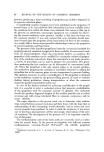
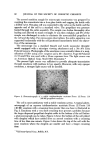
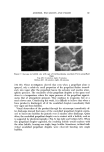
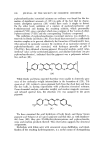
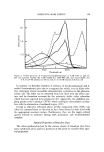
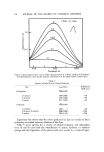
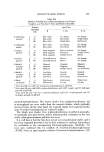
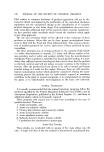
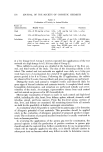
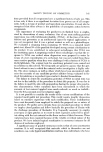
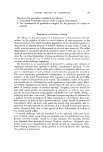
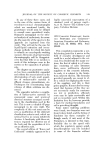
96 JOURNAL OF THE SOCIETY OF COSMETIC CHEMISTS Figure 6. Increase in bubble size with age of triethanolamine myristate/Freon propellant foam Top left. 10 seconds right, 20 seconds Bottom left. 40 seconds right, 60 seconds the strong interfacial film formed by the triethanolamine myristate-myristic acid complex. Augsburger and Shangraw (2) have listed four possible reasons why the bubble size of foams increases vith age. One, which the present author con- siders the most important, is that the initial discharge contains a mixture of the initial emulsified propellant droplets as well as foam bubbles formed by vaporized propellant. If some of the bubbles contained residual liquefied pro- pellant, continued vaporization of the entrapped residual liquefied propellant would increase the bubble size. The evidence for the existence of emulsified propellant droplets in the ini- tial discharge is somewhat circumstantial since it is difficult to distinguish be- tween a small bubble and an emulsified droplet in the photomicrographs. However, in Fig. 6, top right and bottom left, there are a number of small droplets around the interfacial areas of the bubbles which have a different ap- pearance and are much brighter than the foam bubbles. It is believed that these are emulsified propellant droplets. However, even stronger evidence for the existent presence of emulsified droplets in the initial discharge is suggested by the work of York and Veiner

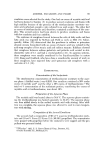
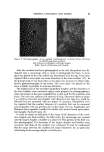
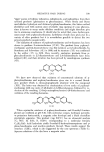
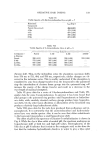
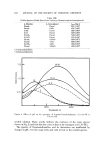
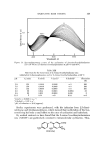
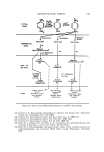
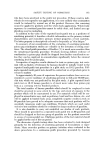
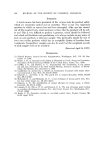
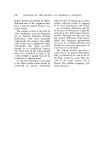
AEROSOL EMULSIONS AND FOAMS 97 Figure 7. Increase in bubble size with age of triethanolamine myristate/Freon propellant foam Top left. 2 minutes right, 5 minutes Bottom left. 10 minutes right, 30 minutes (19, 20). These investigators showed that even when a propellant alone is sprayed, only a relatively small proportion of the propellant flashes immedi- ately into vapor after the propellant leaves the actuator and reaches atmo- spheric pressure. The remainder of the propellant droplets in the spray cool down to a temperature where the vapor pressure of the propellant approxi- mates that of atmospheric pressure. They continue to evaporate, but at a much slower rate. Considering this work, it is difficult to believe that when a foam product is discharged, all of the emulsified droplets immediately flash into vapor and form bubbles. Visual observation of the product through the microscope immediately af- ter discharge showed that many of the emulsified propellant droplets contin- ued to burst into bubbles for periods over 2 minutes after discharge. Quite often, the emulsified propellant droplet was in contact with a bubble, such as is suggested by photomicrographs (Fig. 6, top right and bottom left). When this propellant droplet vaporized, the resulting bubble would coalesce with the other bubble, forming one single, large bubble. Sometimes, isolated indi- vidual emulsified propellant droplets were observed bursting into single bubbles.
Purchased for the exclusive use of nofirst nolast (unknown)
From: SCC Media Library & Resource Center (library.scconline.org)