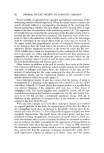
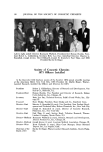
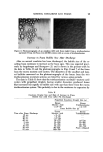
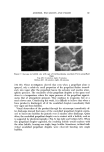
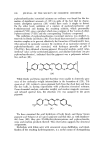
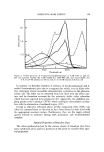
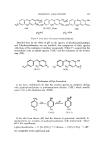
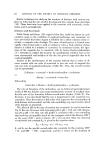
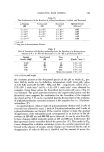
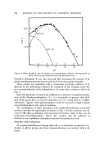
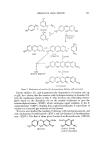
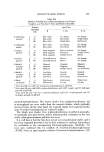
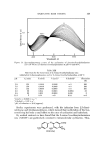
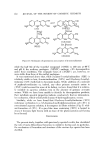
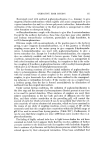
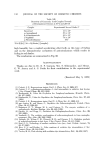
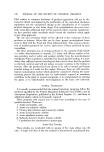
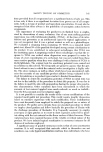
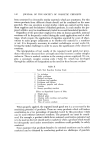
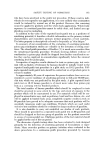
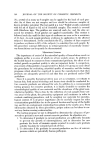
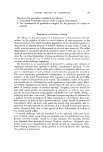
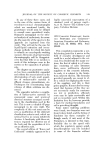
100 JOURNAL OF THE SOCIETY OF COSMETIC CHEMISTS Figure 8. Triethanolamine myristate/Freon propellant emulsion after discharge Top left. 5% discharge right, 25% discharge Bottom left. 50% discharge right, 75% discharge triethanolamine) showed that a definite relationship exists bet•veen the prop- erties of aerosol emulsions and those of the foams h'om the emulsions. Aerosol emulsions with the smaller dispersed propellant droplets had better emulsion stability and, upon discharge, produced foams with smaller bubble size, su- perior stability, higher stiffness, and decreased rate of drainage and wetting. The primary factor in obtaining aerosol emulsions with a small droplet size is the surfactant system. The system with an excess of myristic acid forms a triethanolamine myristate-myristic acid complex. This complex produces the smaller emulsified propellant droplets and the foams with superior properties. The bubbles in the foams froin both types of emulsions continue to increase in size with time after discharge. Initially, this increase is considered to result mainly h'om continued vaporization of residual liquefied propellant in the dis- charged product. The foam with an excess of myristic acid increases in bubble size at a slower rate than that h'om the system with excess triethanolamine. This decreased rate of bubble growth from the excess myristic acid system is postulated to be due to the stronger interfacial film sun'ounding the emulsi- fied droplets and bubbles. The stronger interfacial film is formed by the tri- ethanolamine myristate-myristic acid complex. The stronger interfacial film also results in a slower growth of the large bubbles in the foam at the expense of the smaller bubbles and decreases the possibility of bubble coalescence.

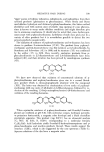
AEROSOL EMULSIONS AND FOAMS 101 Microscopic examination of the aerosol emulsions during discharge up to 75% of the product indicated that the emulsified propcllant droplets de- creased both in concentration and size in order to maintain equilibrium be- tween propcllant concentration in the liquid and vapor phases. The average bubble size of the corresponding foams also decreased accordingly, that from the excess tricthanolaminc system being much more definite. An interesting phenomenon is that the range of diameters of the bubbles appeared to in- crease with discharge, in contrast to the decrease in average bubble size. (Received May 15, 1972) (1) (2) (3) (4) (5) (6) (7) (8) (9) (10) (11) (13) (14) (15) (16) (17) (•S) (19) ½o) (21) PREFERENCES Sanders, P. A., Principles' of Aerosol Technology, Van Nostrand Reinhold Co., N.Y., 1970, Chap. 17, 18, and 19. Auksburger, L. L, and Shangraw, B. F.• Buhble size analysis of high consistency aero- sol foams and its relationship to foam rheology, J. Pharm. Sci., 57, No. 4 (April 1968). Augsburger, L. L., Aerosol shave cream evaluation, Soap Chem. Spec., 44 (February 1968). Richman, M.D., and Shangraw, R. F., Rheological evaluation o[ pressurized foams. I. Methods of testing and effect of formulation variables, Aerosol Age, 11, No. 7 and No. 8 (1966). Richman, M. D., and Shangraw, R. F., A study of pressurized foams with emphasis on theological evaluation. II. Foam stability and effect of shear, Ibid., 11, No. 9 (1966). Carter, P., and Traux, H. M., A study of aerosol shaving eream using statistical exper- imental design, Proc. Sci. Sec. Toilet Goods Ass., 35, 37-44 (1961). Richman, M.D., Contractor, A., and Shangraw, R. F., Aerosol foams: the elimination of container emptying effects, Aerosol Age, 13, 31-88 (March 1968). Sanders, P. A., Molecular complex formation in aerosol emulsions and foams, J. Soc. Cosmet. Chem., 17, 801 (1966). MeBain, J. W., and Field, M. C., Phase rule equilibrium of acid soaps, J. Phys. Chem., 37, 75 (1933). Atkins, F., Pearliness in creams, Perrum. Essent. Oil Rec., 25, 332 (1934). Kohlhaas, R., The structure of crystalline aliphatic compounds: X-ray investigation of an acid sodium palmirate, Chem. Bet., 82, 487 (1949). Schwartz, A.M., Perry• J. W., and Berch, J., Surface Active Agents and Detergents, Vol. II, Interscience Publishers, Inc., New York, 1958, p. 450. Kung, H. C., and Goddard, ED., Molecular association in fatty acid potassium soap systems, II, ]. Colloid Interface Sci., 29, 242 (1967). Schulman, J. H., and Cockbain, E.G., Molecular interactions at oil/water interfaces, Trans. Faraday Soc., 36, 51 (1940). Sanders, P. A., Stiffness measurement of aerosol foams, Aerosol Age, 8, No. 7, 33 (1963). Sanders, P. A., Aerosol foams, Ibid., 14, No. 9 (19•9). Levy, E., The Gillette Co., Boston, Mass., Personal communication, 1972. Edmundson, I. C., Particle Size Analysis, in Bean, H. S., Bechett, A. H., and Carless, J. E., Advances in Pharmaceutical Science, Vol. 2, Academic Press, New York, 1967. York, J. L., Thermodynamics of spray formation, J. Soc. Cosmet. Chem., 7, 204 (1956). Wiener, M. V., How to formulate aerosols to obtain the desired spray characteristics, Ibid., 9, 289 (1958). Davies, J. T., and Rideal, E. K., Interfacial Phenomena, 2nd Ed., Academic Press, New York and London, 1963.
Purchased for the exclusive use of nofirst nolast (unknown)
From: SCC Media Library & Resource Center (library.scconline.org)