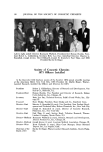
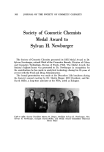
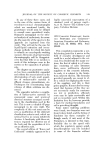
102 JOURNAL OF THE SOCIETY OF COSMETIC CHEMISTS Society of Cosmetic Chemists Medal Award to Sylvan H. Newburger The Society of Cosmetic Chemists presented its 1972 Medal Award to Dr. Sylvan Newburger, retired Chief of the Cosmetics Branch, Division of Colors and Cosmetics Technology, Bureau of Foods, FDA. The Medal Award, the Society's highest honor was presented to Dr. Newburger in recognition for the contributions he has made in analytical technology during his 35 years of service with the Food and Drug Administration. The formal presentation was made at the December 11th luncheon during the Society's annual meeting by Dr. Martin Rieger, SCC President, and Mr. David Miller, a long-time associate at the FDA, acted as Eulogist. Left to right: Society President Martin M. Rieger, Medalist Sylvan H. Newburger, Mrs. Sylvan H. Newburger, Eulogist David Miller, and Medal Award Committee Chairman Henry Maso

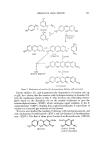
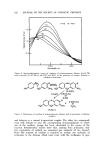
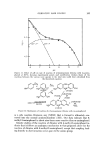
I. Soc. Cosmet. Chem., 24, 103-134 (February 2, 1973) The Role of Meta Difunctional Benzene Derivatives in Oxidative Hair Dyeing. I. Reaction with p-Diamines JOHN F. CORBETT, Ph.D.* Synopsis-A study of the reactions of P-DIAMINES with RESORCINOLS, M-DIAMINES, and M-AMINOPHENOLS, under oxidative conditions, is described. The resulting major colored species are shown to be di-, tri-, and polynuclear indoanilines or indamines, and only rarely, in specific cases, do these undergo intramolecular cyclization to phenoxazines or phenazines under the conditions pertaining in oxidative dyeing. COLOR EFFECTS on hair and the visible spectra of the dyes are described and the IONIC SPECIES present in DYED HAIR is designated. The mechanism of the color- forming reaction is shown to involve initial OXIDATION of the p-diamine to the diimine which reacts, as its conjugate acid, with the neutral amino and/or phenoxide form of the coupler. High relative humidity is shown to be particularly deleterious to the stability of indo dyes on hair. The mechanism of off-shade fading of oxidatively dyed hair is discussed. INTRODUCTION It is well established that there are three classes of components which are important to the color development process of oxidative hair dyeing. These are the primary intermediates, the oxidant, and the couplers. The primary intermediates are difunctional derivatives of benzene which are capable of undergoing oxidation with the concomitant development of color. These intermediates are usually aromatic ortho or para aliamines or ami- nophenols. It has been shown that p-diamines and p-aminophenols undergo oxidation to colorless p-benzoquinone imines (1) which are the essential re~ active species in the color-forming reactions (2). *Clairol Inc., 1 Blachley Rd., Stamford, Conn. 06902. Investigation conducted at Gil- lette Co., Personal Care Division, Chicago, Ill. 103
Purchased for the exclusive use of nofirst nolast (unknown)
From: SCC Media Library & Resource Center (library.scconline.org)