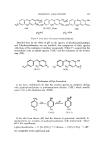
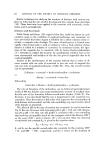
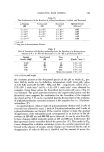
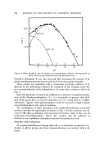
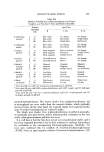
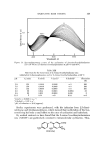
106 JOURNAL OF THE SOCIETY OF COSMETIC CHEMISTS use of these oxidants is unsuited to studies of the kinetics of the coupling re- actions. However, we have found that, above pH 8, the reaction p-diamine + 2 ferricyanide •--- diimine + 2 ferrocyanide is quantitative and virtually instantaneous. Therefore, this system was used, as far as possible, for the generation of the diimine. In kinetic experiments employing 4-equivalent couplers, stoichiometric reaction mixtures can be pre- pared using the p-diamine :ferricyanide: coupler molar ratios of 1:4:1 or 2:4:1. In the first case, the leuco dye is oxidized by ferricyanide while in the second case it is oxidized by a mole of diimine with the consequent formation of a mole of p-phenylenediamine. Below pH 8, the above equilibrium lies partly to the left-hand side and it is therefore necessary to use freshly prepared aqueous solutions of the diimine (15) for kinetic work at pH 8. With 4-equivalent couplers, the required ali- imine:coupler ratio is 2:1. In experiments with 2-equivalent couplers, the req- uisite p-diamine: ferricyanide: coupler ratio is 1: 2:1 and diimine: coupler ratio is 1:1. All the above systems lead to second-order kinetic forms. With less reactive couplers, an excess of coupler must be used and first-order kinetic forms re- sult. Relevant kinetic equations have been given elsewhere (16) as has a consideration of the reaction conditions required to avoid interference of side reactions such as hydrolysis of the diimine and self-coupling with p-diamine (17). t•ESULTS AND DISCUSSION Colors Produced on Hair Resorcinol is the most widely used of all the oxidation dye couplers, being incorporated into most shades as a "drabber," and to achieve a better color balance on hair of differing prior chemical history. Its use as a "drabber" arises from the fact that, in the presence of oxidizing p-phenylenediamine (i.e., p-benzoquinone diimine and p-phenylenediamine), it produces greenish (18,19) and golden brownish (13) shades, depending on the conditions of dyeing. We have confirmed these dyeing results and found that similar color effects are produced using mixtures of p-phenylenediamine or 2,5-diaminotoluene with resorcinol, or the 2-methyl, 5-methyl, or 4-chloro derivatives of resorci- nol. On the other hand, 4-alkyl resorcinols produce pinkish brown shades with either of the above p-diamines. Among the m-phenylenediamines which have been employed in oxidative dyeing, 2,4-diaminoanisole is undoubtedly the most important. Additionally, references to the use of m-phenylenediamine, its 4-chloro and 4-methyl deriv- atives, and 2,4-diamino-5-methylanisole and 2,4-diamino-l,5-dimethoxyben- zene are to be found in the literature (13,20). All these m-diamines react with

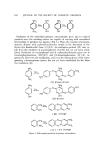
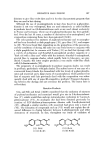
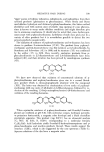
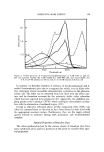
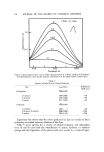
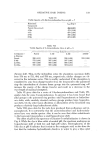
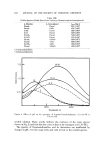
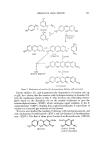
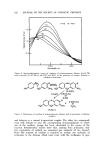
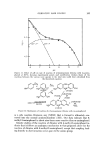
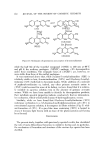
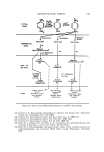
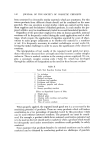
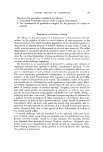
OXIDATIVE HAIR DYEING 107 diimines to give blue-violet dyes and it is for this characteristic property that they are used in hair dyeing. Although the use of m-aminophenols in hair dyes based on p-phenylene- diamine is not very widespread, they are used extensively as color builders in products based on 2,5-diaminotoluene such as are used ahnost exclusively in France and Germany, where use of p-phenylenediamine has been prohib- ited. Over the last 10 years, a number of derivatives of m-aminophenol, and compositions containing them, have been patented (21-30). The color produced by mixtures of p-phenylenediamine and m-aminophe- nol has been described as dark purple-grey (13), grey-blue (31), and magen- ta (32). We have found that, depending on the proportions of the precursors, and the conditions of dyeing, the color can vary from brown to magenta with a slight purplish tint. In common with Tucker (13) we find that dyeings with a variety of p-diamines and 6-methyl-3-aminophenol produce magenta or a "dark red with a blue east" while with the isomeric 4-methyl-3-aminophenol, greyish blue to magenta shades, which rapidly fade to blue-grey, are pro- duced. Uniquely, this latter coupler produces a very stable violet-blue shade with 2,5-diaminoanisole (33). The propensity of m-aminophenols to produce magenta shades can result in problems, particularly with pale shades. The author knows of one case of a commercial honey-blonde dye formulated with low levels of p-pheny!enedia- mine and resorcinol and a large excess of m-aminophenol, which produced no hint of magenta until hair previously dyed with the composition was subse- quently dyed with any of some 20 competitive products! Frequent shampoo- ing between the dyeings did not overcome the problem. The lesson here is self-evident. Reaction Products Cox, and Sidi and Zviak (34-36) considered that the oxidation of mixtures of p-phenylenediamine and resorcinol would give rise to 2-hydroxyindoani- line (V), which would then undergo intramolecular cyclization to 7-amino-3- phenoxazinone (VI). An analogous dye had been obtained previously by reaction of N,N'-dichloro-p-benzoquinone diimine with 5-methylresorcinol (37), although a similar reaction with resorcinol had given only a trace of (VI). The formation of compounds such as (VI) would not explain the ob- served difference in dyeing behavior between 4-alkylresorcinols and other derivatives of resorcinol. In fact, throughout our study of oxidation of (v) R=H (VII) R=Et (VI) R= H (VIII) R=Et
Purchased for the exclusive use of nofirst nolast (unknown)
From: SCC Media Library & Resource Center (library.scconline.org)