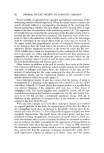
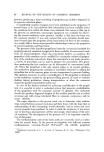
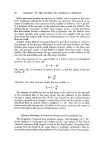
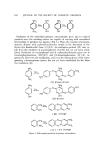
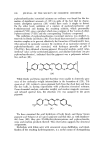
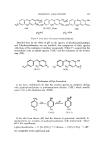
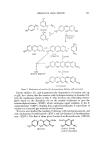
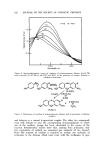
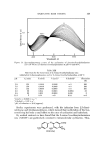
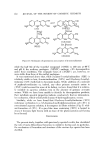
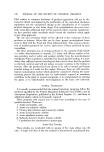
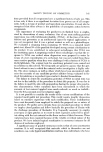
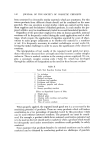
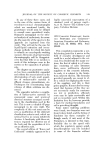
108 JOURNAL OF THE SOCIETY OF COSMETIC CHEMISTS p-phenylenediamine/resorcinol mixtures no evidence was found for the for- mation of significant amounts of (VI) in spite of the fact that its charac- teristic absorption spectrum (38) would have made it simple to detect. On the other hand, oxidation of a mixture of p,-phenylenediamine and 4-ethylresorcinol and heating the resulting solution, which presumably contained (VII), gave a product which was a mixture of the 7-amino-2-ethyl- 3-phenoxazinone (VIII) and the corresponding 7-hydroxy compound. The oxidation of p-phenylenediamine/resorcinol mixtures was studied ex- tensively by Brody and Burns (39). They found that resorcinol is a sufficiently reactive coupler as to prevent effectively the formation of Bandrowski's base, when present in equimolar amount. By oxidation of an equimolar mixture of p-phenylenediamine and resorcinol, with hydrogen peroxide at pH 9 (Na2COa), they obtained a brown pigment. Elemental analysis, acetyl value, methoxyl value (of the methylated pigment), and alkaline hydrolysis (to give p-phenylenediamine), indicated that the pigment was a polymeric indoani- line, such as (IX). While Brody and Burns reported that they were unable to detect the pres- ence of low molecular weight intermediates in the formation of (IX), Tol- gyesi et al. (18) isolated a green pigment both from the dyed hair and from the dye bath, in dyeing experiments with p-diamine/resorcinol mixtures. From elemental analysis, molecular weight, and nuclear magnetic resonance and infrared spectral data, the structure (X) was assigned to the green pigment. H2N' • H O- •"•,'"'•O •"N (X) We have examined the acid hydrolysis of both Brody and Burns' brown pigment and Tolgyesi et al.'s green pigment and find that, as with Bandrow- ski's base (40), they give 2,5-dihydroxybenzoquinone and p-phenylenedia- mine and reaction products thereof. This observation supports the structural assignments. Hydrolysis with dilute acid, with concurrent steam distillation, and identi- fication of the resulting hydroxyquinones, is a useful means of distinguishing

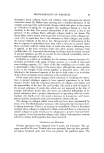
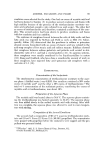
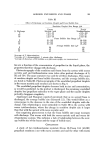
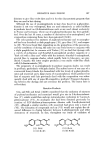
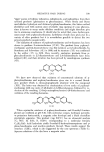
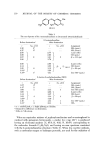
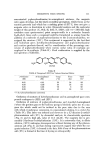
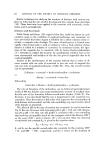
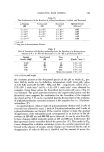
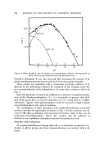
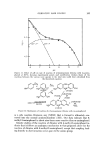
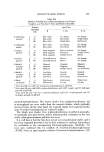
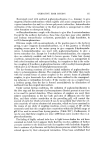
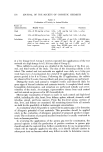
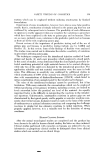
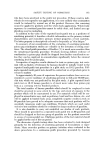
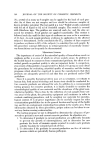
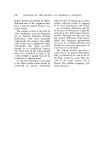
OXIDATIVE HAIR DYEING 109 "open" amino or hydroxy indamines, indophenols, and indoanilines from their cyclized products (phenazines or phenoxazines ). \'Vhile Brody and Burns used alkaline hydrolysis and obtained p-phenylenediamine, this latter method should be used with caution since reversible ring opening of some phenoxa- zincs is known to occur under alkaline conditions and might therefore give rise to erroneous conclusions. It should also be noted that, since hydroxyqui- nones react with p-phenylenediamine, hydrolysis of indo dyes gives rise to a variety of other products but it is nevertheless possible to detect the two primary products unequivocally. The oxidation of mixtures of p-phenylenediamine and m-diamines has been shown to produce g-aminoindamines (17,41). The product from p-phenyl- enediamine and g,4-diaminotoluene was first isolated, as its hydrochloride, by Bernthsen and Sehweitzer (41) in 1886, and its structure (XI) was confirmed by the author (17) in 1939. More recently, analogous products from p- phenylenediamine or g,5-diaminotoluene and g,4-diaminoanisole have been isolated (49.), and their structure has been proved by unambiguous synthesis (43). R2N H2NNH (Xl) We have now observed that oxidation of concentrated solutions of p- phenylenediamine and m-phenylenediamine gives rise to a second bluish- grey product which is chromatographically identical with the compound (XII). The latter was obtained by condensation of two moles of p-phenyl- enediamine with one mole of 4,6-dinitro-l,3-difluorobenzene, followed by re- duction of the resulting 1,3-bis(p-aminophenylamino)-4,6-dinitrobenzene and oxidation of the resulting hexamine. H2N• H•N•NH '•NH• (XII) When equimolar mixtures of p-phenylenedianfine and 6-methyl-3-amino- phenol are oxidized, at pH 8-10, with molecular oxygen, hydrogen peroxide, or potassium ferricyanide, a magenta color develops and a black crystalline precipitate separates. This product (mp g10øC) has an elemental analysis (C, 68.7 H, 5.91 N, 18.5%) corresponding to a molecular formula C•aH•aNaO. Acid hydrolysis yields 5-methyl-g-hydroxybenzoquinone and p- phenylenediamine and reaction products thereof. These results suggest the structure (XIII), which is also supported by the nmr spectrum (Table I). Aqueous solutions of the dye have a magenta color.
Purchased for the exclusive use of nofirst nolast (unknown)
From: SCC Media Library & Resource Center (library.scconline.org)