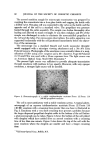
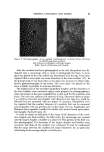
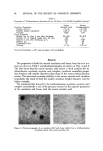
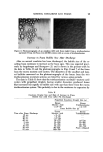
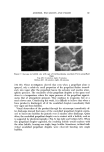
84 JOURNAL OF THE SOCIETY OF COSMETIC CHEMISTS wrinkles so obtained were fixed in formalin and were processed in the usual manner. Sections were cut at 8/• in a plane parallel to the long axis of the wrinkle, and also perpendicular to the long axis. Sections were stained with hematoxylineosin, Verhoeff's stain for elastic, periodic acid-Schiff reaction, alcian blue at pH 2.5, Mallory trichrome stain, and modified Wilders for reticulin, and were then examined under the light microscope. The surgical specimens contained adjacent normal skin making it possible to compare the vrinkle area with "nonwrinkled" skin. RESULTS The epidermis was slightly thinner at the base o[ the wrinkle than in the adjacent normal skin. This appeared to be due to compression of the epider- mal cells at the fold since the number of cell ]ayers was the same as in the adjacent normal skin. The size, shape, number, and staining characteristics of the elastic, reticulin, and collagen fibers were the same in the wrinkle and adjacent skin areas. An inconstant finding was slightly diminished neutral and acid mucopolysaccharides in the wrinkle area compared with the adjacent skin area. Skin specimens taken from light exposed areas revealed some basophilic degeneration of the collagen and an increase in elastic fibers consistent with sun damaged skin. DISCUSSION AND CONCLUSIONS It was not possible to differentiate "wrinkle skin" from "nonwrinkle skin" since the histopathology was similar in both areas. W'rink[es develop in body folds and from underlying muscle contraction. Skin previously damaged from sunlight, especially of the face and neck, and skin which is older (aged) is more subject to wrinkling. ACKNOWLEDGMENT The authors wish to acknowledge with thanks the kind cooperation Kurt Wagner, M.D., and Leonard Glass, M.D., in helping obtain wrinkle speci- mens for this study. (Received August 11, 1972) REFEltENCES (1) Kazanjian, V. H., and Converse, J. M., The Surgical Treatment of Facial Injuries, 2nd Ed., Williams and Wilkins Go., Baltimore, Md., 1959, p. 13. (2) Kraissl, C. J., and Conway, H., Excision of small tumors of the skin of the face with special reference to the wrinkle lines, Surgery, 9.5, 592-000 (1949). (3) Kazanjian, V. H., and Converse, J. M., op. cit., pp. 30-1. (4) Sobel, Harry, et al., The influence of age upon the hexosamine-collagen ratio of derreal biopsies from men, J. Gerontol., 13, 128-31 (1958). (5) Volarelli, F. F., Sulla Istologica e Sulla Patogenesi della Rughe, cited by Chieffl, M., Cowdry's Problems o[ Aging, 3rd ed., Williams and Wilkins Co., Baltimore, 1952, pp. 909-23.

HISTOPATHOLOGY OF WRINKLES 85 (6) Freeman R. G., Cockerell E.G., Armstrong, J., and Knox, J. M., Sunlight as a factor •nltuencing the thickness of epidermis, J. Invest. Dermatol., 3[}, 295-8 (1962). (7) Knox, J. M., Cockerell, E. G., and Freeman, R. G., Etiological factors and prema- ture aging, J. Amer. Med. Assn., 17[}, 630-6 (19{32). (8) Shellow, W. V. R., and Kligman, A.M., Three-dimensional visualization of elastic fibers in thick skin sections, Arch. Dermatol., 05, 221 (1967). (9) Unna, P. G., The Histopathology of the Diseases of the Skin (translated by N. Walk- er), Macmillan and Co., New York, 189{3, top. 976-84. (10) Chieffi, M., Cowdr•/s Problems of Aging, 3rd ed., Williams and Wilkins Co., Balti- more, 1952, pp. 909-23. (11) Lorinez, A. L., Physiology of the aging skin, Ill. Med. J., 117, 59-{32 (1960). (12) Ma, C. K., and Cowdry, E. V., Aging of elastic tissue, J. Gerontol., 5, 203-10 (1950). (13) Strauss, J., and Necheles, H. Variations in derreal absorption with age, J. Lab. CIin. Med., 33, 612-7 (1948). (14) Smith, F. G., Davidson, E. A., and Taylor, R. W., Human Cutaneous Acid Muco- polysaccharides, The Effects o[ Age, and Chronic Sun Damage, in Montagna, W., Advances in Biology o[ the Skin, VI. Aging, Pergamon Press, Inc., New York, 1965, pp. 211-8. (15) Gross, J., Aging o[ Connective Tissue, The Extracellular Components. VII. General Implications, in Bourne, G. H., Structural Aspects o[ Aging, Pitman Medical Pub- lishing Co. Ltd., London, 1961, pp. 179-95.
Purchased for the exclusive use of nofirst nolast (unknown)
From: SCC Media Library & Resource Center (library.scconline.org)