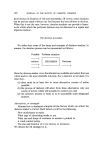
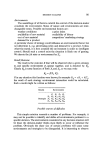
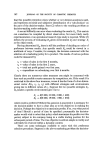
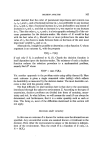
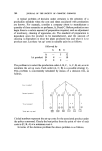
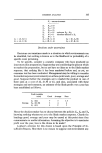
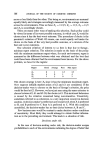
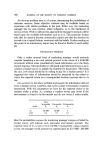
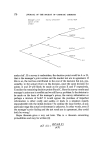
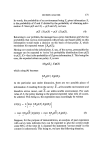
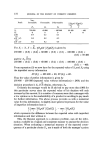
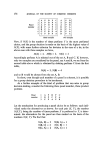
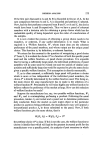
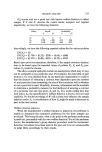
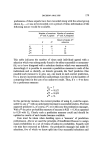
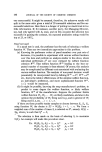
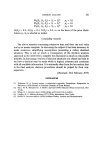
180 JOURNAL OF THE SOCIETY OF COSMETIC CHEMISTS one unsuccessful. It might be assumed, therefore, the unknown results will split in the same ratio given a total of 20 successful selections and five un- successful selections. Here there is a danger of putting too much trust in too little information. If, for instance, another party, the Managing Director, say, h•d only agreed with X• once, and on this occasion the selection was successful in gaining the contract, his expected prediction rating would be top at 25, or 100%. Panel test used If a panel test is used, the perfumer has the task of selecting a welfare function W. There are two immediate approaches to this problem. (a) Knowing the preference orders of panel members over past sets of decisions, it is possible to experiment with various welfare ftmctions over this data and perform an analysis similar to the above, where individual preferences a (ø are now replaced by welfare function selection W (i). That welfare function W (ø leading to the best ex- pected number of successes is then selected. Of course, this analysis may be complicated by different costs associated with evaluating the various welfare function. The analysis of non-panel decision would presumably be incorporated here by defining W ø) = a% W(•)= a © etc., that is the relative effectiveness of the simplest welfare function, an individual's preference, and more sophisticated function W ©, i3, would be measured. (b) It might be possible, knowing the soap manufacturer's problem, to predict to some degree the welfare function, or likely welfare function, W* of the manufacturer. Suppose the perfumer thinks welfare function Wx, W•,... Wn are likely candidates, and also in his opinion the probability of Wx being used is px and in general of W• being used is pi etc... i = 1, -, n. If there are three possible tender samples to choose between Sx, S•, using function W• the choice is Si*= W•(Sj), i = 1, -, n. We form a weighted sum of the number of times Si is selected as S*, namely N(S) = Zpj, where./is such that Sj* = S•. J The selection is then made on the basis of selecting Si to maximize N(S•). An example will make this procedure clear. EX. Wx(S•, S•, Sa) = Sx - Sx* /191 = 0.2 p=0.2 w3(&, $3, $3) = & = $3* p3 = 0.3

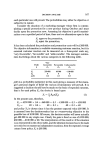
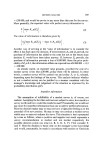
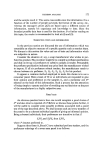
DECISION ANALYSIS 181 w,(&, &., &) = & = &* w,(&, &., &) = & = &* wo(&, &., &) = & = so* P4 = 0.1 P5 = 0.1 P6 = 0.1 = jV[D2) = 6,-, = v.o, •,t•,aJ ,.. th• basis of the prior distri- bution p, Sa is selected as tender. Concluding remarks The above remarks concerning subjective tests and their use and value are by no means complete. In discussing the subject it has been necessary to make numerous simplifying assumptions presenting a rather idealized situation. This is not so much a consequence of the decision analysis approach as the need here to simplify the discussion as much as reasonably possible. In discussing a variety of decision situations our object has been to see how a decision may be made which is logical, coherent and consistent with all available information. It is eminently clear from the last section that in the final analysis, decision procedures should be judged by their con- sequences. (Received: 23rd February 1973) (l) Pridmore, W. A. Sensory testing--a statistician's approach, Proceedings--Symposium on Perfumery (1970) (Society of Cosmetic Chemists of Great Britain). (2) Starr, M. K. Management: A Modern Approach (1971) (Harcourt Brace Jovanovich, New York). (3) White, D. J. Decision theory (1969) (Allen and Unwin Ltd, London). (4) Lindley, D. V. Making decisions (1971) (Wiley Interscience, New York). (5) Raiffa, H. Decision analysis (1970) (Addison-Wesley, London and Massachusetts).
Purchased for the exclusive use of nofirst nolast (unknown)
From: SCC Media Library & Resource Center (library.scconline.org)