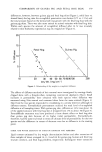
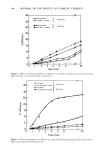
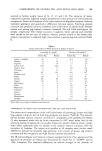
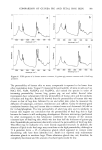
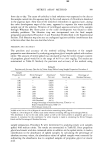
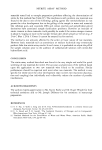
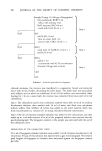
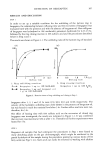
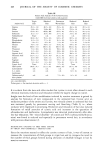
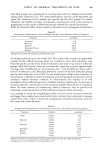
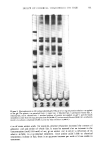
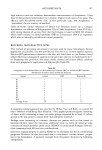
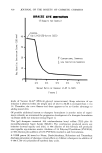
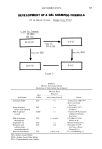
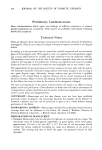
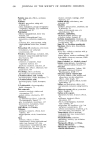
ANTI-IRRITANTS 421 DEVrLOPMENT OF A GEL SHAMPOO FORMULA (72 HR DRAIZE SCORES: CORNEA-IRIs-TOTAL) CLEAR GEL SHAMPOO 5% MEAC 20% TLS I •-- 5-5-17 20-10-39 (ADD 1% _ PVP-K-30) - (D I LUTE 10-5-31 I FIGURE 2 DILU50% 0-0-2 Table V Effective Anti-Irritant Ratios (Reduction of Alkyl Sulfate Eye Irritation) Anti-Irritant Effective Ratio Required Alkyl Sulfate (anti-irritant/irritant) Source Acetamide MEA SLS • 5:1 Stearyl dimethyl SLS 1:1 amine oxide (SDAO) PEG 30 glyceryl SLES 2 1:1 cocoate POE 20 Sorbitan TLS 3 1:3 to 0.8/1 Monolaurate Amphoteric (2) TLS 1:3 Ricinoleic acid SLS 1:10 sulfosuccinate monoethanolamide Polyvinyl Pyrrolidone TLS 1:20 to 1:10 "Schercomid AME-70 "• (Scher Chemicals brochure) US 4,033,895 (1977) (Gerstein) "Varonic LI © Surfactants" (Ashland Chemicals brochure) US 3,808,329 (1974) (Bollch et al.) Miranol Chemical Co. Rewoderm S1333 © brochure--(Rewo Chemical Co.) R. L. Goldemberg (1) •SLS--Sodium Lauryl Sulfate. 2SLES--Sodium Lauryl Ether Sulfate. •TLS--Triethanolamine Lauryl Sulfate.

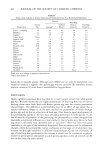
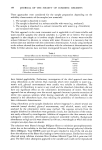
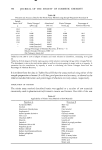
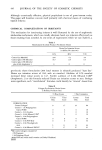
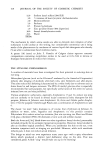
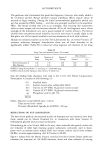
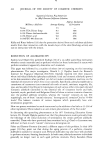
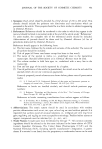
422 JOURNAL OF THE SOCIETY OF COSMETIC CHEMISTS Schuster-(according to V. J. Johnson (9) showed that proteins of molecular weight in the range 750, when condensed with coco-fatty acids, produce surfactants having minimal eye irritation. Such surfactants per se show only 20% of the eye irritation produced by similar condensates where the protein fraction has molecular weight of 500. Furlher, protein condensates with molecular weights in this 750 mw range impart synergestic mildness effects when combined with anionic surfactants. Whereas sodium lauryl sulfate (SLS) had an arbitrary rabbit eye irritation value of 10, replacement of 20% of such SLS by coco-condensates of mw 750 reduced SLS eye irritation by one third. Clearly, formulators of topical products will inevitably choose the most efficient anti-irritant for their own particular formulations. Reducing such anti-irritants to the lowest possible level minimizes their cost, as well as other peripheral problems such as changes in clarity, foam level and viscosity. Efficacy level ratios of several anti-irritants are shown in Table V, which summarizes the ratios required to nullify irritation of certain specific irritants. Note that anti-irritancy is frequently quite specific. A given agent may reduce the skin or eye irritation (or allergenicity) of one material, but not that of others. Table V shows such data in terms of the weight ratios of specific anti-irritants required to substantially neutralize the eye irritation of alkyl sulfate shampoo ingredients. Although molar ratios would perhaps be of greater academic interest, weight ratio comparisons are of greater importance to product formulators from a cost stand- point. REDUCTION OF SKIN IRRITATION We have previously discussed blocking of skin-reactive sites via pre-treatments by polymers such as Union Carbide's Polymer JR. Willer et al. (6) disclose similar uses for the dimer acids. However, such prophylactic treatments, although undoubtedly of value in certain situations (e.g. prior to expected contact with violent allergens such as poison ivy) are of less interest to most topical formulators than materials which can be included in routine topical formulations, to reduce skin irritation which would otherwise occur in their absence. Table VI summarizes the results of repeated insult primary skin irritation testing by Dutton & Reinish Ltd. on their disodium monoricinolamido MEA sulfosuccinate, a surfactant marketed in the USA under two tradenames: Rewoderm S1333 © and Cyclopol SBR-3 ©. Such studies are of value both for shampoos and for emulsions Table VI Addition of SS/RAM to Sodium Lauryl Sulfate (SLS) (Repeated Insult Primary Skin Irritation) 10% SLS alone ..................................................................... 35 10% SLS + 0.5% SS/RAM .......................................................... 16 10% SLS + 1.0% SS/RAM .......................................................... 6 (SS/RAM = Ricinoleic acid sulfosuccinate monoethanolamide)
Purchased for the exclusive use of nofirst nolast (unknown)
From: SCC Media Library & Resource Center (library.scconline.org)