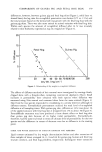
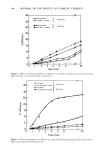
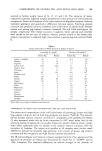
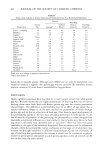
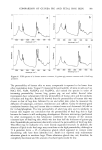
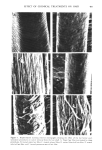
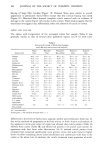
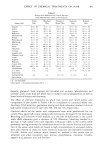
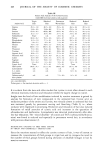
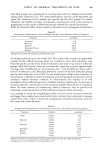
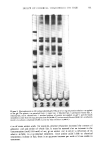
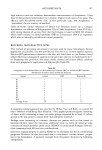
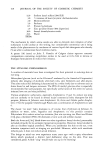
COMPARISON OF GUINEA PIG AND FETAL HOG SKIN 381 resulted in further weight losses of 34, 27, 3.5 and 1.5%. The amounts of water- extractable materials appeared roughly proportional to the amounts of ether-extracted compounds. Amino acid analyses of the water extracts of delipidized stratum corneum indicated qualitative and quantitative differences between species. Fetal hog stratum corneum and periderm extracts contained only small traces of amino acids, whereas human and guinea pig stratum corneum contained 568 and 1,064 /amol/gram dry weight, respectively. The relative amounts of arginine, serine, glycine and citrulline were similar in the two sets of extracts, whereas proline, absent in the human skin extracts, was present in relatively high concentration in guinea pig skin extracts (Table I). Table I Amino Acid Content of Water Extracts of Stratum Comeurn •t moles/g dry weighd Residues/100 residues • Guinea Pig Human Guinea Pig Human Lysine q- ornithine 123 17 11.5 3.0 Histidine 18 54 1.7 9.5 Arginine 23 20 2.2 3.5 Cysteic Acid trace trace 0 0 Aspartic Acid 8 71 0.8 12.5 Threonine 0 33 0 5.8 Serine 301 163 28.2 28.7 Glutamic Acid 23 7 2.2 1.2 Proline 128 0 12.0 0 Glycine 160 88 15.0 15.5 Alanine 118 31 11.1 5.4 Half Cystine 0 0 0 0 Valine 8 6 0.8 1.0 Methionine 2 0 0.2 0 Isoleucine 2 4 0.2 0.7 Leucine 5 4 0.5 0.7 Tyrosine 3 7 0.3 1.2 Phenylalanine 2 3 0.2 0.5 Citrulline 140 60 13.1 10.6 •Each value is an average of duplicate measurements. COMPARISON OF AMINO ACID DISTRIBUTIONS, SPECTRA AND STRUCTURE The amino acid compositions of the acid hydrolysates of guinea pig, human and fetal hog stratum corneum, and of fetal hog periderm, are shown (Table II). The data for human autopsy stratum corneum, included for comparison, were published by Baden (5) who separated whole skin by 30-sec immersion in 50øC water rather than by the ammonia method employed in our studies. Values for sunburn blisters, which contain some killed epidermal cells, are similar to the autopsy stratum corneum, with the exception of histidine. The amino acid profiles of all samples were similar small differences include the relatively high glutamic acid content of guinea pig stratum corneum and the low glycine and high leucine contents of periderm. The IR spectra (Figure 6) of stratum corneum samples from the three species and the spectrum of periderm are similar and dominated by bands due to -CONH- and to -CH- vibrations. The observed differences are relative changes in the intensity of

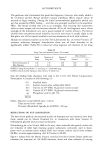
382 JOURNAL OF THE SOCIETY OF COSMETIC CHEMISTS Table II Amino Acid Analyses of Stratum Corneum and Periderm (Amino Acid Residues/100 Residues) • Human Fetal Hog Guinea Sunburn Stratum Fetal Hog Amino Acid Pig Autopsy 2 Blisters Corneum Periderm Lysine q- ornithine 5.6 4.2 6.4 4.4 5.8 Histidine 2.2 1.5 4.0 2.4 1.7 Arginine 5.5 3.8 4.3 5.0 5.0 Cysteic Acid Trace 0 0 0 0.1 Aspartic Acid 6.1 7.9 8.0 7.6 8.8 Threonine 2.2 3.0 2.7 3.3 3.7 Serine 14.4 13.6 16.4 13.3 10.4 Glutamic Acid 20.8 12.6 13.7 12.6 15.7 Proline 4.0 3.0 2.5 3.3 2,5 Glycine 17.7 24.5 22.3 20.6 13.6 Alanine 5.3 4.4 4.5 5.7 6.9 Half Cystine 1.2 1.2 1.3 1.6 0.8 Valine 2.5 3.0 2.7 3.6 4.7 Methionine 0.9 1.1 0.8 1.0 1.5 Isoleucine 2.2 2.7 2.3 2.9 3.4 Leucine 5.4 6.9 7.1 7.1 10.4 Tyrosine 1.9 3.4 2.7 2.6 2.2 Phenylalanine 1.8 3.2 2.4 2.7 3.4 Citrulline 1.3 0 1.4 Trace 0 leach value is an average of duplicate measurements. 2Values from Baden (5). bands due to peptide groups. Although such differences can only be interpreted in an empirical manner, it appears that guinea pig stratum comeurn (B) resembles human stratum comeurn (A) more than it resembles fetal hog periderm. DISCUSSION A1pha-naphthol penetrates fetal hog skin to a much greater extent than adult guinea pig skin. We have shown that the higher permeability of fetal hog skin was not due to freezing alone since both fresh and frozen guinea pig skin had similar penetration characteristics. This difference in permeability may be an effect of age rather than a species difference. Singer et al. (6) have studied the penetration of water through guinea pig and rat skin as a function of fetal age. They found a rapid development of the permeability barrier in the few days preceding parturition in both species. In the last 10 days (d) of gestation of the guinea pig, the permeability to water changed from essentially unrestricted diffusion to a level similar to that of adult skin. Since the fetal hog skins in this study were identified only as "late term," there may have been great variability in the ages of the individual skins used. This uncertainty and the substantial changes which the permeability barrier undergoes at this stage of development may account for the high variability in diffusion measurements. Given the uncertainty of age of fetal hog skin purchased in this manner it should not be considered as good a model for percutaneous absorption as adult guinea pig skin, unless all controls can be run on skin from the same animal.
Purchased for the exclusive use of nofirst nolast (unknown)
From: SCC Media Library & Resource Center (library.scconline.org)