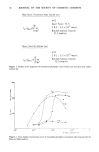
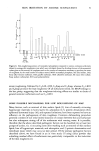
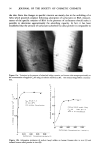
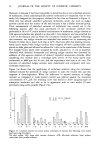
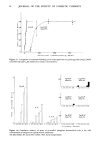
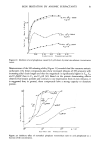
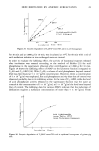
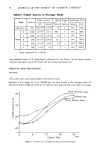
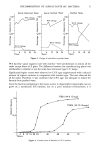
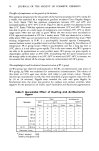
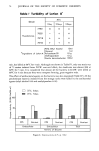
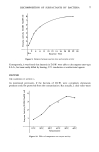
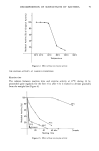
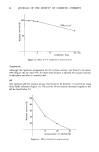
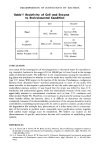
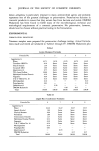
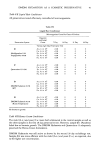
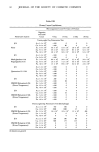
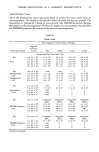
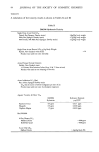
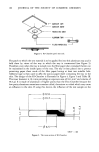
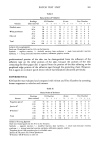
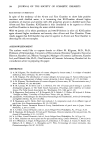
74 JOURNAL OF THE SOCIETY OF COSMETIC CHEMISTS The effect of temperature on the growth of the bacteria The optimum temperature for the growth of the bacteria incubated in C.P.S. media for 2 weeks, was examined by a temperature gradient incubater (Toyo Kagaku Sangyo Co., Ltd.). Strain 77801 has optimum temperature between 25øC and 30øC and increased rapidly at 26øC-30øC in 24 hr. (Figure 5). But its growth was depressed at less than 11øC. Strain 77604 has optimum temperature between 22øC and 30øC. The strain was able to grow at a wide range of temperature, even between 6øC-10øC at which range strain 77801 was not able to grow. When the two strains were inoculated to C.P.S. agar and incubated at 0øC for 3 weeks, strain 77604 was observed as a colony, while strain 77801 was not recovered at all. Therefore, it is considered that strain 77604 existing indigenously in D.W. is a psychrophilic bacterial species. Consequently, various bacteria survive in purified water and their flora is changed by the influence of temperature. W-13 group (strain 77604) is psychrophilic and has a long lag time at 25øC, that is, it is not able to grow rapidly. This is the main reason why W-13 group is not able to be predominant in every purified water. W-6 group can grow rapidly in oligotrophic purified water at 20øC-30øC. Considering that the water temperature of the storage tanks in the plants is at 10øC-20øC in winter and 20øC-30øC in summer, we can assume that almost all the storage tanks are contaminated with W-6 group. The morphological and biochemical characterization of IV-6 group As W-6 group was observed predominantly in D.I.W., its representative type strain of W-6 group, sp.77801 was examined for taxonomical characterization. The colony of this strain on C.P.S. agar was circular with white to pale brown colour. Through microscopic examination of cells, they were identified as gram negative rods (0.4 to 0.8 by 1.0 to 2.0 microns). Flagella stain revealed the cells with polar flagella. In biochemical tests, the strain was positive for catalase and oxidase activities, while negative for the production of indole, starch hydrolysis and fluorescent pigmentation. TableW Germicidal Effect of Heating and Antibacterial Agent Heat Antibacterial Strains 5ooc 6ooc Agents* 20min. 0 5min. 10min. 1 day 2days 77801 Jr Jr .... 78231 --I- + .... 78718 Jr Jr .... Pseudomonos 78755 Jr Jr .... 781215 -I- -i- .... 771105 -I- Jr .... W-13 781014 Jr Jr .... Deionized water 4 x 10⁵/ml 10 •10 *,J' Ethyl Alcohol 10% 1, Methyl Paraben 0.1%

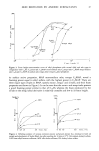
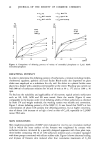
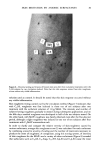
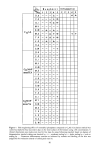
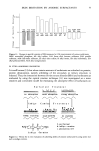
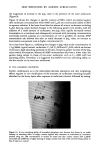
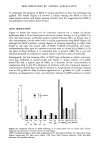
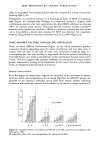
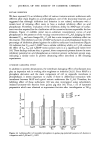
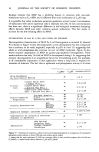
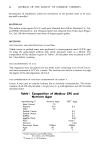
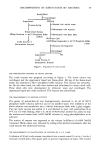
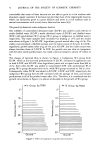
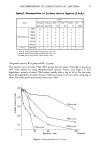
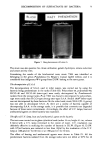
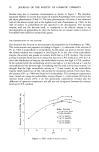
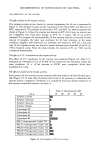
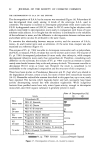
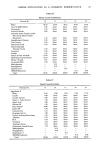
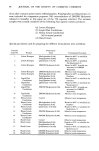
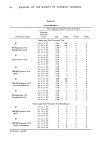
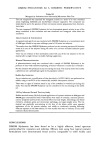
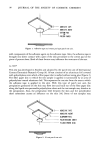
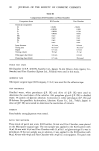
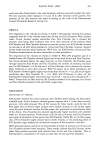
DECOMPOSITION OF SURFACTANTS BY BACTERIA 75 BLANK HAZY PHENOMENON Figure 7. Hazy phenomenon of Lotion A The strain was also positive for citrate utilization, gelatin hydrolysis, nitrate reduction and urease activity tests. Considering the results of the biochemical tests, strain 77801 was identified as belonging to the genus Pseudomonas by Bergey's manual eighth edition, and it is considered that indigenous W-6 group from D.I.W. belong to the same genus. The decomposition of S. A.A. The decomposition of S.A.A. used in toilet waters, was carried out by using the bacteria being predominant in the tanks (Table III). Polysorbate-20, polysorbate-80, H.C.O.-40 and H.C.O.-60 (ester-type) were easily decomposed by Pseudomonads isolated from the storage tanks. Ps.sp. 77801 was found to decompose the polysorbate- type more easily than H.C.O.-type among ester-type S.A.A. Seodol 2020 © (ether-type) was not decomposed by these bacteria. On the other hand, strain 781014 (W-13 group) was not able to decompose S.A.A. As there are a variety of bacteria capable of decomposing S.A.A. in the storage tanks, it is possible that cosmetics are degraded because of these water contaminants. Accordingly, the effect of U.V. lamps, heat and antibacterial agents on these bacteria was examined. The effect of U. V. lamp, heat and antibacterial agents on the bacteria The tests were carried out in glass cylindrical tank (radius 18 cm, height 41 cm, volume 8 liters) with a U.V. lamp immersed in the center of water. U.V. irradiation was definitely effective in reducing the number of bacteria in D.I.W. (Figure 6). D.I.W. with 105/ml bacteria was reduced to less than 10/ml by the irradiation of the U.V. lamp at 1200/xw/cm 2 for 60 min or at 1700/xw/cm 2 for 30 min. The effect of heating and antibacterial agents were shown in Table IV. All the predominant bacteria isolated from the storage tanks were not killed at 50øC for 20
Purchased for the exclusive use of nofirst nolast (unknown)
From: SCC Media Library & Resource Center (library.scconline.org)