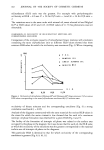
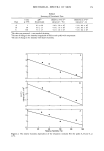
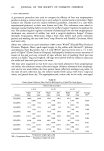
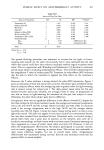
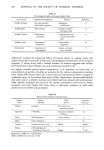
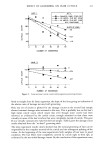
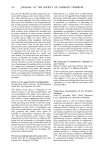
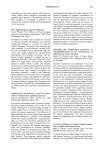
172 JOURNAL OF THE SOCIETY OF COSMETIC CHEMISTS RESULTS Figure 1 shows the relaxation spectra of excised hamster skin at two temperatures but constant relative humidity (90 plus or minus 5%), percent elongation (0.6%) and stretching time (0.6 sec.). [The data obtained at 21øC were reported previously (12).] These results indicate that the intensity of each peak is insensitive to changes in temperature. The time constant for peak A (r^) does not appear to vary with temperature while both rB and rc shift to lower times with increasing temperature. I I I I = A 4 - , 0_, 0 1 2 3 4 Log•o T (sec.) Figure 1. The relaxation spectrum of skin obtained at 90% relative humidity and 45øC (upper) or 21øC (lower). The three peaks are labelled A, B and C in order of increasing time constants.

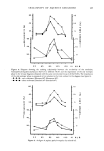
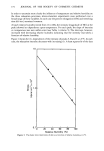
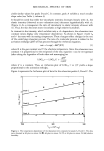
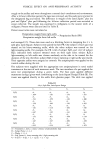
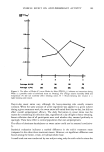
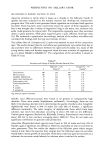
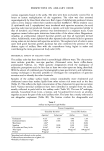
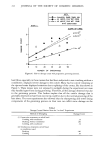
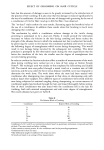
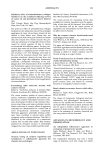
MECHANICAL SPECTRA OF SKIN 173 Table I Summary of Viscoelastic Data 'r (sec) AH *a (dI/dT) at 95% rh a'b Peak at 25øC (Kcal/mole) (dyne/cm 2 ß øK) (dI/d(rh)) at 21øC •'• (dyne/cm 2. %) A 2 0.2 _ 0.8 -0.8 _ 2.0 x 10³ B 50 9.4 - 2.5 -0.4 _ 1.6 x 10³ C 350 7.5 _+ 1.7 -0.2 .+ 1.0 X 10 3 --2.4_+ 0.4x 10³ --3.8- 0.4x 10³ --3.4_+0.4x 10³ •The values are presented _+ one standard deviation. bThe rate of change in the intensity (magnitude of H(r) at each peak) with temperature. CThe rate of change in the intensity with relative humidity. 3 • • 2_ ß ß _ 1 0 4 x •E 2 0 1 - 0 20 40 60 80 100 Relative Humidity (%) Figure 2. The relative humidity dependence of the relaxation modulus H(r) for peaks A, B and C, at 21øC.
Purchased for the exclusive use of nofirst nolast (unknown)
From: SCC Media Library & Resource Center (library.scconline.org)