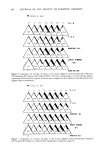
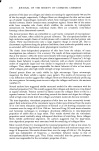
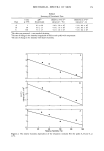
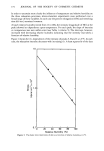
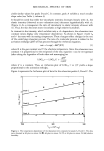
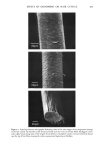
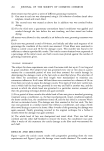
EFFECT OF GROOMING ON HAIR CUTICLE 209 The damage count is then a measure of the average condition of the cuticle at the hair ends for the hair sample. D has a maximum value of 5 and a minimum of 0 and the higher the value of D the greater the degree of damage. The second method of assessment involved examining the hair end-on. For this the hair was specially mounted, the tips cut off to give clear cross-sections and the ends gold-coated to give maximum detail. As only the ends of the hairs were coated, the process did not interfere with any subsequent treatments the hair was given. A number of hair fibres were chosen at random and the maximum number of cuticle layers visible on each fibre cross-section determined. These results were then averaged for each hair sample, and the number obtained designated the "cuticle count." An example of a portion of a hair fibre cross-section is given in Figure 4, where a maximum of six cuticle layers can be counted. This technique is similar to that used by Garcia et al. (2) except that the ends of the hair were examined directly rather than cutting off thin cross-sections from the hair for examination. Figure 4. Portion of a cross-section of a hair fibre showing the layers of cuticle present. It must be noted that the cuticle count is not an average measure of the number of cuticle layers remaining on the hair, as it is the maximum, and not the average number, that is counted for each hair fibre. As a result this measure will tend to overestimate the amount of cuticle remaining, but the bias should be a consistent one. Further, the other measure, that of "damage count," will complement this measure to some extent. In practice it was found that the two measures gave reasonably consistent results. TRESS EXPERIMENTS Samples of Caucasian hair from two different people were divided into two sets of three tresses of approximately 4 grams each and secured at the non-tip end. Each of the

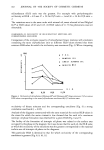
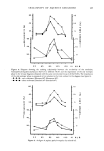
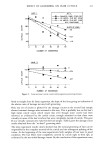
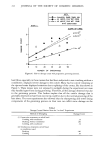
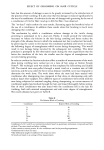
210 JOURNAL OF THE SOCIETY OF COSMETIC CHEMISTS three tresses was then given a series of different grooming treatments: (i) One tress in each set was shampooed using a 15% solution of sodium lauryl ether sulphate, rinsed and towel dried. (ii) The second tress was treated as above but in addition was wet-combed before drying. (iii) For the third tress a quarternary ammonium based conditioner was applied and worked through the hair before the wet-combing, and then rinsed out before drying. All tresses were allowed to dry naturally in air before the next grooming treatment was given. Each tress was groomed a total of 50 times, and initially and after each sequence of 10 groomings the condition of the cuticle was assessed. 25 hair fibres were examined to obtain a cuticle count and 50 for the damage count. This number was found to be sufficient to obtain reproducible results. The cuticle counts obtained were expressed as a percentage of the initial count, and both counts were plotted against the number of grooming treatments given. "ON-HEAD" EXPERIMENT The subject for these experiments was a male Caucasian with hair up to 25 cm long and in good condition. The subject's hair was groomed every one or two days in a given manner for a reasonable period of time and then assessed for cuticle damage by determining the damage count at the hair ends as described above. The selection of hair fibres for assessment and their length were standardized to minimize any extraneous influences. In all cases 100 hair fibres were examined at a distance of 20 cm from their root ends to assess the damage counts. Two types of trials were carried out, one in which half the head was groomed in one way and half in another way, and the second in which the whole head was groomed in a particular manner, assessed, and then the grooming technique altered and again assessed: (i) For a period of three months the whole head of hair was given a standard grooming treatment using a conditioner, i.e., the hair was shampooed, rinsed, conditioner applied, the knots combed out, the conditioner rinsed off, and the hair dried in a manner which did not re-introduce knots. The damage was then assessed at the hair ends. The hair was next groomed in a similar manner but without a conditioner, and using a brush after towel drying to remove the knots. After 4 weeks of this grooming the damage was again assessed. Finally grooming reverted to the original technique for a further 6 months when the damage was again assessed. (ii) The whole head of hair was shampooed and towel dried. Then one half was combed and the other half brushed to remove the knots. No conditioner was used. After 4 weeks of this treatment the cuticle damage at the fibre ends was assessed for each half. RESULTS AND DISCUSSION Figure 5 gives the cuticle count results with progressive grooming from the tress experiments and Figure 6 gives the damage count results obtained. The results were
Purchased for the exclusive use of nofirst nolast (unknown)
From: SCC Media Library & Resource Center (library.scconline.org)