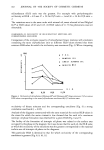
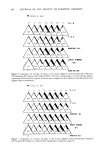
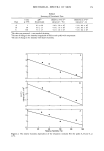
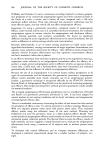
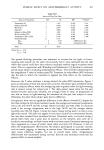
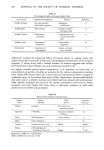
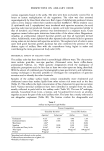
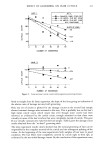
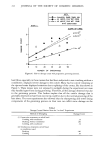
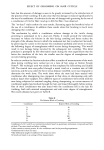
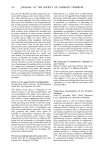
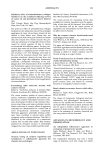
EFFECT OF GROOMING ON HAIR CUTICLE 211 HAI__R 1_. I _K E__Y [ ß I • SHAMPOO, RINSE, TOWEL DRY .•.,•'• /• ---..•..--- AS ABOVE, PLUS WET COMB IUU -r•'•-• • •-- AS ABOVE• PLUS WET COMB I •• I WITH CONDITIONER • '• • -I.03 ,o- •. - 1.19 o 1o o NUMBER OF GROOMINGS lOO 80 6o HAIR 2. ß ß ,• 0 Z• "" ß ' •"- -.407 0 10 20 30 40 50 NUMBER OF GROOMINGS Figure 5. Cross-sectional cuticle counts with progressive grooming (tresses). fitted to straight lines by linear regression, the slope of the lines giving an indication of the relative rates of damage incurred with grooming. Only one set of results is plotted for the damage counts as the second hair sample showed minimal damage when assessed in this way. This is probably due to this hair's high initial cuticle count which meant that even though some cuticle had been removed, as evidenced by the cuticle count, enough remained so that there were virtually no areas of the hair's surface that were completely devoid of cuticle. This gave D as a virtually constant zero value for this hair sample. Table I gives the damage count results obtained from the "on-head" grooming trials. The tress experiment results clearly showed that the normal grooming of hair can be responsible for the complete removal of the cuticle and the subsequent splitting of the cortex. At the beginning of the tress experiments both samples of hair were in good condition. The hair fibres were completely covered by cuticle right to their tips, as evidenced by the zero initial damage counts. By the conclusion of the experiment many

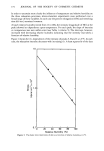
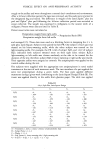
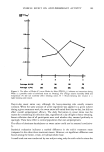
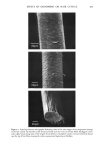
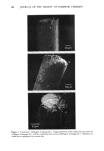
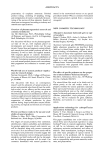
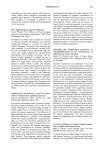
212 JOURNAL OF THE SOCIETY OF COSMETIC CHEMISTS HAIR 1. KEY • SHAMPOO, RINSE• TOWEL DRY ---..•...-- AS ABOVEz PLUS WET COMB --•-- AS ABOVE,, PLUS WET COMB WITH CONDITIONER SLOPE OF LINE.5: t I i I I 0 10 20 30 40 50 -2 •.0 x-10 -2 2./., x 10 NUMBER Of GROOMINGS Figure 6. Side-on damage count with progressive grooming (tresses). hair fibres, especially in those tresses that had been subjected to wet-combing without a conditioner, displayed severe damage to the cuticle. Many had no cuticle remaining at the tips and some displayed striations due to splitting of the cortex, like that shown in Figure 3. These tresses were not exposed to sunlight during the experiment nor were they handled apart from during grooming. Therefore, all the damage observed was due to the grooming process. This further implies that all the cuticle damage that is generally observed on hair from root to tip could be due to the normal grooming of the hair alone. The tress experiments also showed that the shampooing and towel drying components of the grooming process on their own can inflict some damage on the Table I Damage Counts Obtained from the "on-head" Experiments Method of Detangling Damage Count (i) Consecutive treatments on whole head: Combing, with conditioner Brushing, without conditioner Combing, with conditioner (ii) Simultaneous treatments on half head, no conditioner used: Brushing Combing .16 1.86 .29 2.06 .58
Purchased for the exclusive use of nofirst nolast (unknown)
From: SCC Media Library & Resource Center (library.scconline.org)