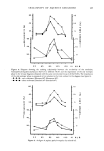
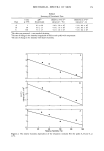
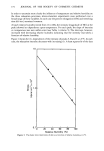
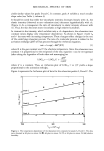
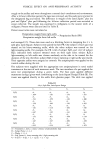
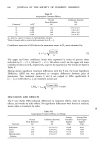
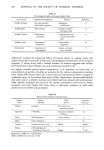
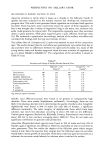
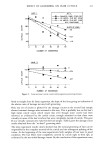
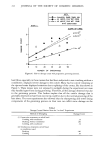
176 JOURNAL OF THE SOCIETY OF COSMETIC CHEMISTS data for each peak were fit to a straight line using a least squares technique to yield the slope plus or minus one standard deviation. Within experimental error, Peak A shows a zero activation enthalpy. In contrast, peaks B and C exhibit m_uch larger AH* values of 9.4 plus or minus 2.5 and 7.5 plus or minus 1.7 Kcal/mole, respectively. The data of Figure 4 represent experiments done at three widely separate conditions of relative humidity. In each case the data at one particular r.h. fit, within error, the total data for each peak. Thus, the r values exhibit no dependence upon r.h. The results are summarized in Table I. DISCUSSION Based upon the temperature and relative humidity dependences of the intensity and time constant of each peak, molecular mechanisms can be proposed for the underlying relaxation process. The two peaks characterized by large •' values (peaks B and C) exhibit similar temperature and relative humidity dependencies. In both instances the time constants depend only on the temperature while the intensities vary only with relative humidity. Our results are similar to those of Gibbs et al. (14) who investigated the dynamic viscosity of gels composed of the mucopolysaccharide hyaluronic acid and water by measuring the temperature dependence of the viscosity over a frequency range of 0.02 to 1.67 Hz. Their results yielded an AH* of 5-10 Kcal/mole, a value typical of polymeric rate processes in which the breaking and formation of hydrogen bonds predominate. The fact that both the AH* and time range (reciprocal of the frequency--0.6 to 500 sec.) of the gel experiments correspond with the values reported here for peaks B and C, suggest that similar mechanisms are at work. We believe that the relaxation mechanisms responsible for peaks B and C involve the movement of chain segments of the mucopolysaccharide molecule. The movement of the chain in a water swollen gel will necessitate the breaking and reformation of H bonds, giving rise to AH * values of about 5 Kcal/mole. The involvement of the gel matrix in the viscoelastic response of skin is further supported by experimental work with human skin and tendon. Finlay (11) found that human skin exhibited viscoelastic responses to small, periodic displacements over a frequency range of 0.04 to 1 Hz, similar to that previously noted for mucopolysaccha- ride-water gels. Therefore, Finlay concluded that the gel was responsible for the viscoelasticity of skin. Note that the time range of Finlay's experiment (reciprocal of the frequency-1 to 250 sec) corresponds to the time range reported here. Cohen et al. (15) measured the isochronal temperature dependence of creep in human tendon within the time range of 20 to 200 sec. The results of these experiments showed that the creep process at low elongations (2%) was characterized by AH * of 12 plus or minus 3 Kcal/mole. The AH * value was similar to that obtained for the shearing of a mucøpølysaccharide-water gel, leading the authors to conclude that stretching of skin resulted in alignment of collagen fibers and subsequent shearing of the gel matrix. The AH * and time range of the creep experiments are nearly identical to the values for peaks B and C reported here. In addition, the extent of elongation in each experiment is similar. Thus, in light of the striking similarities between the results of experiments with human skin and tendon and the results reported here, it appears highly likely that the

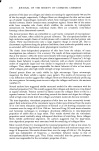
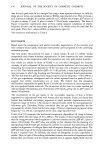
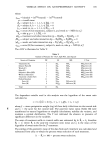
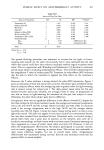
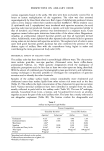
MECHANICAL SPECTRA OF SKIN 177 shearing of the mucopolysaccharide-water gel is responsible for the relaxation peaks B and C. Peaks B and C have similar thermal and relative humidity dependencies. In all spectra obtained however, separate relaxation peaks were observed, strongly suggestive of the existence of two separate relaxation processes. Recall that results obtained with hyaluronic acid-water gels suggested that shearing results in disruptions of hydrogen bonds (14). Mucopolysaccharides contain a number of different sites capable of hydrogen bonding (15). Thus, the relaxation processes responsible for peaks B and C could conceivably reflect the disruption of hydrogen bonds at different sites. The thermoelastic behavior of these skin samples at high r.h. (16) and the value of the elastic modulus obtained (--• 10 6 dyne/cm 2) is very similar to purified elastin. Thus, it is reasonable to propose that low-strain stretching of skin results in the elongation of elastin fibers, in agreement with results cited above. Taken together the results suggest a low-strain viscoelastic model of skin. The model proposed consists of a series of Voigt viscoelastic elements (13) (springs and dashpots in parallel) in which elastin corresponds to the elastic spring and the mucopolysaccha- ride-water gel to the viscous dashpot. In unstrained skin, collagen fibers are only partially aligned. With increasing strain the fibers further align and then at higher strains, stretching occurs. Thus, in this low-strain model, collagen does not bear stress. According to the model, stretching results in the elongation of elastin and displace- ment of the fibers relative to the gel which in turn results in shearing of the intrafibrilar gel matrix. The viscoelastic model is shown schematically in Figure 5. [ J )•ollagen L I Hydrated Viscoelastic Domain Figure 5. A schematic diagram of the proposed model of the viscoelastic behavior of skin. Mathematically the relaxation peaks may be approximated by k exp-t(k/r/), where k is the spring constant, •/the dashpot viscosity and t the real time (13). The time constant r is the ratio of the viscosity to spring constant. Thus, the relaxation intensity is a measure of k and r a measure of 0//k). The experimental lack of variation in r with relative humidity may be explained by several alternative hypotheses. (1) Neither •/or k change with relative humidity. (2) The viscosity and spring constant increase identically with relative humidity. (3) Viscoelastic response occurs only within "domains," the number of which decreases with decreasing relative humidity. Each water-rich, viscoelastic "domain" is characterized by constant •/and k values. Outside of the "domain" there is no viscous element (i.e. no gel) and only k increases with decreasing relative humidity. The first case can be ruled out since the absence of changes in •/and k would imply that both r and the intensity were unchanged with relative humidity, clearly in conflict with
Purchased for the exclusive use of nofirst nolast (unknown)
From: SCC Media Library & Resource Center (library.scconline.org)