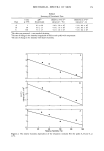
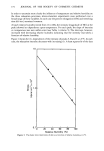
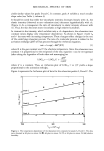
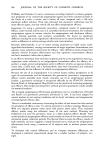
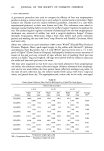
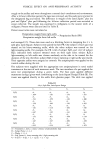
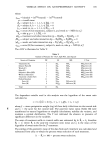
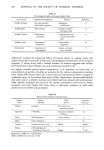
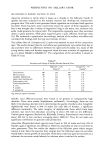
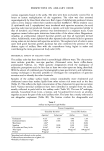
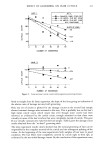
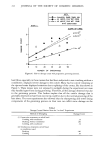
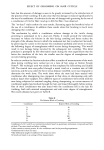
190 JOURNAL OF THE SOCIETY OF COSMETIC CHEMISTS active ingredient in order to observe what effects the base alone might have on perspiration. This subject followed the same protocol used during the test weeks. Since the subject's heavy-sweating side was treated and a decrease in sweat on the treated side was observed with the stick vehicle, the base was ruled out as a properspirant. Increased sweat ratios with the stick treatment may have been caused by the suspended state of the antiperspirant in the vehicle, coupled with the subject's dislike of applying the stick. The antiperspirant agent was in suspension in the stick formula, rather than in solution as in the other three treatments. The activity of MicroDry, Ultrafine* was dependent on the dispersing agent, Procetyl AWS*. Table VII lists the average dose of active antiperspirant agent applied. It is curious to note that lotion with the lowest applied dose obtained the best antiperspirant efficacy, while the stick with a high dose of active ingredient actually increased sweating on the treated side. Subjects generally applied the same amount of a given antiperspirant during the treatment week. Individual subjects tended also to be consistent in the application of a small or large amount of antiperspirant throughout the test. Since the subjects applied the treatments themselves, this may be a result of personal preference for commercial antiperspirant quantities used routinely before engaging in this experiment. Personal acceptance of a product frequently plays an important role in the effectiveness of a product (3). The lotion was considered the most cosmetically acceptable and elegant dose form by all the subjects, while the stick form brought many complaints. The subjects reported that they had used commercial aerosols or roll-on antiperspirant/ deodorant products prior to testing. None of the subjects had ever used a stick or cream antiperspirant before. Their experiences may also have influenced their accep- tance or rejection of the vehicle. No complaints of irritation from antiperspirant test products were recorded. The incorporation of allantoin complex in combination with aluminum chlorhydrate was apparently beneficial in reducing antiperspirant irritant potential and enhancing cosmetic qualities of the dose form. CONCLUSIONS 1. The 4 x 4, split plot, Latin Square experimental design was statistically satisfactory. Statistical analysis indicated that the side treated may be randomly selected without compromising the results. 2. Sweat weights may be affected by temperature, muscular exercise, or emotional stress. However, it is concluded that vehicle does not affect antiperspirant efficacy. 3. Release rate of the active ingredient from the vehicle plays an important role in antiperspirant efficacy, as observed with aluminum chlorhydrate in solution in the cream base, aqueous lotion, and hydroalcoholic base versus aluminum chlorhydrate in suspension in the solid stick. 4. Antiperspirant treatment response in terms of percent sweat reduction (in decreasing order of effectiveness)was: lotion, 38.0% hydroalcoholic solution, 32.4% cream, 31.8%, and stick, -6.2%.

VEHICLE EFFECT ON ANTI-PERSPIRANT ACTIVITY 191 5. Vehicle plays an important role in the cosmetic appeal and personal acceptance of an antiperspirant, which, even though these are subjective responses, may influence antiperspirant efficacy results to a limited extent. REFERENCES (1) E. Jungermann, Antiperspirants: New trends in formulation and testing technology, J. Soc. Cosmet. Chem., 25,621-638 (November 1974). (2) XV.J. O'Malley and J. E. Christian, An evaluation of the ability of antiperspirant compounds to reduce perspiration flow,J. Am. Pharm. Assoc., Sci. Ed., 49, 402-404 (1960). (3) T. A. Bakiewi•ca, A critical evaluation of the methods available for measurement of antiperspirancy,J. Soc. Cosmet. Chem., 24, 245-258 (April 1973). (4) M. XV. Steed, Evaluation of antiperspirant preparations under normal conditions of use,J. Soc. Cosmet. Chem., 26, 17-28 ((January 1975). (5) M. Bart, Percutaneous absorption,J. Pharm. Sd., 51,395-409 (1962). (6) A Kligman, Topical pharmacology and toxicology of dimethyl sulfoxide. Part I.,J. Am. Med. Ass., 193,796-802 (1965). (7) E. S. Bretschneider, A.M. Rubino, andJ. J. Margres, Antiperspirant efficacy,J. Soc. Cosmet. Chem., 28, 441-446 (August 1977). (8) "Antiperspirants and Deodorants Formulary," LD-134, ICI America, Inc., Wilmington, Delaware (March 1972). (9) "Veegum Formulary," Bulletin No. 125, R. T. Vanderbilt Company, Inc., Norwalk, CT (n.d.). (10) K. F. Neulinger, Use of sugar esters in cosmetic sticks, Cosmetics and Toiletties, 92, 65-66 (July 1977). (11) "Arlamol E., "No. 102-15, ICI Americas Inc., Wilmington, Delaware (1977). (12) W. G. Fredell and R. R. Read, Antiperspirant-axillary method of determining effectiveness, Proc. Sci. Sect. Toilet Goods Ass., 15, 23-27 (1951). (13) P. A. Majors and J. E. Wild, The evaluation of antiperspirant efficacy--influence of certain variables,J. Soc. Cosmet, Chem., 25,139-152 (March 1974). (14) W. M. Wooding and P. Finklestein, A critical comparison of two procedures for antiperspirant evaluation,J. Soc. Cosmet. Chem., 26, 255-275 (May 1975). (15) G. W. Fredell and J. Longfellow, Report on evaluating antiperspirant and deodorant products,J. Soc. Cosmet. Chem., 9, 108-111 (1958). (16) J. L. Myers, Fundamentals of Experimental Design, 2nd ed., Allyn and Bacon, Inc., Boston, 1972, pp. 259-302. (17) G. W. Snedecor and W. G. Cochran, Statistical Methods, 6th ed., Iowa 1967, pp. 369-374. (18) National Weather Service, State Airport, Warwick, Rhode Island (April-May 1978). (19) H. H. Relier, Factors affecting axillary sweating,J. Soc. Cosmet. Chem., 15, 99-110 (1964). (20) Federal Register, 43, 46694-46732 (1978).
Purchased for the exclusive use of nofirst nolast (unknown)
From: SCC Media Library & Resource Center (library.scconline.org)