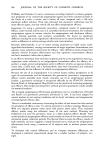
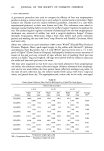
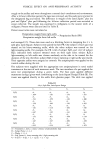
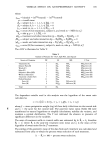
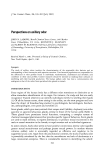
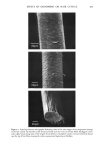
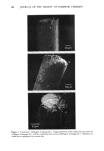
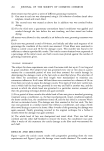
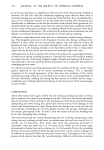
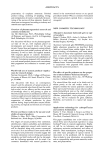
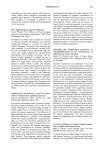
EFFECT OF GROOMING ON HAIR CUTICLE 20• 20pm 201am 20pm Figure 2. Scanning electron micrographs illustrating three of the main stages of the progressive damage to the hair cuticle. (a) Smooth cuticle structure found near the root end of hair fibres (b)Jagged cuticle scale edges found along most of the length of hair fibres (c) Complete cuticle removal sometimes found near the tip of hair fibres, leaving the cortex exposed and beginning to fibrillate.

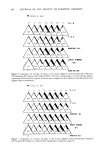
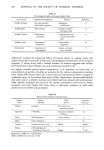
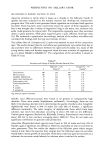
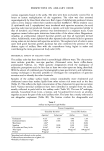
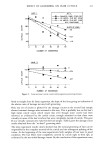
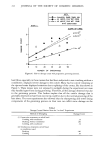
206 JOURNAL OF THE SOCIETY OF COSMETIC CHEMISTS brushing action, with the degree of damage varying with the brushing forces applied. Using an alkali solubility test, they found a chemical degradation associated with the mechanical damage. They concluded that daily brushing contributed significantly to hair damage. Robinson (5) has illustrated that the mechanical abrasion during shampooing, and shampooing and wet brushing, are sufficient in themselves to damage and completely remove the cuticle. The use of conditioners has been shown to significantly reduce the frictional forces encountered during combing (1,9,10). Breuer et al. (9) and Schoenberg and Scafidi (10) have both reported very high reductions of up to 95% in encountered friction forces. Consequently, the use of a conditioner would be expected to considerably reduce the damage caused by brushing and combing. Okumura (6) has demonstrated this effect, in a limited manner, for brushing dry hair. Thus, it is now well known that grooming causes hair damage. What is not well known is which of the various processes involved in grooming, i.e., shampooing, towel drying, wet combing, wet brushing, dry combing or dry brushing contributes most signific- antly to this damage. It is the purpose of this paper to evaluate the damage done to the hair cuticle by the normal grooming processes of shampooing, towel drying, and wet combing or wet brushing. In particular, the effect of wet combing out tangles, with and without a conditioner, and the difference between brushing and combing were examined. Two types of studies were carried out, one employing tresses and the other involving one "on-head" evaluation. The progressive damage to the cuticle near the hair ends caused by various grooming procedures was assessed using a scanning electron microscope. EXPERIMENTAL CUTICLE DAMAGE ASSESSMENT TECHNIQUES Two methods of cuticle damage assessment were used. They involved the examination of the condition of the cuticle near the tips of a representative sample of hair fibres side-on and end-on with a scanning electron microscope (SEM). For this an ISI 100A © SEM was employed in conjunction with a Robinson detector and a charge- free-anticontamination system (CFAS) (11). The use of this system allowed the normal SEM imaging difficulties of charging and excessive edge contrast to be overcome. The first assessment involved examining the hair side-on and without any coating to determine the extent of complete cuticle removal near the tips. The problem of charging normally associated with uncoated non-conductive samples was overcome by operating at a pressure of 0.15 torr and an accelerating voltage of 15 kV. A number of hairs chosen at random were examined and classified according to the extent of complete cuticle removal near their tips. Each hair was assigned a degree of damage (d) from 0 to 5 as indicated in Figure 3. From these results a damage count (D) for the hair was calculated as follows: 2: (d x n) D- Zn where n = the number of hairs.
Purchased for the exclusive use of nofirst nolast (unknown)
From: SCC Media Library & Resource Center (library.scconline.org)