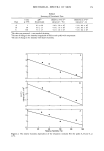
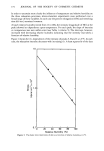
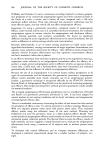
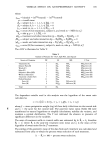
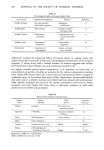
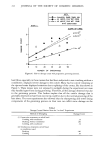
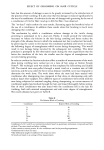
OCCLUSIVITY OF AQUEOUS EMULSIONS 159 Table II Formula of Emulsions Formulas Constituent Oil Surfactant Water Oil/Surfactant Ratio A 5 5 80 3 B 10 5 85 2 C 10 10 80 1 PROCEDURE A 10% (W/W) gelatin solution in water was cast at 70øC to a thickness of 1 cm in a glass tube with an inner diameter of 3 cm. Relative humidity under the gelatin was maintained at 100% (7). The upper surface was in contact with air. The water contained within the gel was thus made to migrate in the same way that insensitive perspiration moves across the stratum corneum. The amount of water loss through the gelatin was determined gravimetrically in standard experimental conditions: 25øC and 60% RH. Water loss was measured 15, 30, 45 min. before application and 15, 30 ... 240 min. after application. The dose applied was 3 mg.cm -2 CALCULATION OF OCCLUSIVITY In order to express the occlusivity (Oc) of the preparation as a measure of resistance to water loss, occlusivity was defined by the following equation: WLB -- WLA Occlusivity (Oc)% = WLB x 100 WLB -- Water loss of the gelatin cell in mg.cm -2 min. -1 before application WLA--Water loss of the gelatin cell in mg.cm -2 min. -1 after application of the preparation. DEHYDRATION OF EMULSIONS The kinetics of dehydration of the emulsions have been studied at the same temperature and RH already described. The gelatin layer has been replaced by a sheet of aluminium paper as inert support, the dose applied was 3 mg.cm -2. So the kinetic of water evaporation of the emulsions was studied as a function of the time. Phase Diagrams in Oil-Surfactant- IVater Systems Ternary phase diagrams were constructed with various oils, mixtures of surfactants and water. The experimental procedure and determination of the phase limits were published previously (8). The percentage of the surface area occupied by the isotropic oil phase was calculated in relation to the totality of the diagram's surface for the different HLB values. STATISTICAL ANALYSIS Statistical significances were calculated using one way analysis of variance (9).

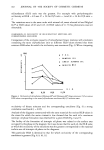
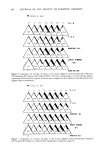
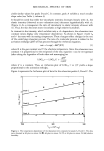
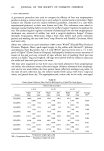
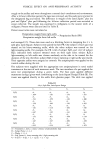
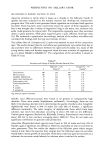
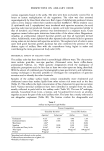
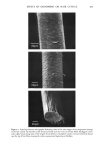
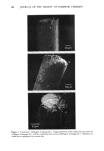
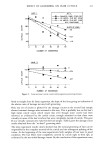
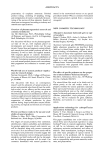
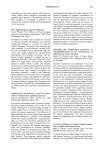
160 JOURNAL OF THE SOCIETY OF COSMETIC CHEMISTS Illill p. H. S. '::O MINERAL OIL lall SWEET ALMOND OIL I• MIGLYOL 812 5o =, . .,,, Figure 1. Relationship between the occlusivity of emulsions and HLB values of the surfactants (Montane 80©/Montanox 80©). The general formula of emulsions is water/oil/surfactant: 80/15/5. Significance of the difference between the emulsions at various HLB for each oil: **p 0.01 P.H.S. Perhydrosqualen RESULTS OCCLUSIVITY OF OILS As shown on Table I, there is no direct relationship between occlusivity and polarity of the four oils studied. The dielectric constant which is related to polarity was the same for P.H.S. and mineral oil, whereas the occlusivity of these oils were 78 _+ 5 and roll p.H.S. MINERAL OIL SWEET ALMOND OIL MIGLYOL 812 50 25 Figure 2. As figure 1 replace Montane 80©/Montanox 80 © by Simulsol 92©/Simulsol 96 ©. Significance of the difference: *p 0.05, **p 0.01 *Fatty acid triglycerid (C8-C•2) **Seppic-Montanoir, Paris, france.
Purchased for the exclusive use of nofirst nolast (unknown)
From: SCC Media Library & Resource Center (library.scconline.org)