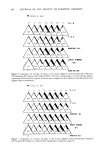
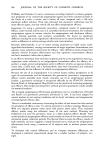
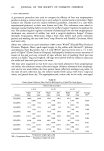
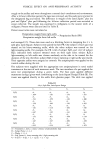
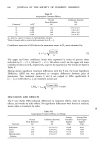
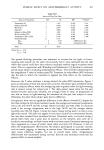
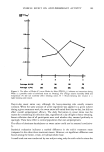
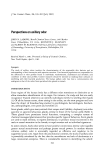
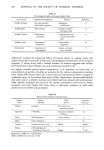
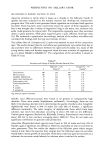
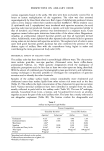
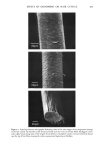
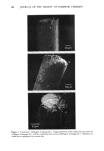
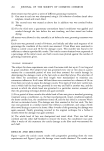
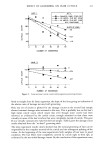
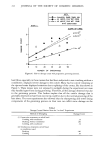
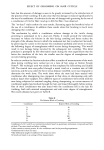
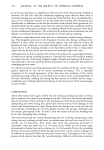
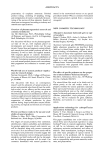
208 .JOURNAL OF THE SOCIETY OF COSMETIC CHEMISTS 20pm 20pro 20pro Figure 3. (Continued) (d) Degree of damage (d) = 3 Approximately % of the cuticle has been removed (e) Degree of damage (d) = 4 All the cuticle has been removed (f) Degree of damage (d) = 5 Striations are visible due to splitting of the cortical cells.

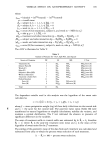
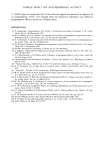
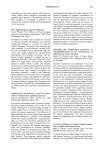
EFFECT OF GROOMING ON HAIR CUTICLE 209 The damage count is then a measure of the average condition of the cuticle at the hair ends for the hair sample. D has a maximum value of 5 and a minimum of 0 and the higher the value of D the greater the degree of damage. The second method of assessment involved examining the hair end-on. For this the hair was specially mounted, the tips cut off to give clear cross-sections and the ends gold-coated to give maximum detail. As only the ends of the hairs were coated, the process did not interfere with any subsequent treatments the hair was given. A number of hair fibres were chosen at random and the maximum number of cuticle layers visible on each fibre cross-section determined. These results were then averaged for each hair sample, and the number obtained designated the "cuticle count." An example of a portion of a hair fibre cross-section is given in Figure 4, where a maximum of six cuticle layers can be counted. This technique is similar to that used by Garcia et al. (2) except that the ends of the hair were examined directly rather than cutting off thin cross-sections from the hair for examination. Figure 4. Portion of a cross-section of a hair fibre showing the layers of cuticle present. It must be noted that the cuticle count is not an average measure of the number of cuticle layers remaining on the hair, as it is the maximum, and not the average number, that is counted for each hair fibre. As a result this measure will tend to overestimate the amount of cuticle remaining, but the bias should be a consistent one. Further, the other measure, that of "damage count," will complement this measure to some extent. In practice it was found that the two measures gave reasonably consistent results. TRESS EXPERIMENTS Samples of Caucasian hair from two different people were divided into two sets of three tresses of approximately 4 grams each and secured at the non-tip end. Each of the
Purchased for the exclusive use of nofirst nolast (unknown)
From: SCC Media Library & Resource Center (library.scconline.org)