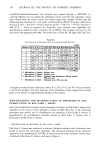
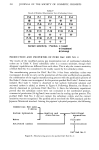
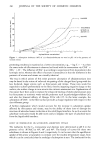
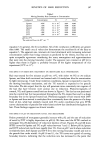
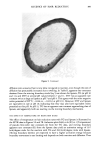
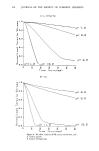
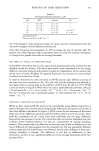
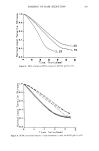
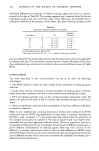
284 JOURNAL OF THE SOCIETY OF COSMETIC CHEMISTS Sorptograph ADS-lB and oil absorption measured according to the JIS standard are shown in Table VI. Both the specific surface area and the oil absorption of the purified articles are on levels comparable with those of the commercial articles. 3. Electron microscopic observation: The purified articles and the commercial article were observed by an electron microscope. Purified articles had the same shapes as corresponding commercial articles. The above results show that the purified pigment's physical properties are comparable with those of the commercial articles. Thus, the manufacturing process was established by combining the regular manufacturing process with a Red Lake C Amine purification process. The cost of the purified article manufactured by this process was fairly close to that of the commercial article, and the pigment can safely be used for cosmetics. Based on the above-mentioned approach, manufacturing processes of other colors such as D&C Red No. 17, D&C Orange No. 4, D&C Yellow No. 10, D&C Green No. 6, etc. have been explored. The colors free from contact sensitizers can be commercially manufactured and appear suitable for cosmetics. REFERENCES (1) S. Fregert and B. Gruvberger, Allergic dermatitis from solvent yellow 14 used in plastic, Contact Dermatitis, 2, 126 (1976). (2) T. Kozuka, M. Tashiro, S. Sano, K. Fujimoto, Y. Nakamura, S. Hashimoto, and G. Nakaminami, Brilliant Lake Red R as a cause of pigmented contact dermatitis, Contact Dermatitis, 5, 297-304 (1979). (3) T. Kozuka, M. Tashiro, S. Sano, K. Fujimoto, Y. Nakamura, S. Hashimoto, and G. Nakaminami, Pigmented contact dermatitis from azo dyes. I. Cross-sensitivity in humans, Contact Dermatitis, 6, 3.30-336 (1980). (4) Y. Sato, Y. Katsumura, H. Ichikawa, T. Kobayashi, T. Kozuka, F. Morikawa, and S. Ohta, A modified technique of guinea pig testing to identify delayed hypersensitivity allergens, Contact Dermatitis, 7, 225 (1981). (5) T. Sugai, Y. Takahashi, and T. Takagi, Pigmented cosmetic dermatitis and coal tar dyes, Contact Dermatitis, 3, 249-256 (1977).

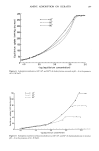
j. Soc. Cosmet. Chem., 34, 285-300 (September/October 1983) The adsorption of long-chain amines and diamines on keratin fibers IAN W. STAPLETON, CSIRO, Division of Protein Chemistry, Parkville 3052, Victoria, Australia. Received February 24, 1983. Synopsis Adsorption isotherms of n-octyl, n-decyl, n-dodecylamine and the corresponding c•,c0-diamines on loose wool fibers have been determined as a function of pH, temperature, and added electrolytes. The equilibrium saturation levels were found to increase with increasing pH and addition of salt. The monoamines were found to have much greater affinity for the fiber than c•,c0-diamines of the same chain-length. Affinities of both series of amines increased with increasing chain-length. The influence of several anions of the lyotropic series on the extent of maximum adsorption uptake was investigated. Adsorption was found to be promoted by water-structure-breaking ions in the case of a monoamine, and lowered when the adsorbate was a diamine of the same chain length. Estimates of standard affinities (A/x ø) at 40 ø, 60 ø, and 80 ø showed that the standard enthalpy (AH ø) of sorption was zero in the case of 1-aminododecane and - 250 cal/mol in the case of 1,12-diaminododecane. The standard entropies (AS ø) of sorption for both sorbates were found to be positive over the temperature range studied. It is concluded that the sorption of amines on keratin fibers takes place over the "internal" surface, and in a manner which entails cooperative formation of an unstructured miceIlar layer around ionically bound ammonium ions. INTRODUCTION The sorptive capacity of keratin fibers for surface active agents such as detergents, wetting agents, softeners, etc., has been the subject of many physiochemical studies extending over most of this century (see 1-2 for reviews of early work). In the case of wool fibers most of the research has been concerned with anionic surfactants such as alkyl sulfates (3-4), while in the case of hair fibers most interest has been shown in the sorptive propensity of cationic surfactants (5-6). This division of emphasis is possibly a reflection of the extent of commercial application anionic products are used widely in wool production technology as wetting agents and dyeing auxiliaries, while cationic types find wide usage in hair care products as conditioning agents. A determination of the factors controlling the interaction of amines, and in particular, polyamines, with the wool fiber surface is a current research objective in this laboratory. This has come about as a consequence of recent findings relating to 285
Purchased for the exclusive use of nofirst nolast (unknown)
From: SCC Media Library & Resource Center (library.scconline.org)