j. Soc. Cosmet. Chem., 36, 189-212 (May/June 1985) Relationship between triboelectric charging and surface modifications of human hair J. JACHOWICZ, G. WIS-SUREL, and M. L. GARCIA, Clairol Research Laboratories, 2 Blachley Road, StamjSrd, CT 06922, Received March 7, 1985. Presented at the SCC Annual Scientific Meeting, New York, December 6, 1984. Synopsis Static charge generation on intact and modified human hair fibers has been studied in the rubbing mode using a variety of metal (stainless steel, aluminum, gold) and polymer (nylon, Teflon, chitosan, polycar- bonate, polystyrene) contact probes. Adsorption of long chain alkyl quaternary ammonium salts, cationic polymers, and polymer-detergent complexes was found to decrease the electrochemical potential and increase the conductivity of the fiber surface. On the other hand, modification of the fibers by reduction, bleaching, and oxidative dyeing has only a small effect on triboelectric charging. Measurements of the kinetics of charge decay indicate that none of these treatments leads to increased surface conductivity of the keratin fibers. It was concluded that the suppression of static charge formation can be achieved by reducing the difference in work functions between the hair and the material it is in contact with. This can be done by the proper choice of comb material or hair surface modification. INTRODUCTION Triboelectric charging is a commonly observed phenomenon. When two different ma- terials are brought into contact, charges of opposite sign and equal in magnitude are generated on their surfaces. This is due to the difference in electrochemical surface potentials of the bodies in contact, which causes the injection of electrons from the material of lower electron affinity to the material of higher electron affinity. The process of charge migration continues until a potential barrier is created at the interface by the ionized surface layers, which compensates for the difference in electron affinities. The driving force of the electron transfer process, i.e. the difference in electrochemical potentials between contacting surfaces 1 and 2 (5), can be derived as follows (1,2): •c] = [xl ø - q Vs] (1) [x2 = [x2 ø - qVs2 (2) Ixl ø = -4)• (3) •x2 ø = - 4)2 (4) /• • = P• - P•2 = P•l ø - P•2 ø + q (V•- V•l)= 4)2 -- 4)1 + q (Vs2 -- Vsl) (5) where [x•, [x2, [xl ø, [x2 ø are the chemical and standard chemical potentials of an electron on each surface, and 4)1 and 4)2, and Vs• and Vs2 are the work functions and surface 189

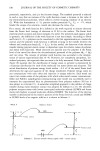
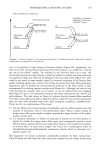
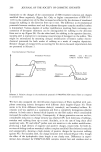
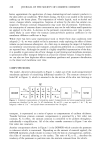
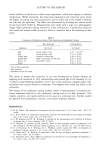
190 JOURNAL OF THE SOCIETY OF COSMETIC CHEMISTS potentials, respectively, and q is the electron charge. The standard potential is selected in such a way that an increase of the work function causes a decrease in the value of the electrochemical potential, which reflects a lower escaping tendency of an electron (2). With this formulation (1-5), positive surface potentials Vs•, Vs2 = +V, which hinder the escape of an electron, would also decrease the value of For a metal, the work function 0 is defined as the work required to remove electrons from the Fermi level (energy of electrons at O K) to the surface. The Fermi level represents both acceptor and donor energies of a metal. For polymers (and organic solids in general), the definition of the work function is not that simple. According to Davis and Lewis (3-5), a polymer can be considered in the first approximation as a molecular crystal, and the polymer work function is defined as lying in the middle between the valence and conduction bands (E c + Ev/2). In this model, the direction of the electron transfer during polymer-metal contact is dependent upon the relative values of polymer and metal work functions. Metal electrons are injected into the polymer if the Fermi level of the metal lies above the electrochemical potential of the polymer (0m and vice versa. The concept of polymer work function was successful in the interpre- tation of various experimental data (6-8). However, for completely amorphous, dis- ordered polymers, this approach does not seem to be fully warranted. Duke and Fabish's theory (9) assumes that the distribution of energy states in polymer is represented by a Gaussian distribution for each of the molecular ion states (donor and acceptor). The actual distribution of polymer energy levels within --0.4 eV of the metal Fermi level determines the sign and quantity of the charge transferred. Polymer energy states do not communicate with each other and injection is energy selective. Each metal can inject into certain states of the polS, mer with which other metals cannot communicate. Duke and Fabish's sampling/non-communicating state model was successfully used to interpret the experimental data on photoemission from polymer surfaces (10) but is also subject to criticism (11). A somewhat simplified approach to the problem of charge transfer during metal-insulator contact was adopted by Gibson (12,13). He identifies polymer acceptor states with lowest unoccupied molecular orbitals (LUMO) and donor states with highest occupied molecular orbitals (HOMO). The direction of the electron transfer is determined by the relative position of the Fermi level of a metal and HOMO or LUMO levels of an organic solid as it is shown in Scheme 1. Metal A Organic Solid Metal B _ • LUMO E1 Fermi Level A E 2 HOMO • Scheme 1. Electron transfer during organic solid--metal contact. B E 1 B E 2 Fermi Level
Purchased for the exclusive use of nofirst nolast (unknown)
From: SCC Media Library & Resource Center (library.scconline.org)