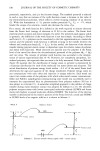
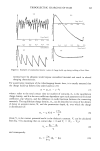
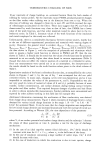
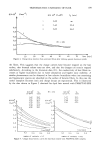
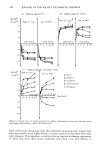
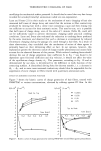
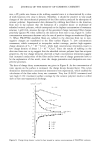
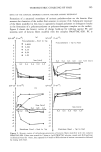
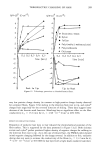
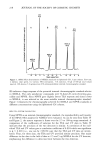
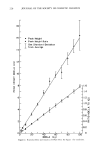
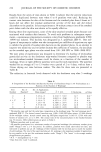
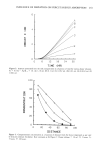
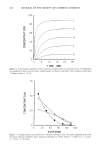
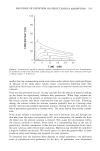
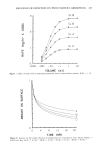
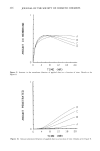
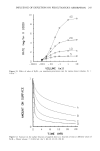
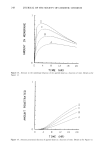
TRIBOELECTRIC CHARGING OF HAIR 199 Q/A'109 (C'cm-2) Q/A 109 (C-eft 2) T« (min) 6.0 5.0 4.0 3.0 2.0 1.0 2 3.62 50.8 3 5.09 26.0 i i ! i i i ! • 10 20 30 40 50 60 70 Time [min] Figure 4. Charge decay kinetics from untreated fibers after rubbing against aluminum probe. the fibers. This suggests that the charge carriers have become trapped on the hair surface, that thermal release rates are slow, and that the charges can remain trapped indefinitely. According to the literature data (21), the conductivity of hair fibers in- creases at higher humidities due to water absorption and higher ionic mobility. A similar phenomenon can be observed at low relative humidities when ion-containing and hygroscopic species are adsorbed on the surface of keratin fibers. In this case the carrier transport becomes ionic and charge decays are exponential. This is illustrated by the data shown in Figure 5 obtained for dyed hair treated with PMAPTAC-SDS Q/A-iO 9 (C, cm -2) 6.0 5.0 4.0 3.0 2.0 1.0 Q/A -109 T« (c.am -2) (see) RH = 23,% 1.62 28.3 2.62 27.8 3.25 26.7 Q/A-109 4.78 27.1 (C/cm- 2) 4.94 27.6 • 5.48 29.7 6.0 6.25 29.7 5.0' 2.0 1.0. ,Time [min•] ß 0 ! i 0.2 0.4 0.6 0.8 number of contacts : 1-7 Q/A -109 (oe.em -2) (Ts•e) 5.57 29.5 6.10 32.3 5.09 42.9 5.41 /43.9 Time [min] i I I I • 0.2 0.4 0.6 0.8 number of contacts : 8-11 Figure 5. Charge decay kinetic curves for dyed hair treated with PMAPTAC-SDS complex.

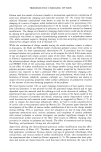
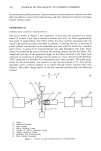
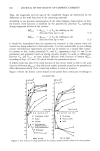
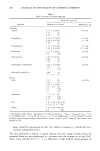
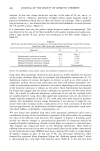
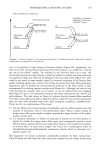
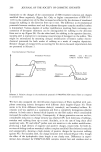
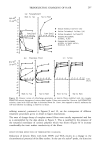
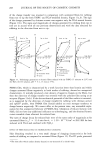
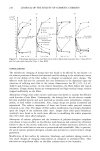
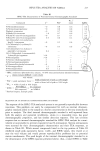
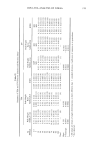
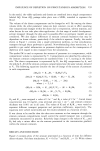
200 JOURNAL OF THE SOCIETY OF COSMETIC CHEMISTS complex. In this case, charge decays are very fast, of the order of 10 • sec, and t•/2 is constant with •. However, generation of higher surface charge densities results in electrical breakdowns which seem to affect the kinetics of discharge. That is probably why an increase in t•/2 was observed after the first electrical breakdown occurred (between the 7th and 8th contact, Figure 5). It is noteworthy that very fast surface charge decays are again non-exponential. This was observed in the case of the fibers modified with cationic polymers and surfactants, when a high density of ionic species was introduced on the fiber surface (Figure 8, Table II). Table II Half-Times and First-Order Rate Constants for the Charge Decays from Fibers Treated With Various Long Chain Alkyl Quaternary Ammonium Salts Surfactant T1/2 K (min) Decyltrimethyl ammonium bromide 11.7 Dodecyltrimethyl ammonium chloride 8.9 Tetradecyltrimethyl ammonium bromide 4.4 Hexadecyltrimethyl ammonium bromide 1.4 Octadecyltrimethyl ammonium iodide 1.2 (min- •) 0.059 0.078 0.157 0.495 Nonexponential EFFECT OF ADSORBED LONG CHAIN ALKYL QUATERNARY AMMONIUM SALTS Long chain alkyl quaternary ammonium salts (quats) are readily adsorbed and retained on the surface of keratin fibers due to coulombic and hydrophobic interactions (30,31). Adsorption studies of cationic detergents on keratin as well as on other anionic or amphoteric surfaces indicate that surfactants may form well-defined monolayers (ver- tically or horizontally oriented in relation to the surface, depending on the concentration of the treatment solutions) or bilayers on the surface. Some experimental data obtained for human hair suggest that the cationic surfactant can penetrate into the cortex of the fiber. As a result of surfactant adsorption, reductions of wet and dry combing forces are usually observed. Long chain alkyl quaternary ammonium salts are also known to impart antistatic properties to hair (21,32), wool, and many other natural or synthetic textiles. The mechanism of static charge elimination is not obvious. It might be con- nected with either increased surface conductivity (21) or with a reduction of the work function gap between the hydrocarbon-modified surface and hydrocarbon comb mate- rials (hard rubbers, polyethylene, polypropylene, etc.). We have found that adsorbed long chain alkyl quaternary ammonium salts cause a considerable decrease of the electrochemical potential of the fiber surface (by increasing the value of the effective work function). The diagram in Scheme 2 illustrates quali- tatively the relative changes in electrochemical potentials of contacting surfaces for hexadecyltrimethyl ammonium chloride treated fibers as compared to untreated hair. This diagram was constructed based on the following observations. Both modes of rubbing (root-to-tip and tip-to-root) of quat-treated fibers by the probes characterized by the work function lower (PMMA) and close to keratin (PC) result in a high density of negative charges on hair. In the case of PC, the directional triboelectric effect observed for untreated fibers disappears (Figure 6a). Rubbing against teflon, © which is characterized by a very high work function value (Table I), in the direction from
Purchased for the exclusive use of nofirst nolast (unknown)
From: SCC Media Library & Resource Center (library.scconline.org)