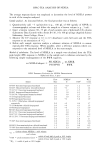
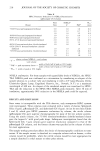
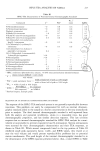
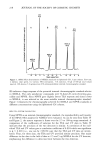
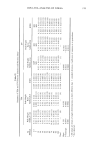
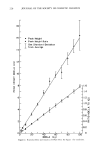
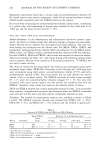
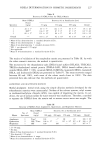
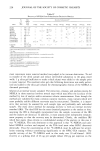
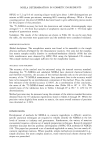
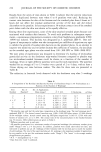
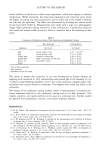
NDELA DETERMINATION IN COSMETIC INGREDIENTS 229 HPLC) or 5.2 ng/1.0 ml counting aliquot would give about 1,000 disintegrations per minute or 800 counts per minute, assuming 80% counting efficiency. With a 10-min counting period, this level of NDELA has been found to give sufficiently precise results for the purpose of this procedure. The •4C-NDELA recovery for both the desiccation and column chromatography steps averaged 71 ___ 2% from four samples of amphoteric matrix and 80 --- 5% from eight samples of quaternium matrix. Va/idatio,. The results of the validation are shown in Table III. As can be seen from the table, the recoveries were quantitative and the methods were considered validated. MORPHOLINE MATRICES Method development. The morpholine matrix was found to be amenable to the simple dilution methods developed for the ethanolamine matrices. Not only did the morpho- line matrix samples readily dissolve in methanol/methylene chloride (4/96) but also little interferences were observed by HPLC-TEA using the Spherisorb CN column. This simple method was judged sufficient for the morpholine matrix. ACCURACY AND PRECISION The accuracy of the method may be estimated using the internal recovery standard. Assuming the •4C-NDELA and unlabeled NDELA have identical chemical behavior and therefore recoveries, the accuracy of the method depends only on the precision and accuracy of the •4C-NDELA measurement. Any systematic bias in the accuracy would have to be measured by an interlaboratory comparison of the method. Thus, the current best estimate of the method accuracy is 100%. As a corroboration of this conclusion, the mean of the •4C-NDELA-based validation data (Table III) is 107 -+ 12%. The overall mean of the validation data in Tables I through IV is 98.7 --- 22% for 93 determinations. Method precision may be measured using the estimate of the relative standard deviation obtained from the 93 validation experiments listed in Tables I through IV. While the precision varies slightly from matrix to matrix, the mean overall estimate of precision was calculated as _+ 22%. CONCLUSIONS Development of methods for NDELA in cosmetic ingredients is difficult sensitive, specific analytical techniques are required to reliably identify the NDELA at the low levels of interest to industry and government. Furthermore, the variety of matrices encountered requires a diverse set of sample preparation techniques. Research presented elsewhere discusses the first problem: development of HPLC~TEA methods for NDELA (18). This paper has presented a set of methods applicable to many, but not nearly all, cosmetic ingredient matrices. Where possible, simple methods are recommended (e.g., simple dilution). For more complex matrices, water removal and column cleanup tech- niques are prescribed.

230 JOURNAL OF THE SOCIETY OF COSMETIC CHEMISTS ACKNOWLEDGEMENTS This work was supported by the Cosmetic, Toiletry, and Fragrance Association, Inc. We wish to thank Norman Estrin, Mel Goodman, Gary Henderson, Lester Isbrandt, Aaron Cooper, John McNally, Ira Rosenberg, C. T. Desmond, Bernard L. Kabocoff, M. Graber, Jack Winstead, and other members of the CTFA Nitrosamine Task Force for their advice and guidance. Specific methods are available from CTFA. REFERENCES (1) R. Montesano and H. Bartsch, Mutagenic and carcinogenic N-nitroso compounds: Possible environ- mental hazards, Murat. Res., 32, 179-228 (1976). (2) L. Griciute, "Carcinogenicity of N-nitroso Compounds and Their Possible Role in the Development of Human Cancer," in Environmental Carcinogens, Selected Methods of Analysis, H. Egan, Ed., IARC Scientific Publication No. 18 (International Agency for Research on Cancer, Lyon, France, 1978), Vol. 1, pp 3-9. (3) D. Schmiihl, Problems of dose-response studies in chemical carcinogenesis with special reference to N-nitroso compounds, CRC Critical Rev. Toxicol., 6, 257-281 (1979). (4) L. R. Ember, Nitrosamines: Assessing the relative risk, Chem. Eng. News, 20-26 (March 31, 1980). (5) W. Lijinsky and S.S. Epstein, Nitrosamines as environmental carcinogens, Nature, 225 (5227), 21- 23 (1970). (6.) E. A. Walker, P. Bogovski, and L. Griciute, Eds., Environmental N-Nitroso Compounds Analysis and Formation, IARC Scientific Publication No. 14 (International Agency for Research on Cancer, Lyon, France, 1976). (7) P. N. Magee, R. Montesano, and R. Preussman, "N-Nitroso Compounds and Related Carcinogens," in Chemical Carcinogens, C. E. Searle, Ed., ACS Monograph 173 (American Chemical Society, Wash- ington, D.C., 1976), pp 491-625. (8) P. Bogovski and E. A. Walker, Eds., N-Nitroso Compounds in the Environment, IARC Publication No. 9 (International Agency for Research on Cancer, Lyon, France, 1975). (9) IARC Monographs on the Evaluation of the Carcinogenic Risk of Chemicals to Humans.' Some N-Nitroso Compounds (International Agency for Research on Cancer, Lyon, France, 1978), Vol. 17. (10) E. A. Walker, L. Griciute, M. Castegnaro, and R. E. Lyle, Eds., Environmental Aspects of N-Nitroso Compounds, IARC Scientific Publication No. 19 (International Agency for Research on Cancer, Lyon, France, 1978). (11) E. A. Walker, L. Griciute, M. Castegnaro, M. Borzsonyi, and W. Davis, Eds., N-Nitroso Compounds.' Analysis, Formation, and Occurrence, IARC Scientific Publication No. 31 (International Agency for Research on Cancer, Lyon, France, 1980). (12) T. Y. Fan, J. Morrison, D. P. Rounbehler, R. Ross, and D. H. Fine, N-Nitroso-diethanolamine in synthetic cutting fluids: A part-per-hundred impurity, Science, 196, 70-71 (1977). (13) I. Schmeltz, S. Abidi, and D. Hoffman, Tumorigenic agents in unburned processed tobacco: N- nitrosodiethanolamine and 1,1-dimethylhydrazine, Cancer Lett., 2, 125-132 (1977). (14) T. Y. Fan, U. Goff, L. Song, D. H. Fine, G. P. Arsenault, and K. Bieman, N-Nitrosodiethanol- amine in cosmetics, lotions, and shampoos, Food Cosmet. Toxicol., 15, 423-430 (1977). (15) W. Lijinsky, M.D. Reuber, and W. B. Manning, Potent carcinogenicity of nitrosodiethanolamine in rats, Nature, 288, 589-590 (1980). (16) I. Rosenberg, The CTFA program on nitrosamines: An overview, CTFA Cosmet. J., 30-37 (July/ August/September 1981). (17) J. T. H. Ong, and B. S. Rutherford, Some factors affecting the rate of N-nitrosodiethanolamine formation from 2-bromo-2-nitropropane- 1,3-diol and ethanolamines, J. Soc. Cosmet. Chem., 31, 153- 159 (May/June 1980). (18) J.'L. Ho, H. H. Wisneski, and R. L. Yates, High pressure liquid chromatographic-thermal energy determination of N-nitrosodiethanolamine in cosmetics, J. Assoc. Off. Anal. Chem., 64 (4), 800-804 (1981). (19) M.D. Erickson, D. B. Lakings, A.D. Drinkwine, and J. L. Spigarelli, Quantitative analysis of N- nitrosodiethanolamine (NDELA) by high performance liquid'chromatography-thermal energy analyzer detection, J. Soc. Cosmet. Chem:, 36, 217-225 (1985).
Purchased for the exclusive use of nofirst nolast (unknown)
From: SCC Media Library & Resource Center (library.scconline.org)