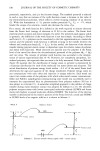
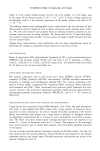
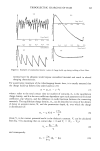
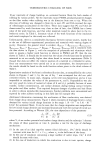
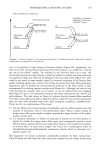
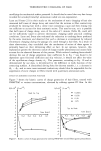
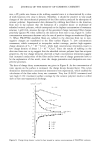
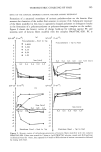
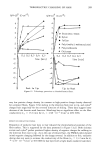
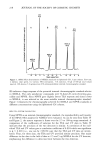
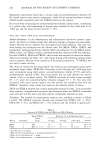
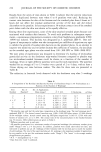
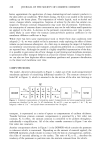
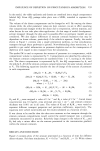
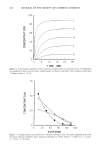
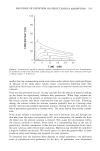
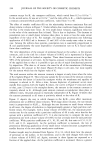
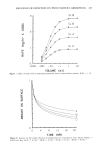
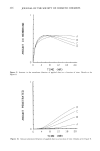
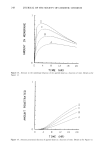
TRIBOELECTRIC CHARGING OF HAIR 195 Time [min] i i i i 0.1 0.2 0.3 0.4 0.5 (b) T•me [m•n] i i i i 0.1 .... 5 0.1 0.2 0.3 0./• 0.5 Time [min] (c) 0.1 0.2 0.3 0./• 0.5 4j• , I I J. me [mJ.•] '• Ik (d) Figure 2. Examples of unsmoothed kinetic curves of charge build-up during rubbing of hair fibers. external layer by abrasion would expose unoxidized material and result in altered charging characteristics. For quantitative treatment of the tribocharging kinetic data, it is usually assumed that the charge build-up follows first-order kinetics (23): tr = tr• (1 - e -kt) (7) where t refers to the total contact time (or number of contacts), tr• is the equilibrium charge density, and k is the rate coefficient dependent upon such parameters as frictional coefficient, slip velocity, and the difference in work functions between the contacting materials. The equilibrium charge density, try, can be described in terms of the density of donor or acceptor states, N, and the penetration depth, t•, over which the charge is distributed (2): 2 VcE tr• = qNqs - (8) where Vc is the contact potential and ½ is the dielectric constant. Vc can be calculated from Eq. 5 by assuming that on contact Apt = 0 and Vc = (Vsl - Vs2): Vc - (9) and consequently - (02 - 0•) (10) tr•

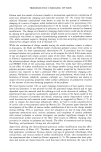
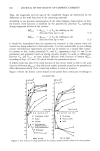
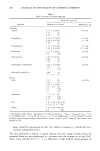
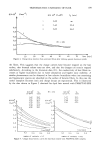
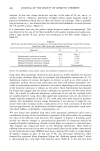
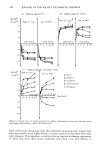
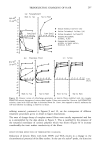
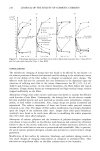
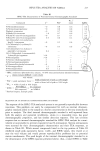
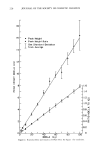
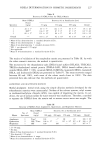
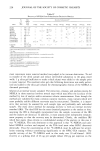
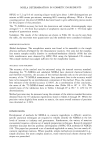
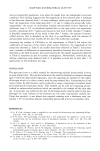
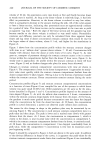
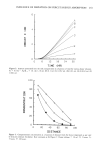
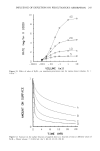
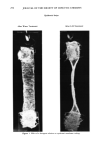
196 JOURNAL OF THE SOCIETY OF COSMETIC CHEMISTS Thus, the magnitude and the sign of the transferred charges are determined by the differences in the work functions of the contacting materials. According to our previous interpretation of the tribe-charging characteristics of hair, the keratin work function is modified by the piezoelectric potential Vpp appearing during tangential friction of the cuticles: oeff. keratin •- 0kerat,n -}- q Vpp for rubbing in the direction from root to tip (11) eft. kerat,n : 4)keratin -- q Vpp for rubbing in the direction from tip to root (12) It should be remembered that the piezoelectric potential is only present when the cuticles are being subjected to frictional stress. It is thus undetectable in non-rubbing contact electrification experiments and will not be present on a relaxed fiber surface. In contrast to this, surface potentials Vs] and Vs2, appearing in Eqs. (1) and (2) are permanent and gradually build up during electron transfer. In order to differentiate .4. eft. between Vpp and Vs•,2, we have defined effective work function of keratin S'k•t.• according to Eqs. (11) and (12) which include the piezoelectric factor. It follows from this that if the work function of the contact probe is close to the work function of keratin (0keratin), this additional surface potential caused by the piezoelectric effect determines which of the contacting surfaces is donor or acceptor. Figure 3 shows the kinetic curves (based on the points from continuous recordings at Q/A el0 9 (C.cm -2) 3 2 1 Time [mini 0 10.2 0.30.40.5 -1 0 Stainless Steel -2 ß Nylon ß Teflon -3 & Poly(methy1 . methacrylate) •4 & Rely(carbonate) -5 ß Chitosan ROOT TO TIP Figure 3. The kinetics of charge generation by rubbing Untreated Hair } •/A-i09 7t (C'cm-2) 6 5. 3' 2 1 ß . 0 0.1 0.2 0.3 0.4 0.5 -1 o Aluminum -2. \ m Polystyrene -3 --5' --6. TIP TO ROOT untreated keratin fibers with various probes.
Purchased for the exclusive use of nofirst nolast (unknown)
From: SCC Media Library & Resource Center (library.scconline.org)