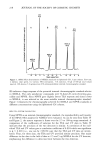
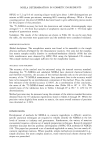
NDELA DETERMINATION IN COSMETIC INGREDIENTS 225 NDELA was quantitated by comparison of peak heights of the unknown and external standards and corrected for recovery using •4C-NDELA, as described above. The average of duplicate analyses was reported if the concentrations found in two duplicates agreed within 10% if not, the sample was reanalyzed. The HPLC-TEA procedure has been described in detail previously (19). Monoethanolamine (MELA) diethanolamine (DELA), and triethanolamine (TRELA) ma- trices. Duplicate weighed (--1 g) samples were thoroughly mixed with 8.8 ml ethyl acetate. Next, --3 g anhydrous sodium sulfate were added, with mixing, to remove water. After the sample was allowed to stand for 1 hr to remove water, it was analyzed by HPLC-TEA. Morpholine matrices. Duplicate weighed (-- 1 g) samples in a culture tube were diluted with 9 ml methanol/methylene chloride (2/98), mixed, and analyzed. Amphoteric and quaternium matrices. Duplicate weighed (--1 g) samples were spiked with •4C-NDELA. The sample was diluted with --2 ml methanol and slurried with --4 ml silica gel. The methanol was evaporated under a gentle stream of dry, purified nitrogen, and the sample desiccated in vacuo overnight or until all the water was removed. A liquid chromatographic column was prepared by slurry packing 3.5 g silica gel in methylene chloride. The dried sample was transferred to the column with methylene chloride rinses (total --50 ml) to complete the transfer. The methylene chloride, fol- lowed by 50 ml acetone/methylene chloride (10/90) was eluted through the column to waste. The NDELA was eluted from the column using 60 ml acetone/methylene chlo- ride (60/40), and collected in a beaker. The sample was concentrated under a stream of nitrogen on a hot plate, transferred to a culture tube with acetone washes, and evaporated to dryness under a stream of nitrogen. The residue was dissolved in 5.0-ml HPLC eluent and analyzed. RESULTS AND DISCUSSION COLUMN CHROMATOGRAPHIC CLEANUP An objective of this study was to develop a scheme which utilized a matrix-specific extraction and, where necessary, a general cleanup technique. A cleanup technique which is common to all matrices may be more thoroughly validated and is easier to execute in the laboratory. The cleanup technique which was judged most suitable was silica column chromatography, based upon the good chromatography on silica gel observed with HPLC (18). To determine the solvent polarity required, NDELA was eluted from a silica gel column with various ratios of acetone/methylene chloride (% acetone/% methylene chloride). No NDELA was detected in 50 ml each of 0/100, 25/ 75, or 33/67. About 95% of the NDELA eluted in 50 ml of 50/50 and the remainder in an additional 50 ml of 50/50. No NDELA was observed in 50 ml of 75/25 or 100/0. A similar experiment using isopropanol/methylene chloride (% isopropanol/% methy- lene chloride) was conducted. Most of the NDELA eluted with 20/80 and 30/70, but smaller amounts were found in 40/60 and 50/50 eluents, indicating smearing of the NDELA on the column. Thus, isopropanol/methylene chloride was less satisfactory than acetone/methylene chloride.

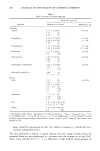
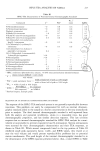
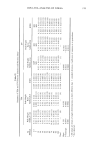
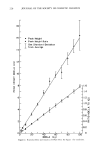
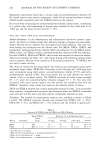
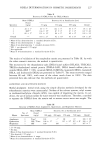
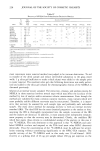
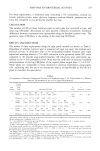
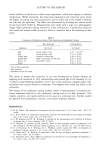
226 JOURNAL OF THE SOCIETY OF COSMETIC CHEMISTS Subsequent experiments found that a column wash of acetone/methylene chloride (10/ 90) would remove some matrix components, while 60 ml acetone/methylene chloride (60/40) would completely elute the NDELA placed on the column. Recoveries from evaporating the acetone/methylene chloride column eluent, transferring to a culture tube, and evaporating to dryness were evaluated at five levels from 50 to 1,000 ng, and the mean recovery was 82 _+ 16%. MELA, DELA, TRELA, THEIR SALTS, AND MORPHOLINE Method development. In the ethanolamine and ethanolamine derivative cosmetic ingre- dients, the matrix is simple enough that elaborate cleanup techniques are unnecessary. Simple dilution prior to analysis was investigated and found sufficient. The only vari- ation among the techniques was the diluent used. For MELA, DELA, TRELA, and morpholine, methanol/methylene chloride (4/96) was sufficient. For the MELA amide, DELA amide, and TRELA amides, methanol/methylene chloride (2/98) was sufficient. For salts of MELA, DELA and TRELA, ethyl acetate was required to solvate the arialyre. These latter matrices are often "wet" and require drying with anhydrous sodium sulfate prior to analysis. Because of the simplicity of the sample preparation, 14C-NDELA was not used to assess recovery. The choice of solvent for the ethanolamine salt matrices was investigated using trieth- anolamine lauryl sulfate (TRELALS). Recoveries at the 200-ng/g and 1,000-ng/g level were investigated using ethyl acetate, acetone/methylene chloride (25/75), and meth- anol/methylene chloride (2/98). The latter solvent did not fully dissolve the matrix instead it left a two-phase system. The NDELA recoveries for ethyl acetate averaged 85 + 8, while the acetone/methylene chloride averaged 79 + 16. Not only were recoveries with ethyl acetate higher, but the solvent tail interfered less with the NDELA. Therefore, ethyl acetate was chosen as the dilution solvent of choice. DELA and TRELA samples may contain appreciable amounts of water. To accommodate these samples, a supplemental procedure was developed where the NDELA is adsorbed onto silica gel and the water and other volatile components removed in vacuo. Validation. The method for ethanolamine matrices were validated as shown in Tables I and II. The NDELA recoveries through each method from TRELA (101 + 20%), DELA (98 + 9%), and MELA (89 + 6%) indicate that the method is quantitative. Table I Recovery of NDELA from the MELA and DELA Matrices Mean NDELA Recovery (%) at Fortification Level Found Matrix Specimens (ng/g) 50 ng/g 300 ng/g 1,000 ng/g Overall MELA 1 ND a 90 83 94 89 + 6 b DELA 2 ND, 33 -+ 8 c 103 --- 3 c 92 -+ 2 c 99 --- 12 c 98 -+ 9 d Not detected (25 ng/g). Mean of three determinations - standard deviation (S.D.). Mean of two determinations _+ range. Mean of six determinations + standard deviation (S.D.).
Purchased for the exclusive use of nofirst nolast (unknown)
From: SCC Media Library & Resource Center (library.scconline.org)