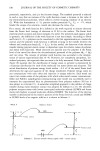
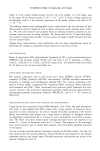
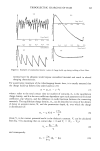
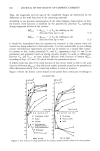
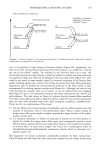
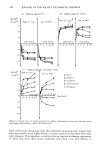
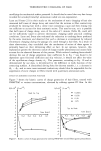
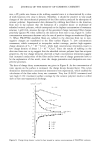
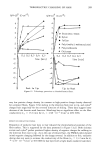
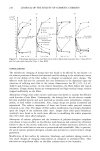
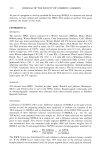
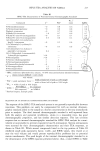
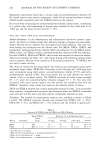
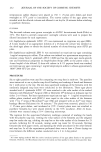
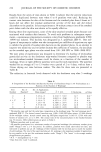
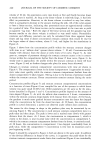
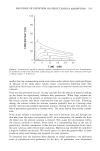
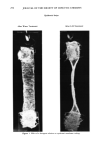
252 JOURNAL OF THE SOCIETY OF COSMETIC CHEMISTS Epidermis Strips After Water Treatment After LAS Treatment Figure 1. Effect of a detergent solution on epidermal membrane curling.

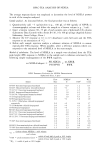
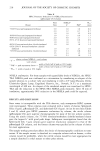
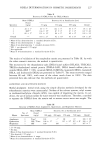
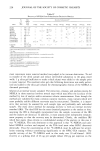
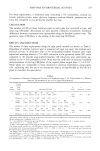
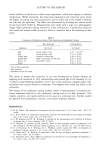
LETTER TO THE EDITOR 253 attain visibility of the slices in tallow soap suspensions, which were opaque at ambient temperature. While immersed, the strips were measured at the narrowest point where the degree of curling was most pronounced, and at either end at the interface between the tabs and the epidermis. The effect was determined by dividing the narrow width by the end width (Table I). Measurements were made with a ruler on a photographic image. High epidermis curling resulted in a low curling ratio. Calculations using the end width and narrow width served as a built-in correction factor for variations in skin slices. Table I Correlation of Surfactant-Induced Skin Irritation and Epidermis Curling Skin Irritation Curling Ratio Surfactant (In Vivo) • (In Vitro) 2 LAS Severe within 1 day 0.25 -+ 0.011' SLS Severe within 1 day 0.33 + 0.008 Tallow soap Intense by fourth day 0.46 + 0.021 AEOS-3EO Mild to moderate by fifth day 0.96 --- 0.043 Tween 20 None after 5 days 0.92 + 0.071 Water 0.98 --- 0.030 • Two to three replicates. 2 Four replicates. * Standard error of the mean. The extent of human skin irritation in vivo was determined on human subjects by applying each surfactant at 10% concentration and neutral pH to the forearms of 2 to 3 subjects using Duhring chambers (10, 11) for 5 days (solutions changed daily). Ob- servations were mainly limited to erythema. The samples were coded and blind to the evaluators. The results of the epidermis curling method (Table I) demonstrated a correlation be- tween surfactant-induced in vitro epidermis curling and in vivo skin irritation. This simple, sensitive, and quick method can be used as a screening tool. Further studies are planned with amphoteric, cationic, and mixed surfactant systems. REFERENCES (1) M. K. Polano, The interaction of detergents and the human skin, J. Soc. Cosmet. Chem., 19, 3-20 (1968). (2) V. K. H. Brown, A comparison of predictive irritation tests with surfactants on human and animal skin, J. Soc. Cosmet. Chem., 22, 411-420 (1971). (3) A.M. Kligman and W. M. Wooding, A method for the measurement and evaluation of irritants on human skin, J. Invest. Dermatol., 49, 78 (1967). (4) G. Imokawa, K. Sumura, and M. Katsumi, Study on skin roughness caused by surfactants: I. A new method in vivo for evaluation of skin roughness, J. Am. Oil Chem. Soc., 52, 479-483 (1975). (5) G.J. Putterman, N. F. Wolejsza, M. A. Wolfram, and K. Laden, The effect of detergents on swelling of stratum corneum, J. Soc. Cosmet. Chem., 28, 521-532 (1977). (6) K. Fernee and C. R. Robbins, A quantitative index for area swelling of epidermal membrane, J. Soc. Cosmet. Chem., 32, 53 (1981). (7) R. Scheuplein and L. Ross, Effects of surfactants and solvents on the permeability of epidermis, J. Soc. Cosmet. Chem., 21, 853-873 (1970).
Purchased for the exclusive use of nofirst nolast (unknown)
From: SCC Media Library & Resource Center (library.scconline.org)