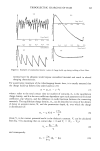
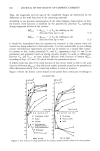
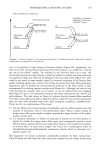
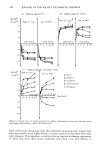
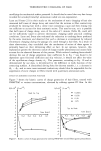
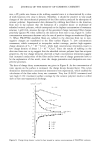
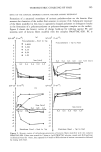
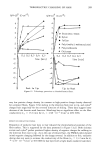
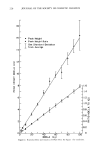
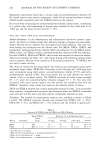
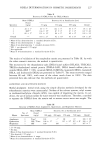
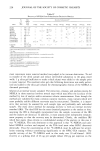
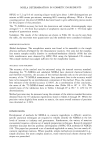
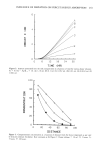
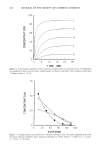
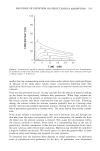
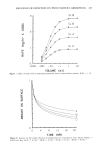
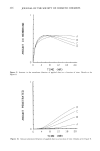
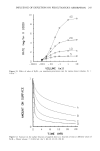
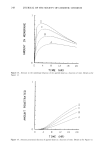
INFLUENCE OF DEPLETION ON PERCUTANEOUS ABSORPTION 249 tendency for the amount within the membrane to increase at early times (Figure 13). As time goes on, amounts within the stratum corneum drop and the curves eventually cross each other. The drop in the amount remaining on the skin surface over time (Figure 12) is more pronounced the higher the partitioning tendency. Although the highest partition coefficient investigated was 8 times that of the smallest partition coefficient, the ratio of values of amounts within the membrane are not nearly this high. The membrane peak value for a partition coefficient of 40 is only about twice as high as the corresponding value for a partition coefficient of 5. Also, while the amounts penetrated do increase with an increasing partition coefficient (Figure 14), an eight times increase in partition coefficient results in only about a two-times increase in penetration. Depletion as a negative feedback is more effective the higher the par- tition coefficient. ACKNOWLEDGEMENTS This work was supported by a FASP leave and a grant from the Research Council of Rutgers University. REFERENCES (1) R. T. Tregear, Physical Functions if Skin (Academic Press, New York, 1966), pp 1-52. (2) T.J. Franz, The finite dose technique as a valid in vitro model for the study of percutaneous absorption, Curt. Probl. Dermatol., 7, 58-68 (1978). (3) E. Menczel and H. I. Maibach, Epidermal-dermal retention in human percutaneous absorption: Benzyl alcohol and testosterone, J. Invest. Dermatol., 54, 386-394 (1970). (4) G. Krantz, H. Schaefer, and A. Zesch, Hydrocoritisone (cortisol) concentration and penetration gradient, Acta Dermatovener (Stockh), 57, 269-273 (1977). (5) J. L. Zatz, "Percutaneous Absorption: Computer Simulation Using Multicompartmented Membrane Models (MMM)," in Percutaneous Absorption, R. Bronaugh and H. Maibach, Eds. (Dekker, NY), in press.

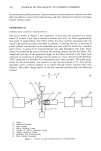
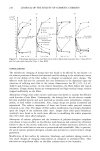
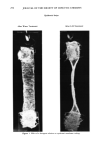
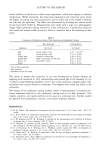
J. Soc. Cosmet. Chem., 36, 251-254 (May/June 1985) Letter to the Editor TO THE EDITOR: Anionic surfactants have a potential to irritate the skin (1-4). A reliable in vitro method of evaluating these agents would reduce the amount of costly and time-consuming testing on animals and humans. Since the epidermal membrane is the initial barrier a surfactant meets in the course of human irritation, changes in this outermost layer have been used to study potential skin irritation (5-7). Our current study began with the use of Fernee and Robbins' epidermis "swelling" procedure (6) as our test method. The epidermis was prepared by using part of the technique described by Kligman and Christophers (9). Frozen abdominal cadaver skin samples from a hospital autopsy pro- cedure were immersed in water at 50-60øC for about 3 minutes. The epidermis was gently teased off while the dermis was securely held, and then the epidermis was immersed in fresh water, lifted on a screen, and allowed to air dry. The epidermis cutting and mounting procedure was developed by Fernee and Robbins (6). Strips of epidermis were cut crosswise to the longitudinal axis of the cadaver, into pieces 0.5 cm wide, and cut into lengths 4 to 5 cm. Plastic tabs were glued with Duco Cement onto both ends of the strip so as to encase the ends of the epidermis, providing final dimensions of 2.5 ( 0.5 cm for the exposed strip. (See Figure 1). Fernee and Robbins determined the surfactant effect on the epidermis by treating the membrane with a surfactant solution and measuring the swelling along the longitudinal axis with a cathetometer. Our investigation with this method confirmed that surfactant solutions which are strong skin irritants do cause an increase in swelling along the longitudinal axis of the epi- dermis. For example, 0.3% linear alkyl benzenesulfonate caused an increase of approx- imately 19%. Under these same experimental conditions we observed that the epidermis also curled and twisted markedly, dramatically decreasing the width at the half-height by approximately 75% (Figure 1). This epidermis curling system procedure was there- fore further developed to determine optimum conditions for observing differences in the effects of varied surfactants. Four artionic and one nonionic surfactants were tested. These were sodium lauryl sulfate (SLS), linear alkylbenzene sulfonate (LAS), the sodium salts of beef tallow mixed fatty acids (tallow soap), ammonium lauryl-3-ethoxy sulfate (AEOS-3EO), and a mixture of laurate esters of sorbitol and sorbitol anhydrides (Tween 20©). Bent copper wires or partially untwisted paper clips were inserted through the plastic mounting tabs, and the strips of epidermis were suspended in water overnight in a refrigerator at about 6øC. Solutions of 2.4% surfactant were adjusted to pH 5.3, approximately the same as the pH value of the skin (8). Four strips of epidermis were removed from the water and suspended in each surfactant solution at ambient temper- ature for 4 hours. The solutions were then warmed to 40øC for 20 minutes in order to 251
Purchased for the exclusive use of nofirst nolast (unknown)
From: SCC Media Library & Resource Center (library.scconline.org)