j. Soc. Cosmet. Chem., 36, 213-222 (May/June 1985) Quantitative analysis of N-nitrosodiethanolamine (NDELA) by high performance liquid chromatography-thermal energy analyzer detection MITCHELL D. ERICKSON, DUANE B. LAKINGS, ARBOR D. DRINKWINE, and JAMES L. SPIGARELLI, Midwest Research Institute, 425 Volker Boulevard, Kansas City, MO 64110. Received December 1 O, 1984. Presented in part at the Pittsburgh Conj•rence on Analytical Chemistry and Applied Spectroscopy, Atlantic City, N J, March 10-14, 1980. Synopsis A method for the analysis of N-nitrosodiethanolamine using high performance liquid chromatography with thermal energy analyzer detection (HPLC-TEA) is presented. Under the normal phase HPLC con- ditions required by the TEA, optimum chromatography was achieved using 75/19/6 (v/v/v) isooctane/ methylene chloride/methanol mobile phase on a Spherisorb CN column. The use of an internal chromato- graphic standard, N-nitrosopyrrolidine, was shown to double the quantitative precision. INTRODUCTION N-nitrosamines have long been recognized as a group of hazardous compounds about 80% of these tested have been found to be carcinogenic to test animals (1-4). Their carcinogenicity, mutagenicity, health effects, environmental presence, and occurrence in commercial products have been reviewed (1-10). In 1977, it was reported that N- nitrosodiethanolamine (NDELA) had been found in cutting fluids (11), tobacco (12), cosmetics (13), lotions (13), and shampoos (13). Subsequently, NDELA was shown to be a carcinogen in the rat (14). Since these reports, scientists in industry and govern- ment have been working to develop and improve upon analytical methods for detecting NDELA (15). Although there have been some efforts directed at NDELA analysis by gas chromatog- raphy/flame ionization detection of derivatives (16), most methods have employed high performance liquid chromatography (HPLC) with UV (17-20) or thermal energy an- alyzer (TEA) (13,21) detection. HPLC-TEA provides not only the selectivity of an N- nitrosamine specific detector, but also low detection limits (1-5 ng for many N- nitrosamines). The use of UV irradiation to destroy N-nitrosamines as a confirmatory technique has been previously reported (22). The N-NO moiety undergoes photolyric cleavage, de- stroying the nitrosamine. The disappearance of a TEA peak following UV irradiation therefore adds confidence to the identification. 213

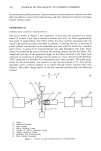
214 JOURNAL OF THE SOCIETY OF COSMETIC CHEMISTS As part of a program to develop methods for detecting NDELA in cosmetics and related matrices, we have refined and validated the HPLC-TEA analytical method. This paper presents the results of this work. EXPERIMENTAL APPARATUS The isocratic HPLC system consisted of a Waters Associates (Milford, Mass.) Model 6000A pump, Waters Model U6K injector, Carle Instruments (Anaheim, Calif.) Model 2025 four-way micro-switching valve, Waters Model 440 UV detector operated at 254 nm, and a Thermo Electron Corporation (Waltham, Mass.) TEA Model 502. The UV and TEA detectors were used in series, the UV used first. The TEA was operated at a furnace temperature of 550øC, argon and oxygen pressures were 0.5 torr, photomul- tiplier voltage was 1475 V DC, and the cold trap was dry ice/isopropanol. The columns were Waters txBondapak CN (300 X 4 mm ID) a Laboratory Data Control (Riviera Beach, Fla.) 5 txm Spherisorb CN (250 x 4.6 mm ID) with a Whatman (Clifton, N.Y.) Co:Pell octadecyl silane guard column and a Laboratory Data Control 5 txm Spherisorb Silica (250 X 4.6 mm ID) with a Co:Pell silica guard column. Unless otherwise specified, flow rates were 2 mL/min isooctane/methylene chloride/methanol (75/19/6 volumetric ratios are used throughout this report). The micro-switching valve was placed in the system between the UV detector and the TEA detector to permit the analyst to switch the column eluent from the TEA detector to waste when desired, based upon the UV response. REAGENTS All solvents were HPLC "distilled in glass" grade (Burdick and Jackson, Muskegon, Mich.) and filtered prior to use in the HPLC system. Reagent-grade compounds used as chromatographic standards were obtained from other research projects at Midwest Research Institute. PROCEDURE Calibration of the HPLC-TEA system. Reference solutions of NDELA in the same solvent system as used for preparing samples were employed to evaluate the linearity of the TEA response to NDELA and to determine the stability of the HPLC-TEA system. A minimum of three reference solution concentrations of NDELA, e.g., 20, 50, and 100 ng/ml, were prepared with each sample set. Each of these solutions was analyzed prior to determining NDELA in a sample set, and a reference solution was analyzed prior to each sample. The relative weight response (RWR) for the reference solution was determined from the measured peak heights (PH) and known weights (wt) of NDELA and the N-nitrosopyrrolidine (NPYR) internal chromatographic standard by: PH NDELA wt NPYR RWR = X PH NPYR wt NDELA The RWR factor was determined for each reference solution analyzed during a sample set. If the RWR factor varied more than 10% from that of the previous solution, sample analysis was terminated until the proper response factor could again be obtained.
Purchased for the exclusive use of nofirst nolast (unknown)
From: SCC Media Library & Resource Center (library.scconline.org)