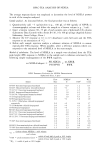
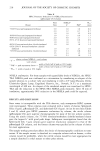
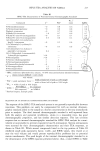
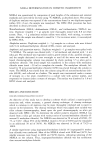
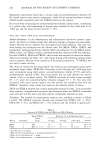
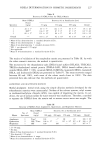
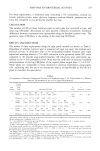
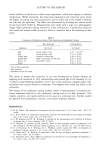
NDELA DETERMINATION IN COSMETIC INGREDIENTS 227 Table II Recovery of NDELA from the TRELA Matrix Specimen Mean NDELA Found (ng/g) Recovery (%) at Fortification Level 33 ng/g 332 ng/g 995 ng/g Overall 1 26+3• 2 ND b'a 3 60 + 5 b Overall __e 87 -+- 7 b 104 + 3 • 95 -+- 7 b 95 + 1() c 136 -+- 15 • 87 -+- 3 • 97 + 9 • 107 --+ 26 • 131 --+ 13 • 86 + 5 • 89 + 0 b 102 + 24 c 118 + 27 c 92 + 10 c 93 + 8 • 101 + 20 • Mean of four determinations _+ standard deviation (S.D.). Mean of two determinations -+- range. Mean of six determinations + standard deviation (S.D.). ND = not detected (25 ng/g). Not applicable. Mean of 18 determinations + standard deviation (S.D.). The results of validation of the morpholine matrix are presented in Table III. As with the other cosmetic matrices, the method is quantitative. The recoveries for the ethanolamine salts [DELA lauryl sulfate (DELALS), TRECALS, TRELA-cohydrolyzed animal protein (TRELA-CAP), DELA laureth sulfate plus co- camide DELA (DLS + CD), cocamide MELA (CoMELA), lauramide MELA, lauramide DELA, and linoleamide DELA] are presented in Table IV. The mean recoveries ranged between 80 and 128%, with most of the values much closer to 100%. The data presented here also indicate that the methods are quantitative. AMPHOTERIC AND QUATERNIUM MATRICES Method development. Initial trials using the simple dilution methods developed for the ethanolamine matrices were unsuccessful. Neither of the solvent systems, ethyl acetate or methanol/methylene chloride (4/96), was capable of dissolving the matrix. In ad- dition, the use of sodium sulfate for water removal was insufficient. Therefore, a method to separate the NDELA from the matrix and to remove excess water was sought. The Table III Recovery of NDELA From Amphoteric, Quaternium, and Morpholine Matrices Mean NDELA Recovery (%) at Fortification Level No. of Found Matrix Specimens (ng/g) 100 ng/g 200 ng/g 250 ng/g 500 ng/g Overall Amphoteric 1 Trace s 103 --• 98 117 106 -+ 10 • Quaternium 2 ND, d Trace 106 -+- 17 e -- 107 -+ 12 e 107 •- 8 e 106 -+ 14 f Morpholine 1 ND 100 108 -- 113 107 -+- 7 c 25-50 ng/g. No data. Mean of three determinations -+ standard deviation (S.D.). Not detected (25 ng/g). Mean of two determinations -+- range. Mean of six determinations -+- standard deviation (S.D.).

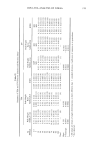
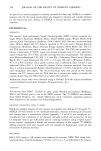
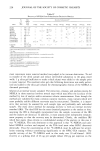
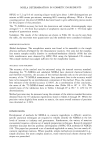
228 JOURNAL OF THE SOCIETY OF COSMETIC CHEMISTS Table IV Recovery of NDELA From Ethanolamine Derivative Matrices Matrix No. Mean of NDELA Specl- Found mens (ng/g) Recovery at Fort•fication Level* 50 ng/g 100 ng/g 200 ng/g 300 ng/g 400 ng/g 500 ng/g 600 ng/g 1,000 ng/g Overall DELALS 3 290 --+ 125 a DELALS 5 280 ñ 15 d TRELALS 2 46 -+ 25 f TRELALS 2 43 ñ 13 TRELA-CAP 3 48 ñ 3 a TRELA-CAP 3 ND, g, T, h T DLS + CD 1 910 Cocam•de MELA 4 ND Laumm•de MELA 2 ND Lam'am•de DELA 2 ND, 185 ñ 5 • Lmoleam•de 5 ND, ND, ND, DELA 102 ñ 18a, T __b __ -- 125 ñ 17 '• 115 ñ 19 • 125 --+ 19 • 120 ñ 17 ( -- 102 ñ 1 e -- -- 92 --- 98 --+ 6 a -- 104 ñ 4 c 106 ñ 10 e --- 110 -- -- 107 ñ 4 • 106 ñ 7' 104 -- 115 110 • 6 • -- -- -- 96 ñ 6 a 116 ñ 10 '• 1(/8 -+ 12 • -- 128 ñ 3 e -- -- 128 ñ 3 c -- -- -- 100 117 109 ñ 8 • -- 101 ñ 9 • -- -- -- 109 ñ 9 • 110 -- 98 .... 104 -- 6 • 110 ñ 10 e --- 95 -+ 8 e -- 107 ñ 1 • 104 -+ 11 • 81 ñ 11 • 79 ñ 1 d ..... 80 _+ 10 k a Mean of three determ•nanons ñ standard dewar•on (S D ) b No. data. c Mean of six determinations ñ standard dewauon (S D ) d Mean ofs•x determ•nauons (three specimens m duphcare) ñ standard dewauon (S.D) e Mean of two determinations ñ range. f Mean of four determinations (two specimens •n duph•ate) ñ standard dev•atxon (S D.) g Not detected (50 ng/g). h Trace(50 100 ng/g). • Mean of four determmanons ñ standard dev•auon (S.D.). I Mean of five determinations ñ standard dewat•on (S D.) k Mean of 10 determ•nauons ñ standard dewauon (S D ) * Recoveries based on NC-NDELA most convenient water removal method was judged to be vacuum desiccation. To aid in transfer of the dried sample and reduce irreversible adsorption to the glass vessel walls, 3 g silica gel (sufficient to make a thick slurry) were added to the sample prior to water removal. The resultant silica gel cake following desiccation was easily pulver- ized and added to the silica gel column for chromatographic elution of the NDELA as discussed previously. Selection of an internal recovery standard. The extraction, cleanup, and analysis process for NDELA in these matrices involves several steps which may affect the accuracy of the method by loss of analyte and/or erroneous volume measurements. Even though the methods are validated for many common cosmetic matrices, many variants which will most probably exhibit different recoveries may be encountered. Therefore, it is imper- ative that recovery be assessed for each sample type and preferably each individual sample. The most direct method for assessing recovery is with an internal recovery standard (IRS). The ideal IRS has the same chemical properties as the analyte so that, assuming the IRS is thoroughly incorporated into the sample, recoveries of the IRS and the analyte are identical. In addition, it must possess some independent measure- ment property so that the recovery may be determined. Clearly, the candidate IRS which best meets these criteria is a radiolabeled analog of the analyte in this case it was •4C-NDELA. The only detriment to this approach is that •4C-NDELA and unla- beled NDELA co-elute and respond to the TEA (and most other HPLC detectors) identically. Thus the concentration of the •4C-NDELA must be sufficient for scintil- lation counting without contributing significantly to the HPLC-TEA response. The specific activity of the •4C-NDELA used in this study was 10 mCi/mmol. 100% recovery at a spiking level of 26 ng per sample (about 260 pg per injection on the
Purchased for the exclusive use of nofirst nolast (unknown)
From: SCC Media Library & Resource Center (library.scconline.org)