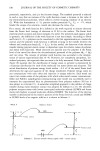
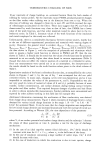
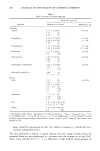
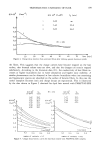
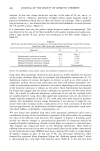
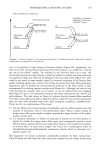
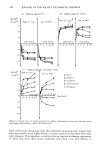
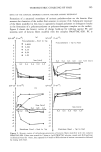
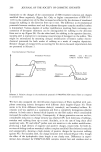
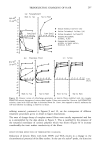
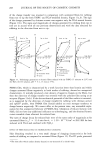
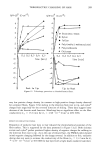
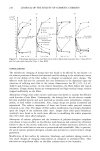
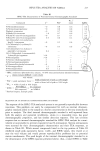
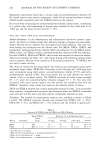
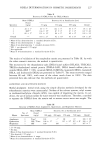
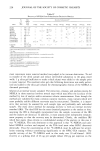
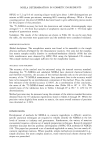
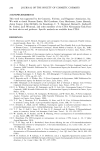
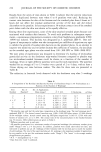
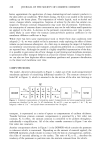
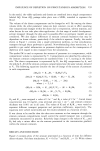
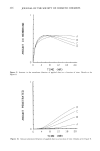
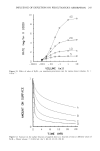
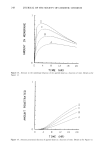
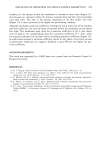
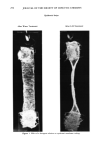
TRIBOELECTRIC CHARGING OF HAIR 209 Q/A.10 9 (C.om -2) -1 -2 -3 -4 -5 -6 Q/A.10 9 (C.em -2) 4 inless S•eel o ill . 11/ ' o' _, •] _ IX o.• o.2 -6 Roo• •o Tip Tip •o Roo• Figure 12. Tribocharge generation on bleached keratin fibers. very low positive charge density (in contrast to high positive charge density observed for untreated fibers, Figure 3) for sliding in the direction from root to tip, and nylon © charged hair negatively for the reversed direction of sliding. These data suggest some decrease of the keratin work function. Bleaching has no significant effect on the fiber conductivity (t•/: = 15.6 min for gl = 4.98 ' 10 -9 C/cm 2 at 29% RH). EFFECT OF OXIDATIVE DYEING Deposition of oxidative hair dyes in hair reduced the electrochemical potential of the fiber surface. This is supported by the data presented in Figure 13a,b. Both chitosan acetate and nylon © probes produced higher density of negative charges for rubbing in the direction from root to tip. As in the case of reduced hair, the PMMA probe showed initial negative charging followed by the charge reversal. In addition to this, oxidative dyeing does not seem to increase the conductivity of the fibers (tv: = 13.2 min for g• = 4.35 ' 10 -9 C/cm 2 at 30% RH for hair dyed with a light shade oxidative haircolor).

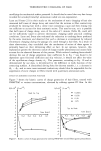
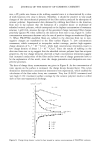
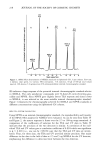
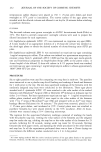
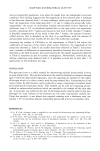
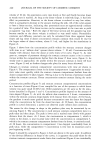
210 JOURNAL OF THE SOCIETY OF COSMETIC CHEMISTS (a) (b) Q/^.10 9 3 / /Y I I o Stainless Steel t ] øNylon F /•,•D•41/.• '? .3 .• .5 ,] -1 • / l• methacrylate) -6 { Root to Tip • Tip to Root Rot o x Tip to Root Figure 13. Tribocharge generation on hair fibers dyed with (a) Dark shade haircolor Nice'n Easy • 121) and (b) Light shade haircolor (Nice'n Easy •99). CONCLUSIONS The tribeelectric charging of human hair was found to be affected by two factors: (1) the relative positions of keratin and material used for rubbing in the tribeelectric series and (2) the ability of the fiber surface to dissipate accumulated static charges. The effective work function for untreated hair was determined to be dependent upon the direction of rubbing and close to the values characteristic for PC (3.85-4.8 eV, Table I) and chitosan acetate. At low relative humidities, the fibers behave like typical insulators. Charge density decays are nonexponential and high residual charge remains trapped indefinitely on the fibers. Adsorption of long chain alkyl cationic surfactants was shown to increase the effective work function of hair fibers. Consequently, the driving force for the electron transfer between modified keratin and such materials as stainless steel, polyethylene, polypro- pylene, or hard rubber is diminished. Also, charge decays are greatly accelerated and exponential. The relative importance of these two factors under practical cosmetic situations is not clear. The degree of fiber surface modification was strongly dependent upon the length of the surfactant alkyl chain. Longer chain alkyl quats (hexadecyl, octadecyl) were found to be much more effective in modifying the surface properties than their short chain alkyl analogues. Adsorption of cationic polymers and the formation of polymer-detergent complexes were shown to have an effect on the effective work function and conductivity of keratin similar to that of the cationic surfactants. In the case of these treatments, however, the increase of the work function was not so pronounced and controllable. Also, in practice, the use of cationic polymer-detergent complex does not lead to a control of static charge generation. Modification of hair surface by reduction, bleaching, and oxidative dyeing results in very small changes of charging characteristics as compared to untreated fibers. They also have an insignificant effect on the fiber conductivities at low humidity.
Purchased for the exclusive use of nofirst nolast (unknown)
From: SCC Media Library & Resource Center (library.scconline.org)