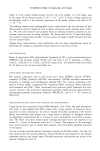
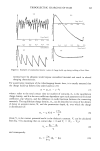
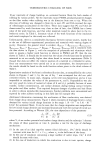
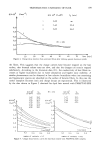
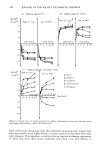
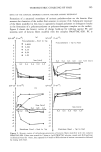
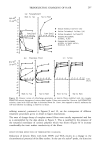
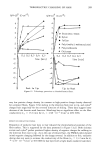
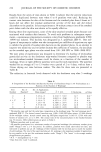
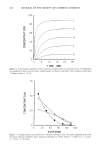
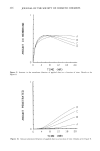
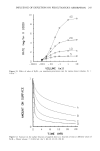
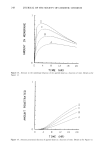
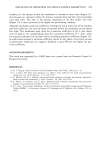
TRIBeELECTRIC CHARGING OF HAIR 203 modifying electrochemical surface potential. It should also be noted that very fast decays recorded for octadecyltrimethyl ammonium iodide are non-exponential. Lunn and Evans (21) in their study on the mechanism of static charging of hair also measured half times of charge decay and stated that the increase in fiber conductivity produced by treating hair with a creme rinse containing a quat and then rinsing was not sufficient to account for their antistatic action. This may be true, as it is possible that half times of charge decay, even of the order of 1 minute (Table II), could still not be sufficiently small to prevent electrostatic charging under practical combing conditions. Lunn and Evans also evaluated the reduction in combing forces produced by the same treatment and observed that such a decrease is accompanied by reduced electrostatic charging during the passage of a comb through a hair tress. As a result of these observations, they concluded that the mechanism of action of these agents is primarily based on their lubricating effect on hair. In our opinion, however, this explanation ignores the electronic nature of charge transfer phenomena and cannot fully account for the observed features of this process. While reduced combing forces should decrease the rate of charge generation (rate coefficient K in Eq. 7 was found to be dependent upon frictional coefficient and slip velocity), it should not affect the value of the equilibrium charge density cry. This parameter, according to Eq. 10 and as demonstrated by our data, is determined by the difference in work function of the contacting surfaces. A diminished driving force for electron transfer, i.e. a decrease in 02 - 0], and in some cases increased conductivity should thus be responsible for the suppression of static charges in fibers treated with quaternary ammonium salts. EFFECT OF ADSORBED CATIONIC POLYMER Figure 7 shows the kinetic curves of charge generation of hair fibers, treated with PMAPTAC at various concentrations, obtained by rubbing against PC film. In this 0/^.10 9 (C.cm -2) Q/A.10 9 (C. em -2) 7 6 5 3 2 1 0 -2 -3 -4 -5 -6 -7 Root to Tip 7 _......o 6 3 2 Time [mini 1 • I ., ,! - - 0 o.a 0.6 o.8 f. 6 -i -2 - • -6 -7 e 0.001% ß 0.01% 0 O. 1% e 1.0% Tip to Root Time [mini I I : : : --• IX 0.2 0.0, 0.6 0.8 1.0 t ' Figure 7. Kinetic curves of charge generation by rubbing PMAPTAC-treated fibers against polycarbonate.

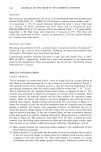
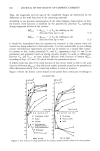
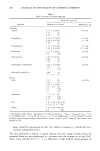
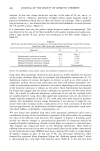
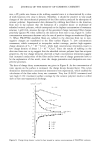
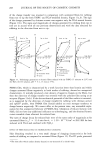
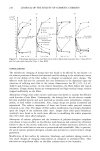
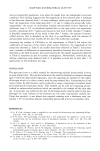
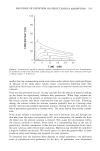
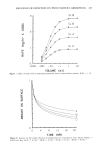
204 JOURNAL OF THE SOCIETY OF COSMETIC CHEMISTS case, a PC probe was chosen as the rubbing material since it is characterized by a value of work function very close to keratin. Therefore, it should be sensitive to very small changes of the electrochemical potential of the fiber surface produced by adsorption of cationic polymer. Experimental data obtained by rubbing hair fibers in the direction from root to tip indicate that the formation of a complete mono- or multilayer of adsorbed cationic polymer, which corresponds to the highest concentration of treatment solution 1 g/dl (34), reverses the sign of the generated charge (untreated fiber charges positively against PC when rubbed in the direction from root to tip, Figure 3). Lower concentration treatments decrease only the rate of positive charge accumulation (Figure 7). When PMAPTAC-modified fibers are rubbed in the direction from tip to root, negative charges are transferred to the fiber surface (Figure 7). Low concentration treatments, which correspond to incomplete surface coverage, produce high negative charge densities of 6-7 ß 10 -9 C/cm 2, while high concentration treatments result in low charge density of about 1.5' 10 -9 C/cm 2. Since the results of rubbing in the direction from root to tip suggest that the adsorbed cationic polymer layer has acceptor properties, the low charge densities observed at high concentration treatments suggest that increased conductivity of the fiber and/or lower rate of charge generation have to be the explanation of this result, since the charge generation and dissipation are com- petitive processes. The data of charge decay measurements are given in Figure 8. As the concentration of ionic species on the surface is increased, the charge decays become faster. The curves obtained at intermediate concentration treatments were exponential, which enabled the calculation of the first-order decay rate constants. Very low (0.001% treatment) and very high (1.0% treatment) surface coverage by the cationic polymer results in either slow or fast non-exponential discharge. Q/A.10 9 (C.em -2) RH = 24% 7 5 4 3 1 Time [min] 0 2 4• -1 -2 -3 • / O 0.001% l/ • 0.01% t ß 1.0% -5 -6 -7 Figure 8. Ch•ge dec•7 k•oe[•c cu[•es •o[ h•[ •e•[ed •[ •[•ous cooceo[[•doos o• P•AP•AC soludoo.
Purchased for the exclusive use of nofirst nolast (unknown)
From: SCC Media Library & Resource Center (library.scconline.org)