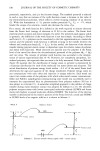
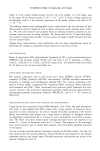
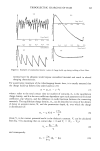
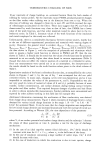
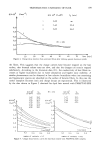
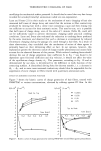
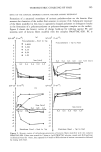
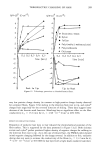
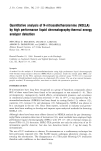
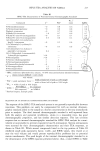
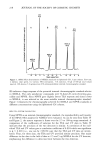
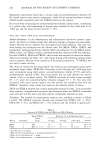
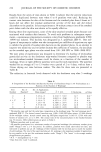
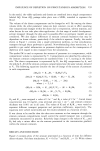
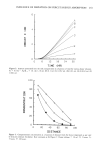
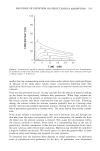
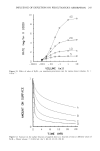
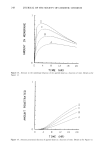
TRIBOELECTRIC CHARGING OF HAIR 205 EFFECT OF THE COMPLEX ADSORBED CATIONIC POLYMER-ANIONIC DETERGENT Formation of a saturated monolayer of cationic polyelectrolyte on the keratin fiber reverses the character of the surface from artionic to cationic (34). Subsequent exposure of the fibers modified in this way to oppositely charged polymers or detergents results in the formation of a polymer-polymer or polymer-detergent complex on the surface. Figure 9 shows the kinetic curves of charge build-up for rubbing against PC and stainless steel of keratin fibers modifed with the complex PMAPTAC-SDS. PC is Q/A.10 9 (C,½m '2) ß 0.001%' 6 ß 0.01% 5 • 0.1% 0 0.5% ß 1.0% 2 1 0 • 0.2 0.4 -1 -3 _a, -5 -6 Q/A.10 9 (C-cm -2) 6 5 3 2 1 0 -1 -2 -3 -5 -6 (a) Q/A.10 9 (oeoem-2) Polycarbonate - Root to Tlp Polycarbonate -Tlp to Root Time [min] i I ' -' 0.6 0.8 1•0 _ 2 (b) 6 5 4 3 2 1 o -1 -2 -3 -5 -6 6 5 2 ] 0.:6 o...8 1 0 o -1 -2 -3 -5 -6 Stainless Steel - Root to Tip 0.2 0.4 0.6 0.8 1.0 I I I i i (C.cm -2) Time [min] Time [min] I I I I I 0.2 0.4 0.6 0.8 1.0 Figure 9. Kinetic curves of tribocharge generation of keratin fibers modified with the complex PMAPTAC-SDS. Fibers were treated for 2 hours in lg/dl PMAPTAC solution, rinsed with H20 and kept in deionized water for 1 hour, then exposed for 4 hours to SDS solutions of various concentrations followed by rinsing with H20. Stainless Steel - Tip to Root

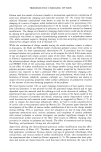
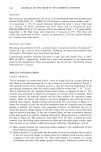
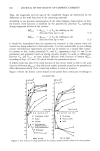
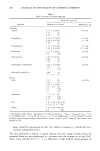
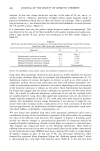
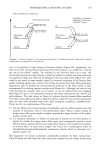
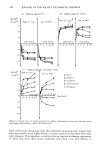
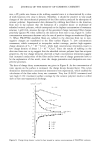
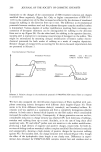
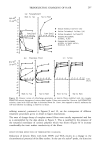
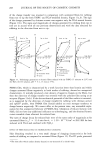
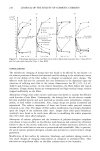
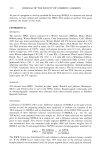
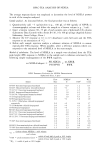
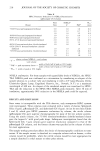
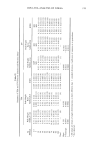
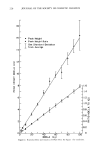
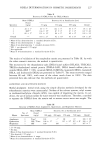
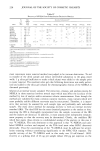
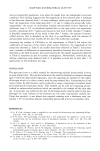
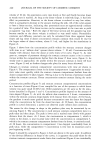
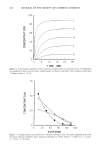
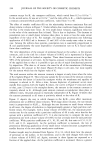
206 JOURNAL OF THE SOCIETY OF COSMETIC CHEMISTS insensitive to the changes of the concentration of SDS treatment solution and charges modified fibers negatively (Figure 9a). Only at higher concentrations of SDS (0.5- 1.0%) is the conductivity of the fiber increased as reflected by the decrease of transferred charge for rubbing in the direction from tip to root. The difference in electrochemical potentials between stainless steel and the polymer-detergent complex modified surface is diminished. Various degrees of surface modification resulting from increasing con- centration of detergent treatment can be distinguished for rubbing in the direction from root to tip (Figure 9b). On the other hand, for rubbing in the opposite direction, stainless steel is insensitive to increasing concentration of detergent on the surface. This might be rationalized by assuming unequal modification of keratin surface electro- chemical potentials for both modes of rubbing as a result of complex deposition. Relative changes of energy levels accounting for the above-discussed experimental data are presented in Scheme 3. Eleekroehemieal Pokenkial Unkreaked Kerakin PMAPTAC (1%) - SDS (1%) Complex Treated Fibers .•_ Root to Tip PC PC Uoot Skainless Stainless Tip to Root Steel Skeel Rook to Tip Scheme 3. Relative changes in electrochemical potential of PMAPTAC-SDS treated fibers as compared to untreated hair. We have also compared the electrification characteristics of fibers modified with com- plexes containing anionic detergents with different chain lengths (Figure 10). There seems to be little difference between dodecyl, tetradecyl, and hexadecyl sulfates. Ei- cosanoic acid was applied as a suspension and from a completely homogenous alkaline solution. In both cases it formed thick deposits on the fiber surface which considerably increased the surface conductivity. Consequently, if charge generation was not too fast, considerable reduction in charge density was observed (PC both directions of rubbing, stainless steel rubbing from tip to root). Similarly, as in the case of long chain alkyl quaternary salts, PC and teflon © probes were not sensitive to the surface modification, producing a high density of negative and positive charges, respectively, for both di- rections of sliding (sodium tetradecyl sulfate complex modified fibers behaved erratically and unexpectedly, showing a high density of positive charges for tip-to-root rubbing against PC). For stainless steel, the charge densities were reduced (Figure 10b), though the effect of the hydrophobic chain length is not clearly seen. Differences in experi- mental data obtained for PMAPTAC-SDS complex treated hair and stainless steel as
Purchased for the exclusive use of nofirst nolast (unknown)
From: SCC Media Library & Resource Center (library.scconline.org)