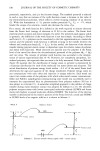
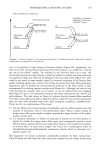
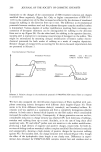
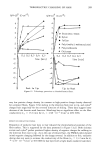
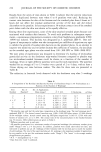
TRIBOELECTRIC CHARGING OF HAIR 191 Gibson used this model of electron transfer to demonstrate quantitative correlations of solid state triboelectric charging and molecular structure (12-14). Linear free energy relations (Hammet correlations) were shown to exist for the process of triboelectric charging of a variety of organic solids [substituted salicyl anils (14), polystyrenes (14), polyethylenes (15), poly(arylomethylstyrenes) (13)] by metals. It was thus possible to alter triboelectric charging properties of polymers in a predictable manner by chemical modification. The change in triboelectric charging characteristics could also be achieved by doping with appropriate low molecular weight donors and acceptors. For example, octadecanol was shown to impart electrodonating properties to a polyethylene matrix (16), while increased negative charging (increase in electron-accepting properties) was observed for collagen mixed with p-chloranil (17). While the mechanism of charge transfer during the metal-insulator contact is subject to discussion, the Duke and Fabish model of polymer-polymer contact event seems to account better for some experimental observations (9). It postulates that the charge exchange between two polymers will occur at all energies for which filled donor states of one are aligned with empty acceptor states of the other. That also implies, similar to Gibson's representation of metal-insulator contact (Scheme 1), that the direction of the polymer-polymer charge exchange would depend on the relative energies of LUMO and HOMO levels of the contacting materials. Very few works have been published on the effect of surface modification on the charge transfer during metal-polymer and polymer-polymer contact (12,18). Changing the surface properties by chemical deriv- atization was reported to have a profound effect on the triboelectric charging phe- nomena. Oxidation or ozonolysis of polystyrene and polyethylene, which leads to the formation of ketone, aidehyde, quinone, carboxyl, etc., functionalities was shown to impart electron-accepting properties while surface sulfonation of polystyrene resulted in the increase of electron-donating properties of the polymer. We have reported earlier (19) on some charging characteristics of hair against various metals and polymers. It was pointed out that the generated charge density and its sign depended upon the material used for rubbing as well as the direction of rubbing. The experimental data could be qualitatively explained in terms of the band model of the electronic structure of polymers and metals, assuming certain characteristic values of work functions for each material under consideration, as suggested by Davis (3-5). In order to explain the directional triboelectric effect, we had to invoke piezoelectricity of cuticle cells as was proposed earlier by Martin (20). The present paper describes the investigation of the effect of various surface modifications of hair on the charge transfer during rubbing. This is important, since the adsorption on hair of long chain alkyl quaternary ammonium salts, cationic polymers, and complexes of cationic polymers with anionic polymers or anionic detergents can produce significant changes in the electrochemical surface potential of the fiber. This results in different charging char- acteristics in relation to polymers and metals. The effect of treatments such as dyeing, bleaching, and permanent waving was also explored. Apart from altering the electrochemical potential, surface modification may also affect the conductivity of fibers (21). Therefore, the primary purpose of our studies was to find qualitative correlations between density and sign of generated tribocharge, fiber conductivity, and various modes of surface modification of hair. Our interpretation of the experimental data is based on Davies' approach (3-5). We assume that both poly- mers and metals are characterized by work functions which determine the value of the

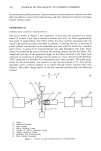
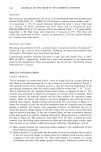
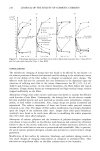
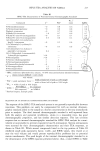
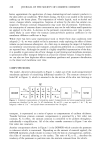
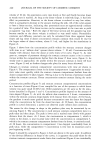
192 JOURNAL OF THE SOCIETY OF COSMETIC CHEMISTS electrochemical surface potential. Surface treatments and piezoelectric potential can also affect the effective value of the work functions and thus influence the direction of charge transfer during contact. EXPERIMENTAL TRIBOELECTRIC CHARGING MEASUREMENTS The device shown in Figure 1 was employed. A hair tress was mounted in a metal frame (4) in such a way that it formed a smooth layer 0.03 cm thick (approximately four layers of single fibers). The fibers within the tress could be positioned with the cuticle edges pointing either downward or upward. A rubbing element in the form of a half cylinder was attached to an adjustable arm that could be rotated by a variable speed motor. A speed of 70 rotations/minute was used throughout this work. Static charge was produced by contact between the rubbing element and the hair fibers. The magnitude and sign of the generated charge on the fibers mounted in the frame were measured as a function of rubbing time by means of a static detector probe (Keithley 2503) connected to a Keithley 616 electrometer and a chart recorder. The entire setup, except for the electrometer, was housed in a dry box maintained at 25-30% relative humidity under a positive pressure of air passed through several columns filled with Drierite. The surface charge density on the hair tress was calculated from the following relation: cr = Q C'E (6) A A 2 3 4 5 6 07 cm 7 8 1. Motor 2. Rubbing Element 3. Hair Sample 4. Metal Holding Frame 5. Target of Static Detector Rrobe 6. Static Detector Probe ?. Keith!ey 616 Electrometer 8. Omni Scribe Recorder Figure !. A device to study triboelectrification of keratin fibe•.
Purchased for the exclusive use of nofirst nolast (unknown)
From: SCC Media Library & Resource Center (library.scconline.org)