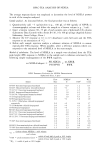
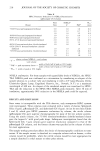
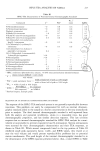
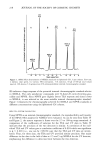
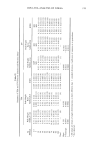
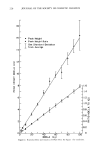
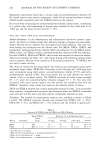
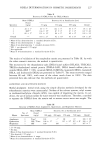
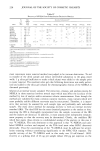
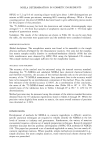
SOAP BAR ANTIBACTERIAL ACTIVITY 235 was not statistically significant, even when the results from two independent tests were combined. This finding suggests that the magnitude of the reduction after 5 washings is less than that observed with 7 or more washings, which gave significant reductions. Since the magnitude of the reductions after 7, 9, and 13 washes are statistically indis- tinguishable, the extent of triclocarban residual antimicrobial activity deposited on deodorant soap (1.5% triclocarban)-washed skin in the agar patch test apparently reaches a maximum after 7 washes and remains at that level at least through 13 washes. A plausible interpretation of this result is that after 7 washes, the amount of antimi- crobial activity that is absorbed on the skin is in equilibrium with the amount of antimicrobial material that desorbs off the skin with additional washings. Increasing the number of CFU/plate in the experiments in Table II did reduce the coefficients of variation of the control plate counts. However, the magnitude of the reductions observed in Table II are smaller than those observed in Table I. Since there were a number of differences in experimental procedures between the two sets of tests, described in the table footnotes, the actual reason(s) for the smaller magnitudes observed in Table II remain(s) an area for further investigation. Nevertheless, statistically sig- nificant reductions were observed with 6-8 panelists in both sets of tests after 7-8 applications of the deodorant bar soap. CONCLUSION The agar patch test is a useful method for determining residual antimicrobial activity on soap-washed skin. This method eliminates the need for chemicals to migrate through agar to reach the deep-seeded organisms, since the organisms are streaked on the surface of the agar which is in direct contact with the soap-washed skin. Contamination of the contact plates by skin bacteria can be reduced by using a streptomycin-resistant strain and streptomycin-containing media. This method can be used for evaluating antimi- crobials or antimicrobial products which are intended to be washed off the skin after use. In principle, any relatively flat area of the human body could be used in this test, although the volar surfaces of the forearms are the most conveniently studied site. Using this method, it was shown that repeated washing with a deodorant soap con- taining 1.5% triclocarban deposits measurable germicidal activity on panelists' skin. REFERENCES (1) A. R. Cade, Antiseptic soaps, a simplified in vivo method for determining their degerming efficacy, Soap Sanit. Chem., 26, 35-38 (1950). (2) P. B. Price, The bacteriology of normal skin a new quantitative test applied to a study of the bacterial flora and the disinfectant action of mechanical cleansing, d r . Infect. Dis., 63, 301-308 (1938). (3) H. J. G. Quinn, G. Voss, and H. S. Whitehouse, A method for the in vivo evaluation of skin sanitizing soaps, Appl. Microbiol., 2, 202-204 (1954). (4) J. J. Leyden, R. Stewart, and A.M. Kligman, Updated in vivo methods for evaluating topical antimicrobial agents on human skin, dr. Invest. Dermatol., 72, 165-170 (1979). (5) D. Taber, J. C. Lazanas, O. E. Fancher, and J. C. Calandra, The accumulation and persistence of antibacterial agents in human skin. dr. Soc. Cosmet. Chem., 22, 369-377 (1971). (6) D. Taber, A. B. Ward, and F. Yackovich, Use of antibacterial soap in the treatment of erythrasma of the toe webs, Cutis, 5, 991-997 (1969).

236 JOURNAL OF THE SOCIETY OF COSMETIC CHEMISTS (7) D. M. Updegraff, Methods for determining the distribution of bacteria on the skin. J. Amer. Oil Chem. Soc., 44, 469-483 (1967). (8) J. A. Ulrich, Technics of skin sampling for microbial contaminants, Hosp. Top., 43, 121-123 (1965). (9) E. Eigen, A. Legenjei, and S. Weiss, An i, vivo method for the detection of residual antimicrobial activity on human skin, J. Soc. Cosmet. Chem., 26, 411-425 (1975). (10) N. R. Ziegler and H. O. Halvorson, Application of statistics to problems in bacteriology. IV. Experimental comparison of the dilution method, the plate count and the direct count for the determination of bacterial populations, J. Bact., 29, 609-634 (1935).
Purchased for the exclusive use of nofirst nolast (unknown)
From: SCC Media Library & Resource Center (library.scconline.org)