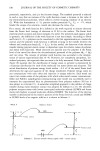
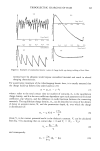
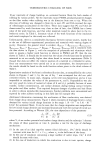
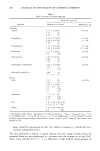
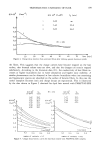
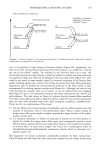
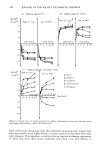
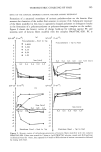
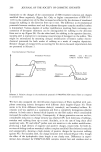
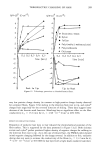
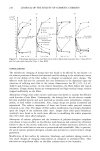
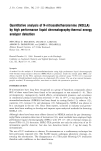
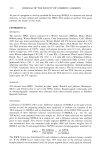
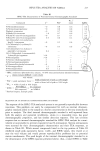
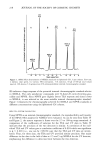
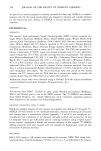
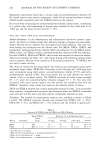
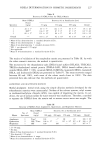
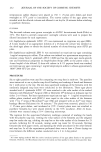
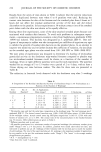
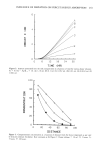
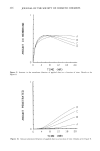
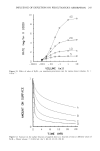
204 JOURNAL OF THE SOCIETY OF COSMETIC CHEMISTS case, a PC probe was chosen as the rubbing material since it is characterized by a value of work function very close to keratin. Therefore, it should be sensitive to very small changes of the electrochemical potential of the fiber surface produced by adsorption of cationic polymer. Experimental data obtained by rubbing hair fibers in the direction from root to tip indicate that the formation of a complete mono- or multilayer of adsorbed cationic polymer, which corresponds to the highest concentration of treatment solution 1 g/dl (34), reverses the sign of the generated charge (untreated fiber charges positively against PC when rubbed in the direction from root to tip, Figure 3). Lower concentration treatments decrease only the rate of positive charge accumulation (Figure 7). When PMAPTAC-modified fibers are rubbed in the direction from tip to root, negative charges are transferred to the fiber surface (Figure 7). Low concentration treatments, which correspond to incomplete surface coverage, produce high negative charge densities of 6-7 ß 10 -9 C/cm 2, while high concentration treatments result in low charge density of about 1.5' 10 -9 C/cm 2. Since the results of rubbing in the direction from root to tip suggest that the adsorbed cationic polymer layer has acceptor properties, the low charge densities observed at high concentration treatments suggest that increased conductivity of the fiber and/or lower rate of charge generation have to be the explanation of this result, since the charge generation and dissipation are com- petitive processes. The data of charge decay measurements are given in Figure 8. As the concentration of ionic species on the surface is increased, the charge decays become faster. The curves obtained at intermediate concentration treatments were exponential, which enabled the calculation of the first-order decay rate constants. Very low (0.001% treatment) and very high (1.0% treatment) surface coverage by the cationic polymer results in either slow or fast non-exponential discharge. Q/A.10 9 (C.em -2) RH = 24% 7 5 4 3 1 Time [min] 0 2 4• -1 -2 -3 • / O 0.001% l/ • 0.01% t ß 1.0% -5 -6 -7 Figure 8. Ch•ge dec•7 k•oe[•c cu[•es •o[ h•[ •e•[ed •[ •[•ous cooceo[[•doos o• P•AP•AC soludoo.

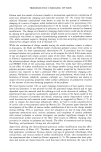
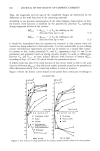
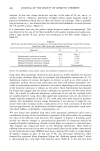
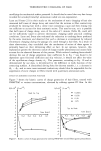
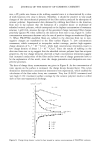
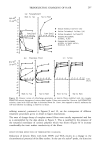
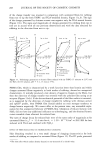
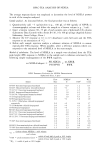
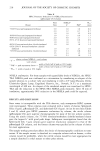
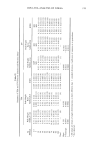
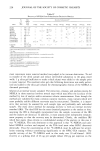
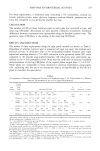
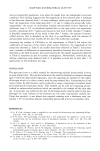
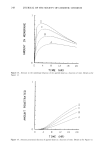
TRIBOELECTRIC CHARGING OF HAIR 205 EFFECT OF THE COMPLEX ADSORBED CATIONIC POLYMER-ANIONIC DETERGENT Formation of a saturated monolayer of cationic polyelectrolyte on the keratin fiber reverses the character of the surface from artionic to cationic (34). Subsequent exposure of the fibers modified in this way to oppositely charged polymers or detergents results in the formation of a polymer-polymer or polymer-detergent complex on the surface. Figure 9 shows the kinetic curves of charge build-up for rubbing against PC and stainless steel of keratin fibers modifed with the complex PMAPTAC-SDS. PC is Q/A.10 9 (C,½m '2) ß 0.001%' 6 ß 0.01% 5 • 0.1% 0 0.5% ß 1.0% 2 1 0 • 0.2 0.4 -1 -3 _a, -5 -6 Q/A.10 9 (C-cm -2) 6 5 3 2 1 0 -1 -2 -3 -5 -6 (a) Q/A.10 9 (oeoem-2) Polycarbonate - Root to Tlp Polycarbonate -Tlp to Root Time [min] i I ' -' 0.6 0.8 1•0 _ 2 (b) 6 5 4 3 2 1 o -1 -2 -3 -5 -6 6 5 2 ] 0.:6 o...8 1 0 o -1 -2 -3 -5 -6 Stainless Steel - Root to Tip 0.2 0.4 0.6 0.8 1.0 I I I i i (C.cm -2) Time [min] Time [min] I I I I I 0.2 0.4 0.6 0.8 1.0 Figure 9. Kinetic curves of tribocharge generation of keratin fibers modified with the complex PMAPTAC-SDS. Fibers were treated for 2 hours in lg/dl PMAPTAC solution, rinsed with H20 and kept in deionized water for 1 hour, then exposed for 4 hours to SDS solutions of various concentrations followed by rinsing with H20. Stainless Steel - Tip to Root
Purchased for the exclusive use of nofirst nolast (unknown)
From: SCC Media Library & Resource Center (library.scconline.org)