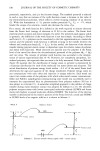
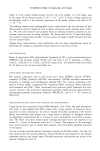
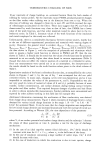
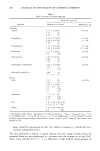
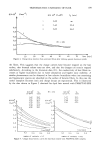
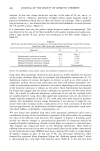
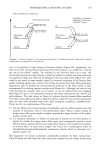
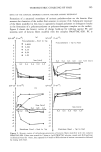
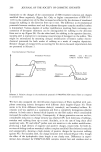
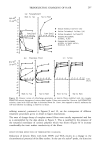
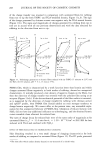
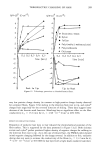
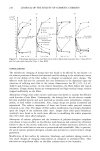
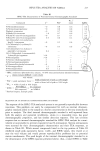
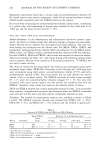
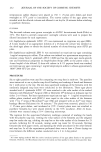
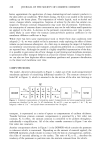
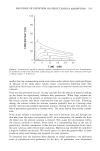
238 JOURNAL OF THE SOCIETY OF COSMETIC CHEMISTS better approximate the application of many dermatological and cosmetic products to the skin under use conditions. With finite dosing, the skin is not soaked in the material making up the donor phase. The evaporation of volatile liquids, such as alcohol and water, changes vehicle composition. Sorption of solvent by the skin has similar con- sequences. Stratum corneum desquamation may cause loss of permeant. Furthermore, the assumption of constant donor concentration may not be valid when small quantities are applied to the skin. A decrease in the permeant concentration over time is partic- ularly likely in cases where the stratum corneum/vehicle partition coefficient or the membrane diffusion coefficient is large. While there has been some experimental work in which finite dose conditions were adopted (2-4), we were unable to find a systematic study exploring the effect of donor volume on percutaneous absorption. As a first step in assessing the impact of depletion on membrane concentration and transport, simulations performed on a computer model are reported here. Although the model is a highly simplified representation of the skin, it is possible to gain some idea of how changes in partitioning and membrane resistance to permeation affect transport behavior as a function of donor volume. Using the model, we can also see how depletion affects membrane gradients and permeant distribution in the donor and membrane over time. COMPUTER MODEL The model, depicted schematically in Figure 1, makes use of the multicompartmented membrane approach of mimicking diffusional transfer (5). The stratum corneum (la- beled SC in Figure 1), which is assumed to be the section of the skin rate limiting to SC KS DONOR •- Figure 1. Schematic representation of simulation model. Compartments and intercompartmental transfer processes are described in the text. In all simulations, K^ and K_^ were set equal to 1 hr -•, K s was assigned a value of 2 hr- 1 and initial donor concentration was 10 mg/ml. transport, is represented as a series of spaces or compartments of uniform thickness. Transfer between stratum corneum compartments is governed by a first order rate constant, K. In effect, the stratum corneum is considered to be uniform throughout, undoubtedly a simplification. All of the other transfer constants in Figure 1 are also first order rate constants. Another compartment shown in Figure 1 is the DONOR which contains the permeant in whatever vehicle is envisioned. Depending on the amount of material applied, the DONOR represents a bulk volume in contact with the skin or a homogeneous, uniform, thin film of material adhering to the surface. The ratio of K• to K_• describes the tendency of the permeant to partition into the stratum corneum from the vehicle.

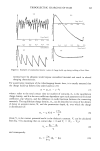
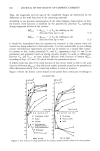
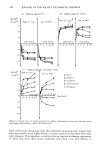
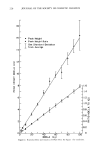
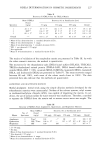
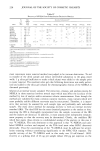
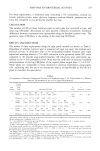
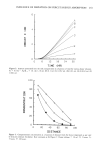
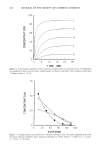
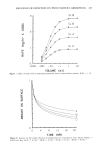
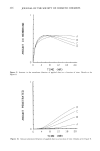
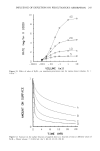
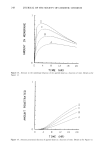
INFLUENCE OF DEPLETION ON PERCUTANEOUS ABSORPTION 239 In the model, the viable epidermis and dermis are combined into a single compartment labeled AQ. From AQ, passage takes place into a SINK, intended to represent the blood. The volume of the donor compartment can be changed at will. By varying the donor volume while the other parameter values are kept constant, we are in effect assuming that compositional changes within the donor due to evaporation, solvent sorption, and other factors do not take place after application. At this stage of model development, solvent transport through the skin and its possible effect on permeant transfer are not considered. We also neglect differences in stratum corneum hydration that may be dependent on donor volume, particularly if the vehicle is aqueous. Finally, the model shown in Figure 1 contains only a single permeation pathway, so that simultaneous transport through shunt pathways is ignored. Notwithstanding these restrictions, it is possible to get useful information on permeant depletion and on the consequences of depletion with regard to skin transport from the simulations. The symbol M is used to represent the amount of permeant in a compartment, while compartment volume is represented by V. Compartments are identified by subscripts the stratum corneum compartments are numbered from 1 to 5, starting at the donor side. The donor compartment is represented by D, the AQ compartment by A, and the sink by S. All of the stratum corneum compartments have the same volume, denoted as V•. The following equations describe the rate of change of the amount of permeant in each compartment: dMD/dt = K_•M• -- KiMDV1/V D (1) dM•/dt = K•MDV•/VD + K(M2 -- M1) - K_•M1 (2) dM/dt = K(M i_1+ Mi+I - 2Mi) where j = 2,3,4 (3) dMs/dt = KM4 + K_^M^V1/V^- (K + K^)M 5 (4) dM^/dt = K^M 5 - (K_^V1/V^ + Ks)M^ (5) dMs/dt = KsM^ (6) K^ and K_^ were assigned a value of 1 hr-land Ks a value of 2 hr-1. Initial donor concentration was 10 mg/ml, cross sectional area was 1 cm -2, and stratum corneum thickness was 0.001 cm in all cases. The values of K and of K•/K_• were varied to represent different transport properties and partition coefficients, respectively. The equations were solved numerically and the results tabulated as a function of time. K was chosen to be smaller than the other rate constants so that transport through the stratum corneum compartments would control the overall transport rate, a situation commonly encountered in practice. Relatively large changes in the values of K_^ and Ks had only a minor effect on the amount penetrated or the concentration gradient within the stratum corneum. RESULTS AND DISCUSSION Figure 2 contains plots of the amount penetrated as a function of time for different donor volumes. For these simulations, K = 0.6 hr- • and K•/K_• = 10. With a donor
Purchased for the exclusive use of nofirst nolast (unknown)
From: SCC Media Library & Resource Center (library.scconline.org)