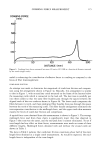
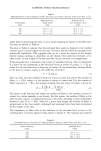
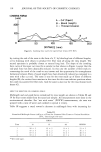
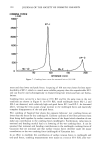
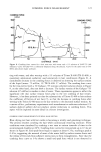
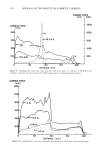
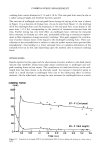
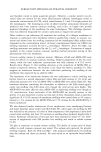
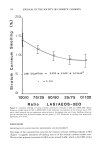
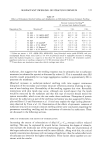
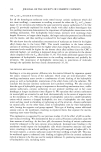
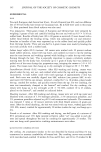
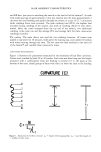
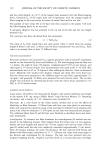
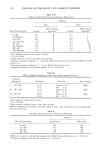
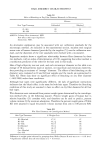
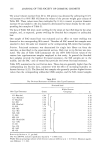
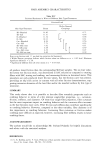
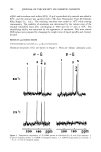
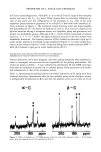
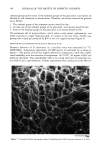
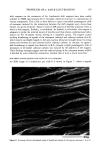
COMBING FORCE MEASUREMENT 121 COMBING FORCE (rnN) .. ?'"' ......... .^•%., •.- H20 GAF-755 i• 0 50 I00 150 200 DISTANCE (ram) COMBING FORCE (mN) - 2000 - 1500 !000 5OO Figure 8. Combing force curves for a hair tress wet with water and a 1% solution of GAF-755 (left ordinate). Curve for GAF-755 is arbitrarily displaced along the abscissa. Curve for the same tress at 65% RH is also shown (right ordinate). ting with water, and after wetting with a 1% solution of Triton X-400 (TR-X-400), a quaternary ammonium surfactant used extensively in hair conditioners (Figure 9). A considerable decrease in the combing forces is observed on lowering the surface tension of the liquid (water: 72 raN/m 1% TR-X-400:27 mN/m). The combing force curve for the tress wetted with a 1% Gafquat-755 (cationic polymer) solution shown in Figure 8, on the other hand, does not show a decrease. The surface tension of the Gafquat-755 solution (67 mN/m) is similar to that of water. These experiments appear to reflect the significant role that surface tension forces play in the wet combing of hair tresses. However, it has been pointed out that the substantivity of Triton-X-400 to hair reduces the coefficient of friction of wet hair (7), so that the decrease in combing forces after wetting with Triton X-400 may not be due entirely to the decreased surface tension. As a matter of fact, preliminary experiments with nonsubstantive surfactant solutions (1% sodium dodecyl sulfate) did not produce similar reductions in combing forces. This aspect will be explored in more detail in a future investigation. COMBING FORCE MEASUREMENTS DURING HAIR DRYING Blow drying wet hair with hot combs is becoming a widely used grooming technique. The process involves combing the hair while continuously removing moisture. These conditions were simulated by combing a wet tress at various intervals of time in the environmental chamber at 60øC. Combing force curves for time periods up to 0.3 ks are shown in Figure 10. End-peak forces begin to appear at about 0.3 ks, reaching a peak at 0.4 ks, suggesting the removal of most of the water held by surface tension forces and the release of free ends from adhesive interactions to form entanglements. Note that the combing force curve at 0 ks shows a small end-peak force which is not observed in

122 JOURNAL OF THE SOCIETY OF COSMETIC CHEMISTS COMBING FORCE (mN)- 3000 COMBING FORCE (mN) •-65%R H H , -II I I / I00 ,,'\--•- I 0 50 I00 150 200 DISTANCE (mm) - 2500 - 2000 - 1500 - I000 - 500 Figure 9. Combing force curves for a hair tress wet with water and a 1% solution of TR-X-400 (left ordinate). Curve for the same tress at 65% RH is also given for comparison (right ordinate). COMBING FORCE (mN) 12( ks 0.12 ks .:' Ill /0.18 ks ._./'--'-':/•':.-'%, ...'"' II/. ............. ""-A 3 k ' '-' "-' "' ...... •'/' I I I I ......... I I 0 50 I00 150 200 DISTANCE (ram) Figure 10. Combing force curves for a hair tress during drying at 60øC after various drying times.
Purchased for the exclusive use of nofirst nolast (unknown)
From: SCC Media Library & Resource Center (library.scconline.org)