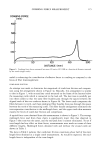
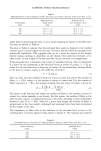
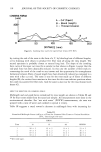
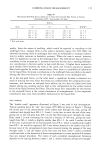
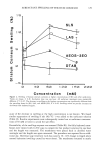
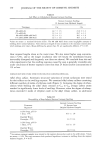
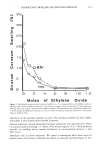
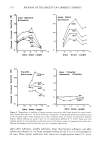
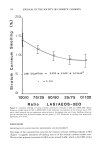
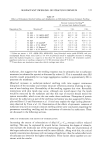
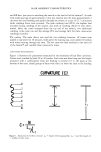
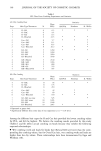
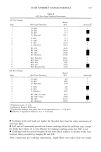
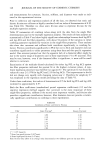
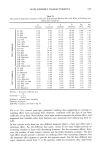
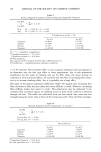
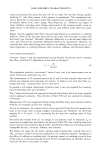
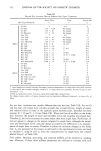
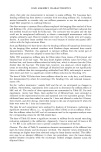
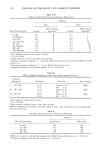
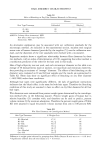
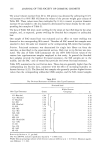
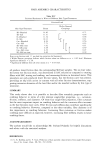
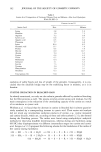
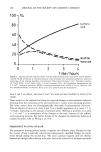
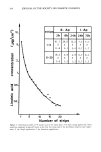
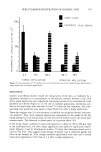
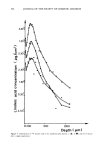
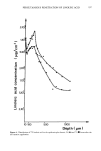
SURFACTANT SWELLING OF STRATUM CORNEUM 133 and therefore varied in molar quantities present. However, a similar pattern was ob- tained (data not shown) for the linear alkyl benzene sulfonate homologues tested at equimolar concentrations (0.07M, which varies between 2.1 and 2.8 weight percent for the homologues). The homologous series of alkyl trimethyl ammonium bromides all produced very little stratum corneum swelling, and in fact, at longer time periods produced shrinkage of the membrane for some homologues. This shrinkage phenom- enon was observed frequently for cationic surfactants at longer time periods. Other studies in our laboratory (8) examined the swelling of a collagen membrane in response to surfactants (this membrane behaves qualitatively similar to stratum cor- neum) and showed that the swelling maximum for the homologous alkyl sulfate series depended on the concentration tested. At lower concentrations (below the CMCs) the swelling maximum occurred for the C•6 homologue. However, above the CMC, the swelling maximum was produced by the C•2 or C•4 homologue. Limitations of sample numbers in the current stratum comeurn swelling method prevented testing of this phenomenon with this membrane. Crosswise swelling response by surfactant mixtures. Mixtures of LAS and AEOS-3EO were tested for effects on stratum comeurn swelling. Relative proporti•ons of the two were varied, while the total surfactant concentration was held constant at 0.15% (w/w). Results show (Figure 5) that swelling decreases as the proportion of AEOS-3EO in- creases as expected however, the decrease is not linear but shows a quadratic fit. This suggests an interaction between the two surfactants producing less swelling of the membrane than expected by an additive effect. The hypothesis of an interaction between the two surfactants to reduce swelling was further tested in a second experiment where LAS was held constant at 1% (w/w) and additional amounts (1% w/w) of AEOS-3EO or AEOS-6EO were added (Table IV). The treatment solutions containing the ethoxylates in addition to the LAS caused signifi- cantly less swelling than LAS alone even though the total actives were higher. The AEOS-6EO was more effective than AEOS-3EO at inhibiting swelling even though at 1% concentration, fewer molecules of the AEOS-6EO are actually present in the system. It is also important to point out that each of these ethoxylates causes a small but significant (P • 0.05) amount of membrane swelling when tested alone at 1% concen- tration (i.e. 5% increase for the AEOS-3EO and 2.7% increase for the AEOS-6EO by 6 hours incubation). We also observed similar interactions of two amphoterics (coco amidopropyl betaine and lauryl dimethyl amine oxide) with SLS (Table IV), where again the swelling by SLS was reduced by the presence of either of these amphoterics (the amphoterics alone both caused some swelling, less than 5 % increases in swelling above hydrated lengths after 6 hours). Surfactant interactions of this type have been reported by others (9-12). Inter- actions of amphoterics with SLS produce less swelling and result in milder systems (9,10). The efj•ct of counterions on stratum corneum swelling. The ability of various salts of lauryl sulfate to swell stratum corneum was tested. The sodium salt produced the greatest swelling response. Both the TEA and Mg 2+ salts produced significantly less swelling than the sodium salt (data not shown). All were tested on an equimolar lauryl sulfate basis.

134 JOURNAL OF THE SOCIETY OF COSMETIC CHEMISTS LINE EQUATION = 3.203 't- O.04X -I- 0.0144X r =0.93 100/0 75/25 50/50 25/75 0/100 Ratio LAS/AEOS-3EO Figure 5. Crosswise swelling of human stratum corneum by mixtures of LAS and AEOS-3EO. Ratios shown are weight ratios of LAS to AEOS-3EO. Total surfactant concentration of the mixtures was 0.15% (w/w), while ratios of the two surfactants varied as shown. Incubation time was 1 hour. Swelling values are percent increases from hydrated lengths and are means + S.D. Reduction in swelling was statistically significant, P • 0.05. DISCUSSION IMPORTANCE OF CONCENTRATION DEPENDENCE AND REVERSIBILITY The shape of the concentration curve for the stratum corneum swelling response to SLS (Figure 1) suggests saturation of binding sites or of the stratum corneum surface area. The fact that apparent saturation for SLS occurs around 8 raM, which is the CMC of this
Purchased for the exclusive use of nofirst nolast (unknown)
From: SCC Media Library & Resource Center (library.scconline.org)