j. Soc. Cosmet. Chem., 37, 177-189 (May/June 1986) Physicochemical properties and applications of and I-glycyrrhizins, natural surface active agents in licorice root extract MITSUO KONDO, HIROMI MINAMINO, GENICHIRO OKUYAMA, KEIICHI HONDA, HISANAO NAGASAWA, and YASUHISA OTANI, Cosmetics Laboratory, Kanebo, Ltd., 5-3-28 Kotobuki-cho, Odawara 250, Japan. Received August 17, 1983. Presented at the 12th IFSCC Congress, Paris, September 1982. Synopsis Physicochemical properties of [3-glycyrrhizin ([3-G, a triterpenoid saponin) and ot-glycyrrhizin (or-G, a stereoisomer of [3-G, newly developed as part of this study) were examined for cosmetic applications. Both or- and [3-G exhibited similar considerable interfacial activity. However, the aqueous solution of [3-G formed an extremely rigid gel in acidic media, whereas ot-G showed no sign of gelation. [3-G can emulsify various oily materials over a wide range of required HLB values, while ot-G has solubilizing ability for several perfume materials. A series of experiments was carried out to obtain some information on the solubilizing, emulsifying, and gelling mechanisms of or- and [3-G using •3C-NMR and scanning electron microscopy with various deriva- tives of Gs. The results suggested that the [3-G molecule which was found to be cyclically constructed constitutes the micelies which in turn orient anisotropically to form a rigid gel and to stabilize the emulsion. INTRODUCTION •3-glycyrrhizin (•3-G), a triterpenoid saponin present in licorice root extract, has been widely utilized in cosmetics owing to its excellent anti-inflammatory action (1). In addition to such characteristics, this compound was found to display unique physico- chemical behavior, particularly surface activity (2-4) and gel formation (5), even in dilute aqueous media. An isomer, (x-glycyrrhizin ((x-G, a new compound), was prepared to compare physical properties of the two isomers. The present paper deals with the surface activity, solubi- lizing and emulsifying mechanisms, and application to cosmetics of both Gs. Also, the mechanism of gelation by •3-G is discussed. EXPERIMENTAL MATERIALS (x- and [3-glycyrrhizins. (x-G was prepared by base-catalyzed isomerization of [3-G ac- 177

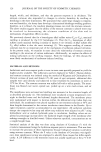
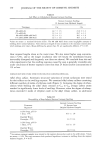
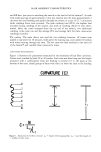
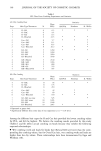
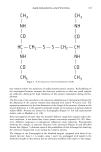
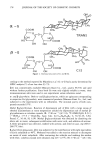
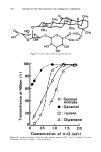
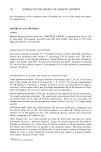
178 JOURNAL OF THE SOCIETY OF COSMETIC CHEMISTS QH ,co ¸ CH30 c'•_ 1•8••• O ,'•••-•¾' ' •',•/•• 17 •'H3 COOH • CH3 CH3 Osj_ O TANS H H / i OOH OM OM O CMa .' a •• o dh, COOH • V ¸ U H I I OH OH HOOL•co0 H H O•'Sb cH3 cIs Figure 1. Chemical structures of o•- and [•-Gs. cording to the method reported by Miyashita eta/. (6). o•-G had a purity determined by HPLC analysis (7) of not less than 93.7%. [3-G was commercially available (Maruzen Kasei Co., Ltd. purity 98.5%) and used without further purification. Since both Gs were only slightly soluble in water, their monoammonium salts were used in our experiments unless otherwise noted. a- and [•-glycyrrhetins. Both o•- and [3-glycyrrhetins, which are aglycones corresponding to respective Gs (glycosides), were commercial products (Maruzen Kasei Co., Ltd.) and subjected to the experiments with no refinement. The minimal purity of both com- pounds exceeded 97%. &lethy/ •-g/ycyrrhizinate. Reaction of dipotassium salt of •-G with a large excess of ethereal diazomethane at room temperature yielded the dipotassium salt of methyl •- glycyrrhizinate as colorless crystals IR: 1740 cm-z O/C = 0) z3C-NMR(D20): 8 52.3 (-OCH3), 177.9 (-CO2CH3). Anal. Calc. for C43H62Oz6K2: C, 56.56 H, 6.84. Found: C, 56.46 H, 6.98. Methyl •-glycyrrhizinate was obtained by dissolving the above salt in water, subsequent acidification with acetic acid, and addition of acetone. A white precipitate was collected, washed with acetone, and dried in vacuo, mp 268.0- 268.5øC (dec). [•-g/ycyrrhizin pentaacetate. •-G was subjected to the esterification with eight equivalents of acetic anhydride at 40øC. Methanol was added to the reaction mixture to decompose an excess of acetic anhydride. After evacuating the volatiles and washing the residue with ether, colorless crystals were obtained mp 225-227øC IR: 1740 cm-• O/C = O)
Purchased for the exclusive use of nofirst nolast (unknown)
From: SCC Media Library & Resource Center (library.scconline.org)