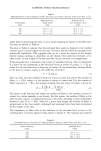
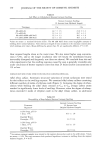
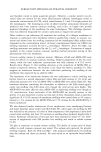
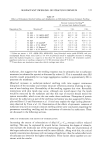
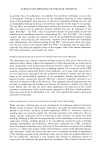
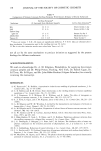
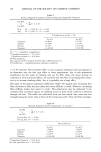
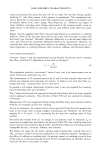
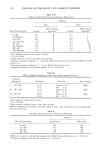
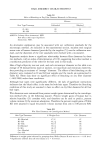
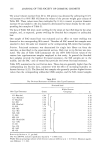
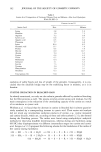
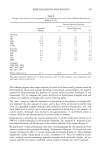
150 JOURNAL OF THE SOCIETY OF COSMETIC CHEMISTS Table ¾' Results of Regression Analysis of Hair Combing and Single-Fiber Properties Log PCL or Log ACL PCL ACL =EF, C,S,D R 2 = 0.938 P F = 0.001 R 2 = 0.947 P F = 0.001 B Coefficients:• and (P T)• log PCL log ACL Curvature + 0.80** + 0.79** Stiffness - 0.28** - 0.32** Friction + 0.16' + 0.10 NS Diameter + 0.06 NS + 0.09 NS -b •: P T = probability of significance: ** Significant beyond o• = 0.01 level. * Significant beyond o• = 0.05 level. NS Not significant. Data analyzed by Proc Stepwise and Proc Reg of SAS Institute (11). • B Coefficients = standardized partial regression coefficients. 71 to 94 microns. The treatment effect is over a greater diametral scale and appears to be dominant over the hair type effect in these experiments, but it only approaches significance for the work of combing and not for PCL. Since the major concern in cosmetics is with treatment effects, we conclude that the effect of increasing fiber diam- eter is to increase combing effort, but it is probably not a large effect. The signs of the partial regression coefficients (Table VI) suggest that increasing hair fiber curvature or fiber friction makes hair more difficult to comb. However, increasing fiber stiffness makes hair easier to comb. This observation may be explained if one considers that a primary impact on combing occurs in front of the comb as it advances through the hair. The stiffer the individual hairs the less readily they cross over and entangle along the entire tress in front of the advancing comb. Thus the fewer entangle- Table VI Multiple Regression Results Considering F, S, D and C 2 log PCL or = E F, C2, S, D log ACL For log PCL R 2 = 0.966 For log ACL R 2 = 0.974 Curvature Stiffness Friction Diameter Beta Coefficient log PCL 0.84** - 0.25'* +0.20** + 0.06 NS log ACL 0.83** - 0.29'* + 0.14'* + 0.08 NS ** Significant beyond o• = 0.01 level. NS, Not significant at o• = 0.05 level.

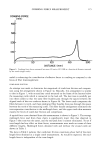
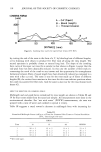
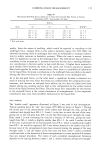
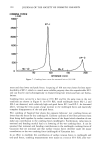
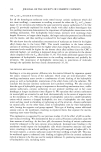
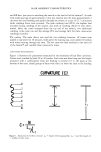
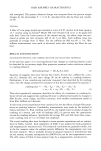
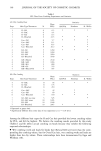
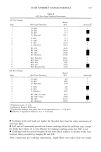
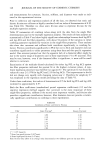
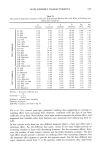
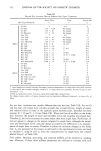
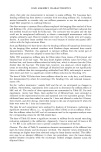
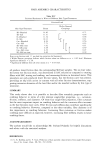
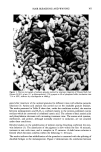
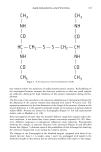
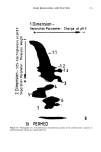
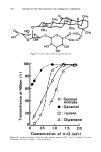
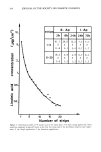
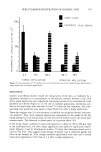
HAIR ASSEMBLY CHARACTERISTICS 151 ments encountered the easier the hair will be to comb. For the best fitting models,. involving C 2, only three percent of the variance is unexplained. This unexplained vari- ance is likely due to error and to other fiber properties not included in the model, such as cohesive effects of oil, static charge, fiber ellipticity, etc. However, the impact of these variables, including static charge (mentioned in the original model), must be small relative to the effects of curvature, friction, and stiffness under these test condi- tions. Bogaty (14) has suggested that fiber cross-sectional ellipticity is important to combing behavior. Three of the four hair types used in this study were Caucasian in origin and the fourth type Oriental. Therefore, although differences in cross-sectional shapes did exist, they were not the maximum differences likely to be encountered. However, we conclude that other than having some influence on stiffness, fiber ellipticity •per se is of lesser importance to combing behavior than curvature, stiffness, and frictional effects. SINGLE-FIBER MEASUREMENTS Curvature. Figure 1 and the experimental section describe the scheme used to measure hair fiber curvature (C). Expression (4) was used to calculate C. N c - (4) (Lc/LT) This expression provides a minimum C value of zero, and is an improvement over an earlier estimation involving Lc/L T (15). The measurement of N required practice for O and Cau hair samples where the curl pattern was irregular and sometimes not distinct. It helps to view each hair fiber as a simple sine wave, counting from crest to crest for N. In general a curl height (amplitude) of greater than 2 mm was required for counting thus microcrimps were not considered. The C values for Oriental hair approach a bimodal distribution while the kinky samples tend to approach normality. Thus the data of Table VII were not analyzed by Analysis of Variance. Measurement of C was complicated where strong interfiber forces were operative such as with the oil treatment and for wet combing. For the oil treatment, the cohesive forces were so great for O and Cau hair samples that hairs in the tresses were virtually straight, eliminating curl. Therefore, for these hair samples N = O and C = O, accounting for the very low combing loads of these systems. For kinky hair treated with oil, no change in curl pattern could be measured. L c in tresses and in single hairs was found to be the same (Table VII), but combing loads were much lower for oil treatments than for SAC. Nevertheless these two treatments provide comparable friction, curvature, stiffness, and diameter. We believe the reason for the lower combing loads of kinky hair, treated with oil vs SAC, are due to cohesive forces not employed in our correlation equation. Analogous to the effects of stiffness on combing load, the primary impact on combing occurs in front of the comb as it advances through the hair. Fewer entanglements are therefore encoun- tered and the hair is thus easier to comb.
Purchased for the exclusive use of nofirst nolast (unknown)
From: SCC Media Library & Resource Center (library.scconline.org)