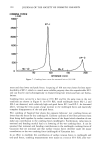
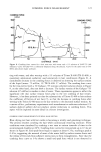
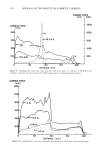
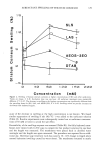
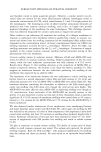
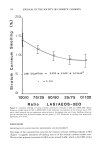
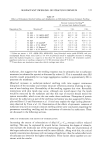
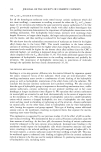
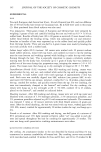
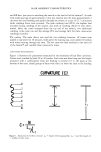
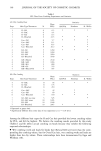
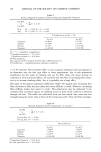
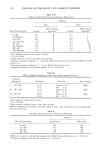
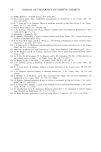
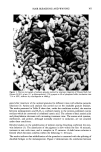
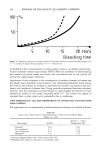
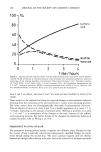
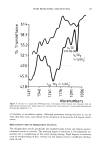
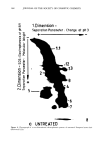
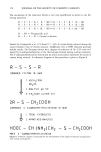
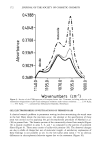
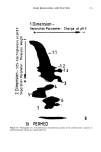
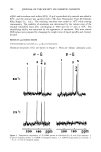
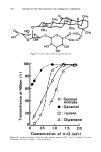
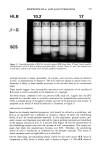
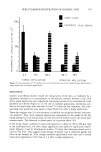
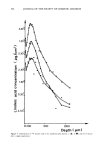
166 JOURNAL OF THE SOCIETY OF COSMETIC CHEMISTS lOO- 5'0 80- 60- 20- ,, su[fonic ucid ø •' • "'•"'••• • '•,, .'•'•.• disu monoxide I I I 1 2 3 lime / hours Figure 4. Alkaline peroxide oxidation (pH 9.5) of the model disulfide N,N'-bisacetyl-L-cystine-bismeth- ylamide (ACM). Formation of oxidation products versus treatment time (oxidation products are plotted as percentage of the original disulfide concentration) (Schumacher-Hamedat (14)). Treatment solution: 10-2mol/l ACM, 10 ml/1 H202 (35%), 0.5 ml/1 ammonia (25%), 2g/1 tetrasodium pyrophosphate pH 9.5 . 30øC. Analytical procedure: HPTLC (chloroform: methanol:acetic acid/95: 3: 5/v:v:v) detection with tert.-butylhypochlorite, o-toluidine, KI in acetic acid quantification by densitometry. areas 4 and 5 are absent, and areas 6 and 7 are weak and also modified in terms of the charge. These results can be explained as being the expected changes in electrophoretic behavior resulting from the conversion of the native proteins to cysteic acid-containing proteins. The latter cannot form the fiuorographically detectable S-carboxymethyl derivative. Thus an absence of spots (e.g. areas 4 and 5) or a weaker appearance (e.g. areas 1.1, 6, 7) results, depending on the amount of oxidized sulfur. Shifting of proteins, as in areas 1, 2, 6, and 7, is a consequence of the changes in the ionic character of the sulfonic acid-containing proteins. For further details on the changed electrophoretic behavior of oxidized keratins, refer to Wittig et al. (19). PERMANENT WAVING OF HAIR The permanent waving process usually comprises two different steps: During the first the cystine of hair is partially reduced and subsequently, disulfide bridges are oxida- tively rebuilt during the second step. The most common reagents used are alkaline ammonium thioglycollate during reduction, and acidic solutions of hydrogen peroxide

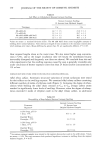
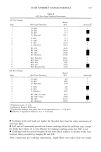
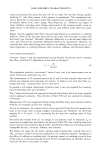
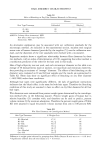
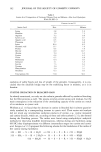
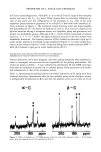
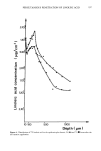
HAIR BLEACHING AND WAVING 167 58.3 55 52.1 9.0 in Vs so Vs so3 in CySO 3 L5.9 /-,.2.8 Vas $0 3 in CySO•- I I I I l m ..:!' ,,o t-- c• o "• • c'• '•- o o Wovenumbers Figure 5. Section of a single fiber FTIR-spectrum of European brown human hair measured with the high-pressure diamond cell. Upper spectrum: untreated hair lower spectrum: commercially bleached hair (Schumacher-Hamedat (17)). or bromates as reoxidation agents. Although permanent waving has been in use for more than forty years, some details of the mechanism of the process still require clarifi- cat{on. REDUCTION STEP OF PERMANENT WAVING The thioglycollate attacks specifically the disulfide bonds in hair and reduces protein- combined cystine to cysteine. The resulting degree of reduction is of fundamental im- portance for a consideration of the events during waving. High degrees of reduction cause an overprocessing of hair, whereas too low degrees result in insufficient develop- ment of curl.
Purchased for the exclusive use of nofirst nolast (unknown)
From: SCC Media Library & Resource Center (library.scconline.org)