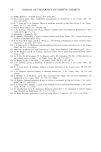
SURFACTANT SWELLING OF STRATUM CORNEUM 139 (13) (14) R. Scheuplin and L. Ross, Effects of surfactants and solvents on the permeability of epidermis, J. Soc. Cosmetic Chem., 21, 853-873 (1970). G. Imokawa, K. Sumura, and M. Katsumi, Study on skin roughness caused by surfactants: II. Correlation between protein denaturation and skin roughness, J. Am. Chem. Soc., 52, 484-489 (1975). (15) H. Durrheim, G. L. Flynn, W. I. Higuchi, and C. R. Behl, Permeation of hairless mouse skin. I. Experimental methods and comparison with human epidermal permeation by alkanols,J. Pharm. Sd., 69, 781-786 (1980). (16) R. J. Scheuplin and I. H. Blank, Mechanism of percutaneous absorption. IV. Penetration of nonelec- trolytes (alcohols) from aqueous solutions and from pure liquids, J. Invest. Dermatol., 60, 286-296 (1973). (17) H. P. Baden, N. McGilvroy, L. D. Lee, L. Baden, and J. Kubilus, Comparison of stratum corneum and hair fibrous proteins, J. Invest. Dermatol., 75, 311-315 (1980).

j. Soc. Cosmet. Chem., 37, 141-158 (May/June 1986) Prediction of hair assembly characteristics from single-fiber properties. Part II. The relationship of fiber curvature, friction, stiffness, and diameter to combing behavior C. R. ROBBINS and C. REICH, Colgate-Palmolive Research Center, Piscataway, NJ 08854. Received January 27, 1986. Presented in part at the SCC Annual Scientific Seminar, Anaheim, California, May 1984, and the 3rd International Hair Science Symposium, Syburg, West Germany, November 1984. Synopsis Results of studies are described relating force and work of quantitative combing to the single fiber proper- ties of curvature, friction, stiffness, and diameter. Tresses of straight, wavy, and kinky hair were treated with shampoo (sodium lauryl sulfate), creme rinse (stearalkonium chloride), a pomade (mineral oil/petro- latum mixture), or a hair bleach, and combed quantitatively. Fibers were then taken from the tresses, and curvature, friction, stiffness, and diameter measured. The data consisting of 27 sets of combing observa- tions, with each observation consisting of 5 to 10 replicas (tresses), were then evaluated via multiple regression analysis to relate the comparative effects of the single fiber properties to combing behavior. The results of this study indicate that curvature has the most important impact on combing and that the curvature effect increases as the hair becomes more curly. Fiber friction and stiffness also contribute signifi- cantly to combing behavior, while fiber diameter is of less importance. Increasing fiber curvature or fiber friction makes combing more difficult as expected however, increasing fiber stiffness results in lower combing forces. For pomade-type treatments, cohesive forces also serve to lower combing loads, probably by inhibiting formation of entanglements beneath the comb as it traverses through the hair in a manner analogous to fiber stiffness. INTRODUCTION A few years ago Scott and Robbins published a paper hypothesizing how changes in the behavior of hair assemblies (tresses or heads of hair) depend on changes in single-fiber properties (1). We described a matrix of relationships predicting how changes in combing ease, body, flyaway, manageability, and style retention of hair assemblies relate to changes in fiber friction, stiffness, curvature, diameter, weight, and static charge. The objective of this current paper is to describe the results of experiments done to test the hypothetical relationship between combing behavior and the relevant single-fiber properties: friction, curvature, stiffness, and diameter. 141
Purchased for the exclusive use of nofirst nolast (unknown)
From: SCC Media Library & Resource Center (library.scconline.org)