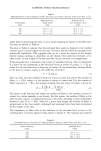
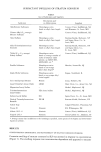
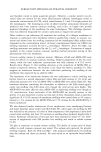
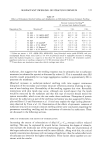
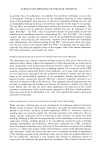
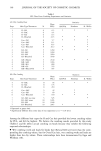
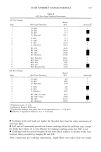
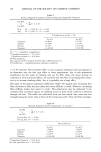
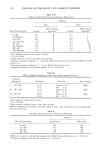
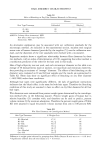
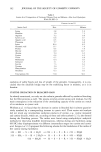
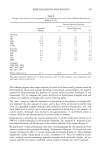
COMBING FORCE MEASUREMENT 1 17 Table I Midlength Forces in the Combing of a Hair Tress with and without Auxiliary Comb (65% RH, 2 IøC) Midlength Force, Midlength Force Tress Length Single Comb with Auxiliary Comb (mm) (mN) (raN) 100 38.2 -+ 2.9 20.6 -+ 3.9 150 33.3 -+ 2.0 20.6 -+ 2.0 200 36.3 -+ 4.9 18.6 _+ 2.0 rather than by shortening the tress, so as to avoid changing the nature of the fiber ends. The data are shown in Table II. The data in Table II indicate that the end-peak force seems to depend on the combed distance up to a certain length (in this case 150 mm), beyond which the increase is not statistically significant. This suggests that up to a point the nature of the tangles formed during combing is dependent on the distance the comb has traversed, or in other words, on the length of the free end that can get involved in entanglements. If the end-peak force is assumed to be a result of interfiber friction, then its magnitude F is given by the summation of the frictional forces at points of contact, fi = Ri where fi is the frictional force at the point of contact, R i the normal force between fibers at the point of contact, and Ix is the coefficient of friction: F = • niR i po. (1) Since in a hair tress the number of points of contact is some function of the number of fibers, n = f(N), where n is the number of points of contact and N is the number of fibers, and since n = •nl, the average end-peak force per point of contact is given by • __ • niR i • _ • niR i Ix (2) n fiN) The nature of the function that relates the number of fibers to the number of points of contact for a dense assembly is not known. For this reason, the number of fibers in the tress has been used as a normalizing factor in this work, assuming a linear relationship between n and N (n = kN). Since for a given tress length the number of fibers is proportional to the tress weight, midlength and end-peak forces have been normalized by the weight of the tress. The importance of fiber ends to the existence of the end-peak force is seen in the combing force curves for tapered tresses shown in Figure 6. The tapering was achieved Table II End-Peak Forces as a Function of Combing Distance Along the Same Tress (65% RH, 2 IøC) Combed Distance End-Peak Force (mm) (mN) 100 194 --- 15.7 150 273 + 36.0 200 286 + 36.0

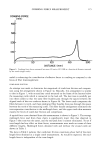
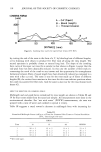
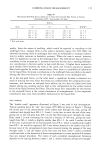
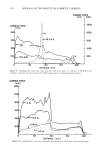
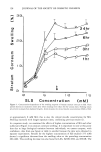
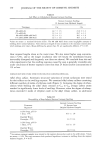
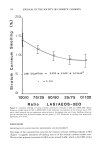
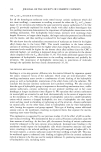
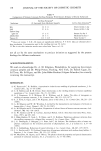
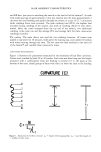
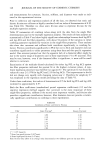
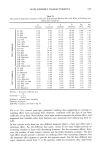
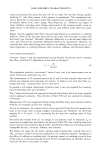
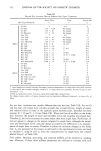
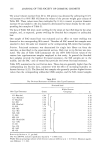
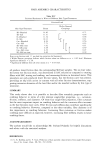
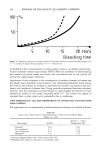
118 JOURNAL OF THE SOCIETY OF COSMETIC CHEMISTS COMBING FORCE (raN) I C- Thinned {she(•rs) 0 50 I00 150 200 DISTANCE (turn) Figure 6. Combing force curves for tapered hair tresses (65% RH). by cutting the end of the tress in the form of a V, by blending hair of different lengths, or by thinning with shears to produce free fiber ends all along the tress length. The second specimen is probably closest to natural long hair. The shape of the combing force curve of the taper cut tress (A) is similar to that shown in Figure 3 except that the end-peak force has been drastically reduced. In this case the number of fiber ends en- countering the teeth of the comb at any instant and the opportunity for entanglement formation between fibers of equal length have been drastically reduced as compared to a tress with a flat cut end. The same is true for the tress made up of fibers of different lengths (B) the various force maxima in the curve for this tress indicate positions where the comb encounters free fiber ends. And the same is also true for the tress thinned with shears (C). EFFECT OF MOISTURE ON COMBING FORCE Midlength and end-peak forces normalized by tress weight are shown in Tables III and IV for four tresses made from the same hair sample. All measurements were done in the environmental chamber. For "wet with water" (XVXVXV) measurements, the tress was sprayed with a mist of water and combed to spread it evenly. Table III suggests a trend toward a decrease in midlength force with increasing hu- Table III Normalized Midlength Forces (mN/g wt of Tress) for Untreated Hair Tresses at Various Humidities (28øC, Tress Length 140 mm) RH(%) Tress 30 65 90 WWW* 1 18 _+ 2 12 _+ 2 11 _+ 1 23 -+ 5 2 15 -+ 3 13 + 2 17 _ 1 36 + 7 3 19 -+ 2 12 _+ 2 14 + 3 48 _+ 6 4 19 + 2 18 + 4 13 -+ 4 36 -+ 4 Wet with water.
Purchased for the exclusive use of nofirst nolast (unknown)
From: SCC Media Library & Resource Center (library.scconline.org)