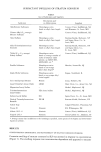
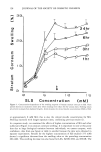
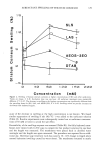
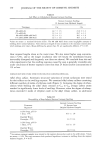
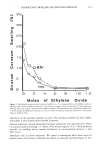
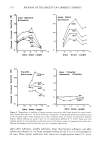
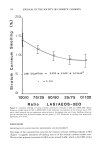
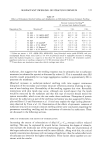
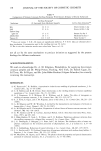
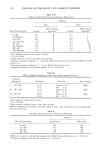
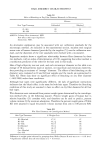
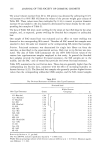
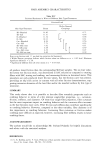
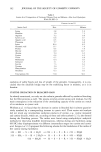
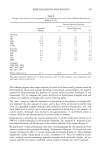
SURFACTANT SWELLING OF STRATUM CORNEUM 137 In general, then, for surfactants, we postulate that membrane shrinkage can occur due to electrostatic binding at some sites on the membrane resulting in water-repelling forces of the hydrophilic tails however, at other sites, membrane swelling can occur due to hydrophobic binding resulting in electrostatic repulsion by the negative end groups. The net effect will depend on both forces and on the structure of the surfactant. The effect of counter ions on surfactant-induced swelling may now be explained in this light. Both Mg 2+ and TEA + salts of equimolar amounts of lauryl sulfate elicited less swelling of the membrane than the corresponding Na + salt. The Mg 2+ salt is highly cationic and may crosslink the negative tails of the hydrophobically-bonded anionic surfactants, thus reducing the electrostatic repulsive forces between the hydrophilic tails. Alternatively, the reduced swelling for the Mg •+ salt of lauryl sulfate may, how- ever, be due in part to the reduced CMC. For TEA + we speculate that the large TEA + molecule may block the repulsive forces of the negative tails of the anionic surfactant. Still other mechanisms may explain the results. POSSIBLE EXPLANATIONS OF SURFACTANT INTERACTIONS REDUCING SWELLING The observation that stratum corneum swelling caused by LAS can be reduced by the addition of alkyl ethoxy sulfates and amphoterics clearly demonstrates an interaction of these components. Such interactions have been found by others (9-12) and may result from (a) competition for binding sites or binding surfaces, (b) a reduction in the CMC resulting in lower submicellar levels of free surfactant, or (c) some other association of the two surfactants, reducing either the surfactant available to interact with the mem- brane or the water-binding capability of the membrane. Faucher and Goddard (11) reported similar interactions between SLS and a nonionic surfactant (measured as a reduction in sorption of SLS to hair keratin). They suggested that this phenomenon was not due to competition for binding sites because the nonionic is sorbed very little by itself. Rather they felt that the more likely explanation was reduction in the overall monomer concentration of the mixed system compared to SLS alone. Similar explana- tions were postulated by Miyazawra eta/. (12), who explored the protein-denaturing potential of surfactants. ROLE OF SWELLING OF STRATUM CORNEUM IN THE IRRITATION MECHANISM What role does swelling play in the mechanisms of surfactant-induced irritation? Within classes of anionic and nonionic surfactants, the extent of swelling largely corre- sponds to the known irritancy of these surfactants (Table V). However, extent of swelling does not correctly predict the irritation potential of all surfactants. For ex- ample, cationic surfactants can be as irritating as some anionics, yet induce very little swelling. Swelling is thus not an important part of the mechanism of action of cationic surfactants. Clearly, swelling appears to be controlled by parameters such as binding strength, hydrophobic and hydrophilic interactions, molecular size, CMC, concentra- tion, and length of exposure time. Structure of the surfactant is important for swelling activity, i.e. alkyl chain length, degree of ethoxylation, nature of the polar head group, and counterion. Surfactant interactions also occur in mixtures resulting in modulation of the swelling response of the membrane these may be related to solution behavior of the two surfactants. Irritation is very complex and involves an additional cascade of events once the surfactant has penetrated the membrane. Thus chemical irritants may

138 JOURNAL OF THE SOCIETY OF COSMETIC CHEMISTS Table V Comparison of Stratum Corneum Swelling Response With Known Irritancy of Several Surfactants Surfactant Swelling Response •* (% Increased from Hydrated Length) In Vivo Skin Irritation ** SLS 32 - 11 Severe within 1 day LAS 21 - 6 Severe within 1 day Tallow Soap (pH 10) 17 -+ 4 Intense by day 4 AEOS-3EO 14 _+ 3 Moderate by day 5 Tween 20 0.2 _+ 0.5 None by day 5 * Values are means _+ S.D. All means are significantly different, P • 0.05. Data are obtained after 1 hour incubation. Concentration used in the swelling test was 2% (w/w). ** The in vivo skin irritation results were taken from Tavss eta/. (4). not all act by the same mechanism to produce irritation as suggested by the present findings for different surfactants. ACKNOWLEDGMENTS We wish to acknowledge Dr. A.M. Kligman, Philadelphia, for supplying the stratum corneum samples and Dr. Philip Person, Flushing, New York, Dr. Robert Cagan, Dr. Ed Tavss, Mr. Ed Eigen, and Mr. John Blake-Haskins (Colgate-Palmolive) for critically reviewing the manuscript. REFERENCES (1) K. Fernee and C. R. Robbins, A quantitative index for area swelling of epidermal membrane, J. Soc. CosmeticChem., 32, 53-54 (1981). (2) C. R. Robbins and K. M. Fernee, Some observations on the swelling behavior of human epidermal membrane, J. Soc. Cosmetic Chem., 34, 21-34 (1983). (3) G.J. Putterman, N. F. Wolejsza, M. A. Wolfram, and K. Laden, The effect of detergents on swelling of stratum corneum, J. Soc. Cosmetic Chem., 28, 521-532 (1977). (4) E. A. Tavss, E. Eigen, and A.M. Kligman, Letter to the editor, J. Soc. Cosmetic Chem., 36, 251-254 (1985). (5) A.M. Kligman and W. M. Wooding, A method for the measurement and evaluation of irritants on human skin, J. Invest. Dermatol., 49, 78-94 (1967). (6) A. M. Kligman and E. Christophers, Preparation of isolated sheets of human stratum corneum, Arch. Dermato/., 88, 702-705 (1963). (7) G. W. Snedecor and W. G. Cochran, Statistical Rlethods, 6th ed. (Iowa State University Press, Ames, Iowa, 1967), pp 419-446. (8) J. Blake-Haskins, D. Scala, L. D. Rhein, and C. R. Robbins, Predicting surfactant irritation from the swelling response of a collagen film, acceptedJ. Soc. Cosmetic Chem., 1986. (9) J. G. Dominguez, F. Balaguer, J. L. Parra, and C. M. Pelejero, The inhibitory effect of some am- photeric surfactants on the irritation potention of alkylsulphates, Int. J. of Cosmetic Sci. 3, 57-68 (1981). (10) R. L. Gotdemberg, Reduction of topical irritation, J. Soc. Cosmetic Chem., 28, 667-679 (1977). (11) J. A. Faucher and E. D. Goddard, Interaction ofkeratinous substrates with sodium lauryl sulfate: 1. Sorption,J. Soc, Cosmetic Chem., 29, 323-337 (1978). (12) M. Miyazawra, M. Ogawa, and T. Mitsui, The physico-chemical properties and protein denaturation potential of surfactant mixtures, Int. J, of Cosmetic Sci., 6, 33-46 (1984).
Purchased for the exclusive use of nofirst nolast (unknown)
From: SCC Media Library & Resource Center (library.scconline.org)