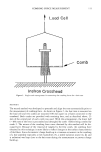
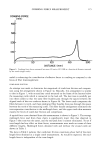
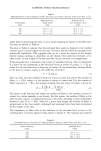
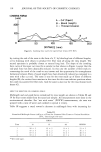
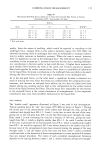
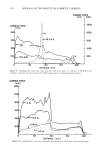
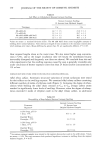
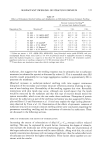
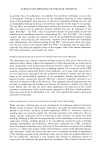
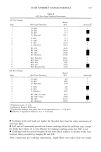
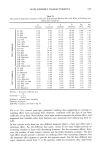
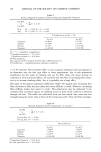
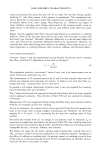
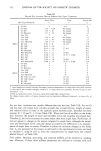
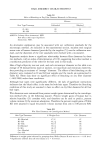
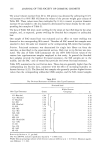
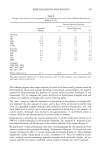
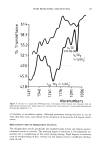
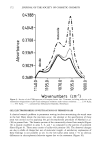
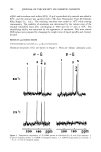
COMBING FORCE MEASUREMENT 119 Table IV Normalized End-Peak Forces (mN/g wt of Tress) for Untreated Hair Tresses at Various Humidities (28øC, Tress Length 140 mm) RH(%) Tress 30 65 90 WWW* 1 192 ñ 21 175 ñ 22 130 q- 16 51 ñ 4 2 307 ñ 44 238 ñ 23 221 ñ 23 56 ñ 7 3 241 ñ 15 227 ñ 33 232 ñ 36 46 ñ 3 4 305 ñ 18 262 ñ 22 293 ñ 49 39 ñ 3 * Wet with water. midity. Since the extent of swelling, which would be expected to contribute to the midlength force, changes little in this relative humidity region (30-90% RH), the observed decreasing trend in midlength force may be attributable to increased lubrica- tion by surface moisture as humidity increases. When the tress is wetted, however, there is a significant increase in the midlength force. The three factors that are likely to contribute to this increase are 1) increase in hair-hair friction due to swelling (deforma- rive contribution to friction) and/or in hair-comb friction, 2) higher forces required to pack swollen fibers between the teeth of the comb, and 3) forces required to separate fibers held together by surface tension forces. Since there is a possibility of lubrication by the liquid film, frictional contributions to the midlength force are likely to be small, leaving the other two factors to be the major contributors to the midlength force. As to the end-peak forces, on the other hand, a significant decrease is observed as a result of wetting the tress. Since the tresses are combed before the combing force mea- surement, this decrease in end-peak force reflects, the fact that the fibers have been aligned during pre-combing and are held in that configuration by the surface tension forces of the liquid between the fibers. Thus the major force responsible for the decrease in the end-peak forces is the virtual elimination of entanglements. A less important contribution may come from interfiber lubrication by the liquid film. WET COMBING The "double comb" apparatus illustrated in Figure 2 was used in this investigation. Typical combing forces for "dry" hair tresses (30% RH) are shown in Figure 7. During the initial part of the measurement, both combs slide through the tress, giving the combined mid-length force ML-1,2. Comb 1 is the first to reach the end of the tress, giving rise to the end-peak force EP-1 as the free fiber ends move through the comb. Only comb 2 is now traversing the tress for a distance of 100 mm, giving the mid- length force ML-2, which is slightly smaller than ML-1,2. As comb 2 reaches the end of the tress, it generates the second end-peak force EP-2, which is significantly smaller than EP-1. As would be expected, EP-2 was always observed to be smaller than EP-1 because most of the entanglements have been removed during the passage of the tress through comb 1, and the release of the free tress end from comb 1 under controlled conditions leads to the formation of fewer entanglements in a more reproducible manner than any manual procedure. The extent of such controlled entanglement formation depends on the spacing between combs 1 and 2, shorter distances giving less entangle-

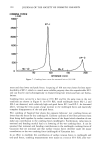
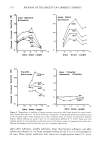
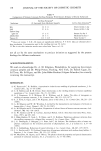
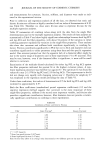
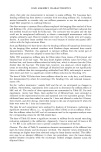
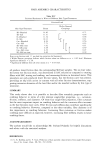
120 JOURNAL OF THE SOCIETY OF COSMETIC CHEMISTS COMBING FORCE (raN) 3000-- 2500 1500 I000 EP-i ML- t,2 ML-2 EP-2 50 I00 150 DISTANCE (mrn) Figure 7. Combing force curves for untreated hair at 30% RH. 200 ment and thus lower end-peak forces. A spacing of 100 mm was chosen for best repro- ducibility of EP-2, which is a much more reliable property than the unpredictable EP-1 and can thus be used advantageously in characterizing hair tresses and hair care formu- lations. Combing force curves for a hair tress at 65% RH and for the same tress in the wet condition are shown in Figure 8. At 65% RH, small midlength forces ML-1,2 and ML-2 are observed, with relatively high end-peak forces EP-1 and EP-2. As discussed above, wetting the tress causes a large increase in the midlength forces and essentially complete disappearance of the end-peak forces. Wet combing of Negroid hair shows the opposite behavior: wet combing forces are lower than the forces for dry combing (6). Extreme curliness of the fibers prevents them from being held together by surface tension forces of the liquid which therefore do not make any contribution to the combing forces (midlength). Furthermore, reductions in torsional and bending moduli lead to a lowering of the wet combing force. It can be assumed that torsional and bending contributions to the midlength combing forces of Caucasian hair are minimal and that surface tension forces therefore make the major contribution to the wet combing force (midlength) of Caucasian hair. In an effort to establish the contribution of surface tension forces to midlength and end-peak forces, combing measurements were made on a tress at 65% RH, after wet-
Purchased for the exclusive use of nofirst nolast (unknown)
From: SCC Media Library & Resource Center (library.scconline.org)