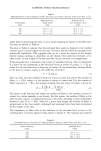
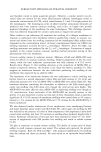
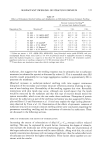
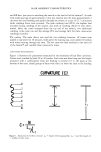
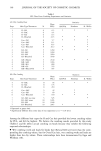
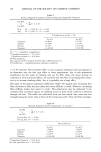
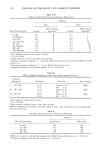
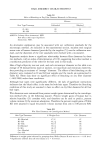
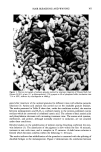
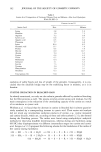
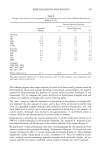
160 JOURNAL OF THE SOCIETY OF COSMETIC CHEMISTS and the cortex proteins as well. This is often referred to as bleaching or oxidative damage. The bleaching reagents most often utilized are aqueous solutions of hydrogen peroxide adjusted to pH values between 9 and 11. Although this treatment has been carried out in practice for several decades, there are relatively few older publications concerned with chemical or mechanical data on bleached human hair. There are, however, numerous articles on the subject of bleaching of wool, but this process is carried out at elevated temperatures in neutral or slightly alkaline media. Consequently it is not possible to transfer these findings to the substrate human hair. One of the first comprehensive reviews on the mechanism and kinetics of bleaching of hair was given by Wolfram et al. (1), including different aspects of irreversible changes in melanin and hair due to the treatment. Reaction of the bleaching reagent with the keratin protein as an unwanted simultaneous side reaction was also described earlier by Zahn (2). Newer results in this field from the German Wool Research Institute include a mild procedure for isolating melanin, bleaching experiments on isolated melanin with special attention to the dissolution of the melanoproteins, further evidence for intermediate oxidation products of cystine in bleached hair, and analysis of keratin proteins of bleached hair by two-dimensional gel electrophoresis. ISOLATION OF MELANIN AND ITS PROTEIN COMPONENT Giesen (3) has worked out conditions for an enzymatic digestion of human hair which allows the isolation of intact melanin granules (Figure 1). Using papain as the enzyme of choice, the investigator found a melanin content of 3.4%-3.5% on the weight of hair in different black human hair fibers, originating from India, China, and Europe. The protein content of the enzymatically isolated pigments ranged from 23-33%. This is considerably higher than the amount of 9.4% reported by Hall et al. (4). This dis- crepancy is conceivably due to the fact that the latter authors used a more destructive isolation method. Comparison of the amino acid composition of the protein found in the melanin granule (denoted as melanoprotein) with that of the total hair fibers, as given in Table I, shows obvious differences (3). Whereas the content of the basic amino acids lysine, arginine, histidine, as well as of glycine and tyrosine, is elevated in the proteins of the granules, the concentration of glutamic acid, serine, threonine, cystine, and proline is lower compared to the fiber keratins. BEHAVIOR OF MELANIN DURING THE BLEACHING PROCESS There have been numerous investigations on the modification of the fiber proteins during alkaline peroxide bleaching (2,5- 10) but few reports about the influence of this process on the melanin. One important study was by Wolfram et al. (1), who found that the bleaching reaction occurs in two steps: The initial solubilization of the granules is followed by the decolorization of the dark brown solubilized pigment. In our institute, changes in composition of the melanoprotein component were investi-

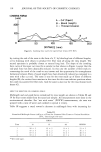
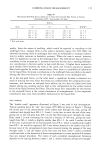
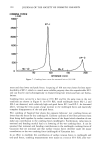
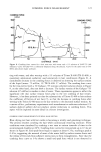
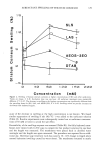
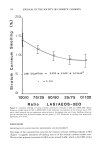
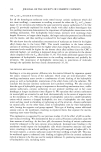
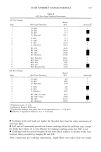
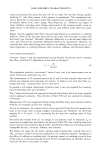
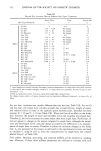
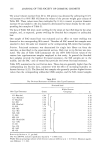
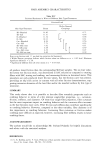
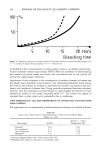
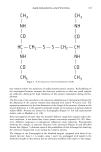
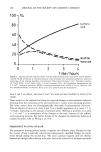
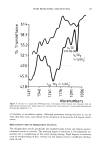
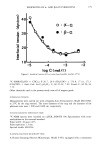
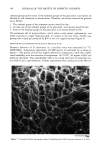
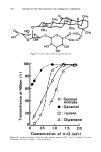
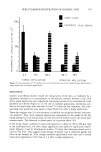
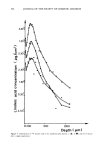
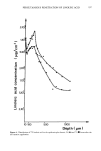
HAIR BLEACHING AND WAVING 161 • .• • •? • •. •- /' • • :: -' ..•" -'" " .- "'2 • • Figure 1. Electon micrograph of melanin granules isolated by enzymatic digestion of Chinese black hair (Giesen (3)) (0.3 g hair, O. 1 g dithioerythritol, 2.58 g papain in 40 ml phosphate buffer incubation time 72 h at 50øC isolation by centrifugation at 4000 g). gated after treatment of the isolated granules for different times with alkaline peroxide solutions (3). Amino acid analysis was carried out on the insoluble granule residues. The results presented in Table II show that, under the conditions studied, the reaction between melanoprotein and H202 is confined mainly to the protein-combined cystine residues which are converted to combined cysteic acid. The content of basic amino acids and phenylalanine decreases with increasing treatment time. The amino acids tyrosine, methionine, and proline, although normally sensitive to oxidation, are not attacked under these conditions. Detailed studies on the solubilization of melanin during bleaching confirmed the step- wise behavior (3). The dissolution of the pigment is slow within the first 10 minutes, increases in rate with time, and is complete in 25 minutes. A dark brown solution is formed which becomes colorless within the following 5-10 hours. The results indicate that solubilization of the granules is connected with the splitting of disulfide bridges in the melanoprotein. Figure 2 demonstrates the correlation between
Purchased for the exclusive use of nofirst nolast (unknown)
From: SCC Media Library & Resource Center (library.scconline.org)