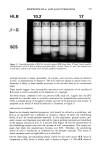
174 JOURNAL OF THE SOCIETY OF COSMETIC CHEMISTS SUMMARY Hair was modified cosmetically by bleaching and by perming treatments and subse- quently examined using new and advanced analytical techniques. 1. Melanin was isolated from hair of various origins by enzymatic digestion in the presence of dithiothreitol. The protein content of the melanin granules ranged from 23-33%. The chemical resistance of the pigment was shown to be connected to the number of disulfide crosslinks in the melanoprotein. 2. Investigations on intermediate oxidation products of cystine have been performed using a peptide model. High performance thin layer chromatography was used in sepa- ration of the oxides. The existence of cystine monoxide even in alkaline medium was shown. 3. An increase in intermediate oxidation products after cosmetically modifying the hair was confirmed by FTIR as well as by the determination of the apparent cysteic acid via hydrolysis, this being the difference between the amounts of cysteic acid after hydro- lyzing with and without the addition of a reducing agent. 4..Gel electrophoresis was applied in order to analyze changes in proteins from un- treated and cosmetically modified hair. The method used gave reproducible results based on investigation of more than one hundred different single hair samples. The keratin patterns of bleached hair differ from those of untreated hair and the changes can be explained by the conversion of some hair proteins to cysteic acid-containing proteins. Permanent waving also causes alteration in the pattern of the proteins but to a lesser extent. 5. Degrees of reduction were estimated after the first waving step by S-carboxymethy- lation of cysteine and subsequent determination of the derivative by amino acid anal- ysis. During the subsequent peroxide treatment, 91% of the broken cystine bonds were rebuilt, the waving process being close to that used in practice. After permanent waving of hair, incomplete resynthesis of disulfide bonds and a small loss of material are observed as aspects of hair damage due to the process. 6. Solubilized material was isolated from the treatment liquor after the reduction step of permanent wave'treatment. It consists of hydrophilic, water soluble, and hydro- phobic, methylene chloride-soluble components, totalling about 8% of the hair weight. Analyses performed indicate that the cell membrane complex is an important source of the material in both fractions. REFERENCES (1) L. Wolfram, K. Hall, and J. Hui, The mechanism of hair bleaching, J. Soc. Cosmet. Chem., 21, 875-900 (1970). (2) H. Zahn, Chemische Vorgiinge beim Bleichen von Wolle und Menschenhaaren mit Wasserstoffper- oxid und Peroxysiiuren, J. Soc. Cosmet. Chem., 17, 687-701 (1966). (3) M. Giesen, Beltrag zur Kenntnis des Melanins in Keratinfasern, Thesis, Rheinisch-Westoeilische Tech- nische Hochschule, Aachen (1981). (4) K. Hall and L. Wolfram, Application of the theory of hydrophobic bonds to hair treatments, J. Soc. Cosmet. Chem., 28, 231-241 (1977). (5) E. EliSd, H. Nowotny, and H. Zahn, Die Einwirkung von Wasserstoffsuperoxid auf Wolle, Melliand Textilber, 23, 313-316 (1942). (6) I. E. Weber, Hydrogen peroxide bleaching,J. Soc. Dyers Co/our, 39, 209-214 (1923).

HAIR BLEACHING AND WAVING 175 (7) (8) (9) (lO) (11) (12) (13) (14) (15) (16) (17) (18) (19) (20) (21) (22) (23) (24) (25) N. C. Wilson, The scientific aspects of bleaching, II. Wool, Textile J. Australia, 15, 496-498 (1941). G. Laxer and C. S. Whewell, The measurement of damage produced by treatment of wool with solutions of hydrogen peroxide, J. Soc. Dyers Color, 68, 256-257 (1952). H. Zahn, Chemische Ver•inderungen von Wolle beim Waschen, D•impfen und Bleichen, Textil- Rundschau, 19, 573-584 (1964). K. Ziegler, Neue Ergebnisse fiber das Bleichen von Wolle, Textil Praxis, 17, 376-380 (1962). C. R. Robbins, in: Chemical and Physical Behavior of Human Hair (van Nostrand Reinhold Company, New York, 1979), pp 69-71. W. E. Savige and J. A. MacLaren, "Oxidation of Disulfides, With Special References to Cystine," in: The Chemistry of Organic Sulfur Compounds, N. Kharasch Ed. (Pergamon Press, Oxford, 1966), Vol. 2, pp 367-4O2. J. F6hles, U. Schumacher-Hamedat, and H. Zahn, Methode einer differenzierten Cysteins•iurebes- timmung in sauren Totalhydrolysaten, International Wool Textile Organization (IWTO) Report No. 12, Copenhagen Meeting (1983). U. Schumacher-Hamedat, Modellstudien zur Entstehung yon part ell oxidierten Cystinderivaten be oxidativer Veredlung von Wolle, Thesis, Rheinisch-Westf•ilische Technische Hochschule, Aachen (1985). B. J. Sweetman, J. Eager, J. A. MacLaren, and W. E. Savige, A study of partial oxidation of the disulphide groups in wool, Proc. Int. Wool Text. Res. Conf. Paris, 1965, II, 85-97. J. Nachtigal and C. Robbins, Intermediate oxidation products of cystine in oxidized hair, Text. Res. J., 40, 454-457 (1970). U. Schumacher-Hamedat, to be published. R. C. Marshall and J. M. Gillespie, Comparison of samples of human hair by two dimensional dec- trophoresis, J. Forensic Sci. Soc., 22, 377-385 (1982). M. Witrig, I. Bindewald, R. C. Marshall, M. Stein, and H. Zahn, Two dimensional keratin patterns of single human hair fibres, Proc. 8th Austr. Intern. Forensic Sci. Symp., Perth Western Australia (1983). J. M. Gillespie and R. C. Marshall, "The Proteins of Normal and Aberrant Hair Keratins," in: Hair Research, C. E. Orfanos, W. Montagna, and G. St6ttgen, Eds. (Springer Verlag, Berlin, Heidelberg, New York, 1981), pp 76-83. J. G. Gumprecht, K. Patel, and R. P. Bono, Effectiveness of reduction and oxidation in acid and alkaline permanent waving, J. Soc. Cosmet. Chem. 28, 717-732 (1977). A. StrfilBmann, Deutsches Wollforschungsinstitut, Internal Project Report (1983). H. Zahn, T. Gerthsen, and M. L. Kehren, Anwendung schwefelchemischer Analysenmethoden auf dauergewelltes Haar, J. Soc. Cosmet. Chem., 14, 529-543 (1963). J. Chao, E. Newsom, and I. Wainwrite, Comparison of the effects of some reactive chemicals on the proteins of whole hair, cuticle and cortex, J. Soc. Cosmet. Chem., 30, 401-413 (1979). I. Bindewald, R. Greven, R. C. Marshall, M. Stein, G. Stephan , M. Witrig, and H. Zahn, Deutsches Wollforschungsinstitut, Internal Report for Bundeskriminalamt (1984).
Purchased for the exclusive use of nofirst nolast (unknown)
From: SCC Media Library & Resource Center (library.scconline.org)