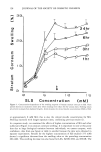
j. Soc. Cosmet. Chem., 37, 125-139 (May/June 1986) Surfactant structure effects on swelling of isolated human stratum corneum L. D. RHEIN, C. R. ROBBINS, K. FERNEE, and R. CANTORE, Colgate-Pahnolive Research and Development Center, 909 River Road, Piscataway, NJ 08854. Received November 8, 1985. Presented at the Society of Cosmetic Chemists' Annual Meeting, New York, December 5-6, 1985. Synopsis Many surfactants in solution induce swelling of isolated human stratum corneum beyond that of water (1-3). The highest levels of swelling observed were for anionic surfactants, and very little swelling occurs with cationics and nonionics (3). Stratum corneum swelling is frequently accompanied by curling of the membrane edges (4). We have now extended these studies to examine effects of other surfactants on swelling of stratum corneum. Swelling caused by surfactants increased with time, was concentration-dependent, was saturable with in- creasing concentration, and was reversible. Apparent saturation for sodium lauryl sulfate (SLS) occurs near the critical micelie concentration. The extent of swelling was reduced with increased ethoxylation of alkyl (C12-C14) sulfate. When Mg 2+ or triethanolamine were the counter ions rather than Na +, swelling by lauryl sulfate was reduced. For homologous series of various anionic surfactants (alkyl benzene sulfonates, alpha olefin sulfonates, alkyl sulfates, and paraffin sulfonates), maximal swelling occurred at either C 12 or C14 carbon atoms. For cationic surfactants, membrane shrinkage rather than swelling occurred at the longer incubation times. Surfactant interactions to reduce swelling were found, e.g. addition of alkyl ethoxy sulfates or amphoterics to SLS produced less swelling than the SLS alone. The results suggest mechanisms of action and a basis for in vivo irritancy of surfactants. INTRODUCTION It has been demonstrated (.1-3) that surfactants in solution induce swelling of isolated stratum corneum. For some surfactants swelling is accompanied by curling of the edges (4). Putterman et al. (3) examined the effects of a variety of surfactants on swelling of guinea pig stratum corneum. They reported that the highest levels of swelling were induced by the artionic surfactants, sodium laurate and sodium lauryl sulfate (SLS), while very little swelling was induced by cationic and nonionic surfactants. They con- cluded that swelling of stratum corneum results from a reversible conforrnational change due to cooperative binding of the detergent. It has also been suggested by Putterman et al. (3) that the micellization state of the surfactant solution may con- tribute to these swelling effects the concentration of free monomer varies depending on the critical micelle concentration. Some of us (2) previously studied the swelling response of human stratum corneum in more detail and found that in water and SLS solution the stratum corneum swells in 125

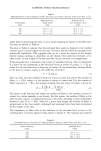
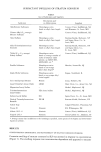
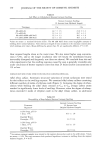
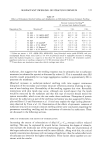
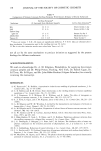
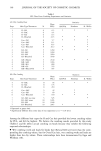
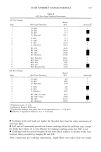
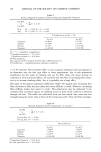
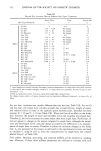
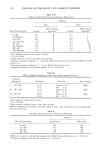
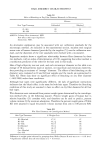
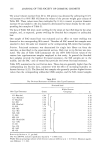
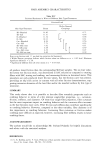
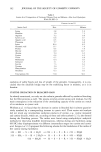
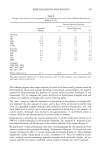
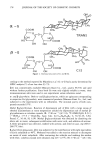
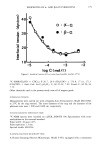
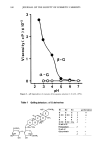
126 JOURNAL OF THE SOCIETY OF COSMETIC CHEMISTS length, width, and thickness, and that the greatest response is in thickness. The stratum corneum also responded to changes in relative humidity by swelling or shrinking in the three dimensions. We postulated that under large changes in tempera- ture and humidity, the horny layer develops a dimensional shrinkage-swelling gradient therefore, as it is flexed, the resultant shearing stresses can crack the stratum corneum. The above studies suggest that the ability of the stratum corneum to absorb water may be involved in determining the ultimate condition of the skin and in mechanisms of ingredient effects on skin. We previously showed that for a homologous alkyl sulfate series (C 8 to C•6) , maximal swelling is produced by the C12 homologue (2). That the C•2 homologue of alkyl sulfates causes maximal swelling is similar to known in vivo irritancy of alkyl sulfates (the C•2 alkyl sulfate is also the most irritating) (5). This suggests swelling of stratum corneum may be an important part of the mechanism of surfactant-induced irritation. In the present study, we examine in more detail the relationship of stratum corneum swelling to the structure of various surfactants. Additionally, we explore the effects of mixing surfactants on the swelling response. From the findings, we then discuss the most likely mechanism(s) of surfactant-induced swelling. MATERIALS AND METHODS Surfactants used were reagent grade or were in some cases specially prepared to yield the highest purity available. The surfactants used are displayed in Table I. Human abdom- inal stratum comeurn was isolated using the method of Kligman and Christophers (6). Vertical sections of male and female (25-80 years of age) autopsied, abdominal skin samples were used directly and subjected to heat treatment by immersion in water at 55øC for 30 sec. The stratum corneum was rubbed off with a teflon spatula. The mem- brane was floated over water, spread out, picked up on a wire mesh screen, and air dried. The membranes were sectioned and swelling was measured in the crosswise length, all as described previously (2). The membranes were incubated at room temperature over- night in distilled water and the hydrated lengths determined. The membrane pieces were randomized with respect to location within the abdominal strip (taken from one individual). Six membranes were placed together in one treatment solution at 40øC and their lengths determined at the various incubation times shown in the Results. Up to eight treatments could be accommodated in one experiment. All surfactant solutions (except the competitive bar soap and tallow soap solution) were adjusted to pH 7 using hydrochloric acid or sodium hydroxide prior to incubation. Swelling values are ex- pressed as percentage increase above the hydrated length (length of the membrane after soaking overnight in distilled water). Unless otherwise specified, concentrations are on a weight/weight basis. Statistical analysis of the data was done using Analyses of Covariance (7) with the covariate measurement being the hydration response prior to treatments. This was done to increase the precision of these experiments because biological variation is prevalent using stratum corneum. When the F value in the Analyses of Covariance was signifi- cant, least significance testing was employed to identify those means that differ signifi- cantly. A 2% difference in the treatment means was usually significant at the p • 0.05 level.
Purchased for the exclusive use of nofirst nolast (unknown)
From: SCC Media Library & Resource Center (library.scconline.org)