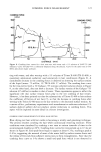
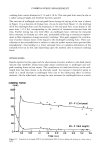
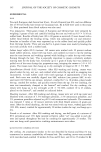
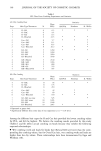
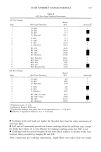
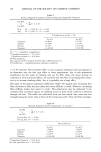
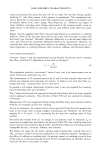
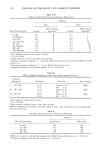
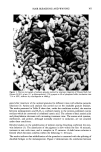
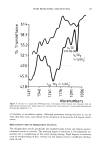
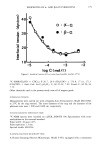
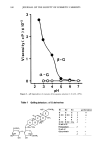
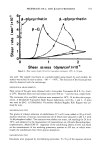
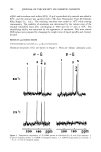
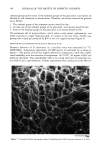
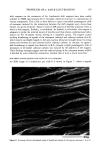
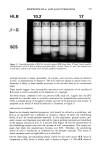
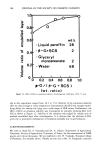
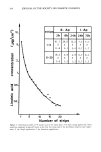
PROPERTIES OF or- AND [3-GLYCYRRHIZINS 181 • 6 3 0 • -g lycy rrhet i n d, -g l y cy rrh e t i n ! ,+ / \ ß , I I •,•ø o 1 2 Shear stress (dyne/cm 2 )X10 -4 Figure 4. Flow curves of gels (10 wt%), Cone-plate viscometer, 30øC, 0-30 rpm. was used. The sample was frozen in a sample-holder using liquid N2 and cracked. Its surface was etched in vacuo at about - 80 - - 90øC. The structure of the frozen gel was directly observed with the microscope. RHEOLOGICAL MEASUREMENTS Flow curves of the gels were obtained with a Cone-plate Viscometer (B.E.E. Co., Ltd.) at 20øC. Maximal shear rate and sweep time were 500 sec-• and two min, respectively. The viscosities of or- and [3-G solutions were measured at 20øC, 24 hr after their prepa- ration. A Brookfield Viscometer (Seiki Kogyo Laboratory, rotor No. 1 and 3, 12 rpm) was used for [3-G. A Ubbelohde's Viscometer (Shibata Kagaku Kiki Kogyo) was uti- lized for ot-G. SOLUBILIZATION TEST Ten grams of ethanol solutions of solubilizates (0.5 wt%) were added to 90 g of ot-G aqueous solutions of various concentrations (all of which were adjusted to pH 4.5 with V3o M phosphate buffer). The mixtures were shaken ten times, left standing for 24 hr at 30øC, and subjected to the measurement of transmittance on a Hitachi Recording Spec- trophotometer, Model EPS-3T. Appraisal of the solubilizing ability of ot-G was based on the transmittance of the resulting quaternary systems at 450 nm, at which wave- length the solubilizates have little optical absorption. EMULSIFICATION TEST Emulsions were prepared by the following procedure. To 70 g of the aqueous solution

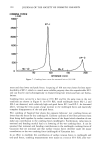
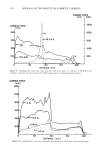
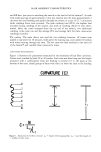
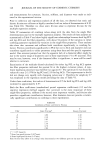
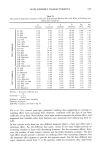
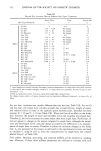
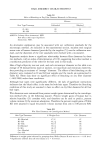
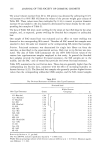
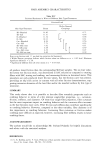
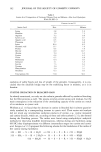
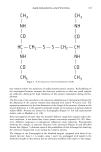
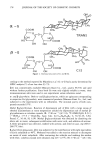
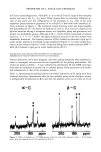
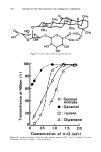
182 JOURNAL OF THE SOCIETY OF COSMETIC CHEMISTS of I3-G and/or sodium cetyl sulfate (SCS), 30 g of a prescribed oily material was added at 80øC, and the mixture was agitated with a TK Auto Homomixer Type M (Tokushu Kika Kogyo Co., Ltd.). The resulting emulsion was cooled to 30øC while stirring continuously. The stabili.ty of emulsions was determined by the volume ratio of the residual emulsified layer after centrifuging at 3000 rpm for 15 min at 30øC. The emulsifying ability was examined by the appearance of emulsions. Oils with various HLB values were prepared by changing the weight ratio of liquid paraffin and 2-hexyl- decanol. RESULTS and DISCUSSION PHYSICOCHEMICAL NATURES of or- and [3-GLYCYRRHIZINS Chemical structures of Gs are shown in Figure 1. They are tribasic carboxylic acids. 80 øC 2 1 3 1 45 2 5 25øC ß • I I I I,, 200 180 ppm 200 *SO ppm Figure 5. Temperature dependence of t3C-NMR spectra of individual Gs (10 wt% D20 solution). 1: C=O of triterpene moiety. 2: COOH of triterpene moiety. 3,4: COOH of glucuronic acid moiety. 5: - • = C - C = O of triterpene moiety.
Purchased for the exclusive use of nofirst nolast (unknown)
From: SCC Media Library & Resource Center (library.scconline.org)