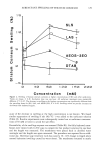
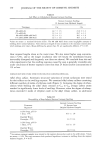
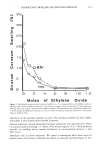
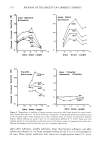
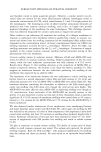
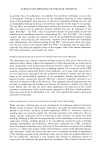
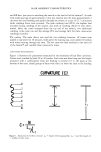
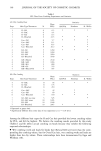
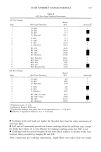
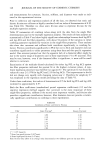
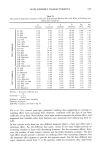
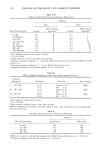
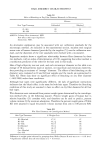
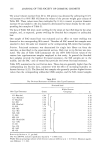
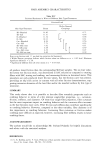
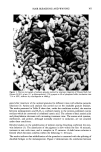
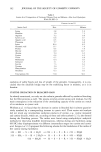
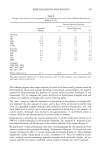
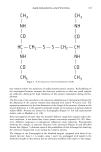
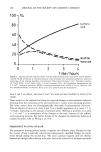
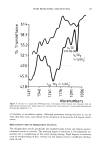
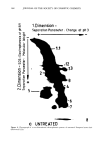
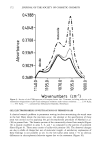
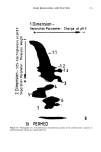
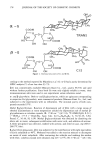
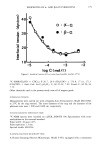
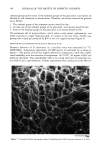
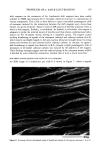
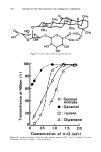
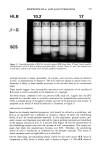
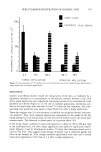
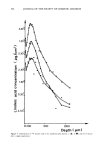
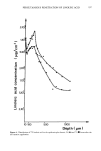
PROPERTIES OF o•- AND [3-GLYCYRRHIZINS 187 HLB SCS 10.2 17 Figure 11. Emulsifying ability of •-G for oils with various HLB values (after l0 days). Liquid paraffin, 2-Hexyldecanol: 30 wt%. I•-G or sodium cetylsulfate (SCS): 3.0 wt%. Water: 67 wt%. The number given to each bottle indicates the weight ratio of liquid paraffin/2-hexyldecanol. network structure is clearly discernable. In contrast, such structure cannot be observed in o•-G, as demonstrated in Figure 8. The c•-G molecule taking an almost linear con- formation is likely to form lamella structures in the miceliar state as do conventional soaps. These results suggest that intermicellar association and orientation of the micelies of [3-G seem to result eventually in the formation of a rigid gel. All these results, combined with our previous ESR study (9), suggest that the molecule in a miceIlar state is cyclically constructed by intramolecular interaction be- tween a carboxyl group of the aglycon moiety and one of the glucuronic acid moiety. A proposed cyclic model of the [3-G molecule is illustrated in Figure 9. APPLICATION TO COSMETICS Based on the already described properties, o•-G should be utilized as a solubilizer, and [3-G as an emulsifier and a stabilizer in cosmetics. Figure 10 shows the solubilizing ability of o•-G for several perfume materials. In this experiment, geranyl acetate, ger- aniol, ionone, and dipentene were selected for typical perfume materials and solubilized in the aqueous solution of o•-G. It is obvious from Figure 10 that the transmittance of the solubilizing system rises with the increase of o•-G concentration. This system ap- pears clear when the transmittance becomes over 80%. Therefore, the solubilizing ability of o•-G is satisfactory as evidenced for the perfume materials. This seems to ensure extensive practical applicability as a solubilizer. On the other hand, the emulsifying ability of [3-G for oils with various HLB values in comparison to SCS, which is widely used, is shown in Figure ! 1. The HLB values of

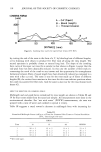
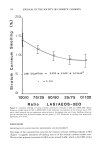
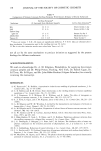
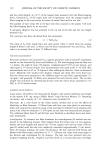
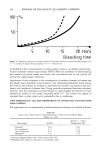
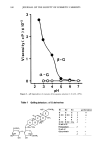
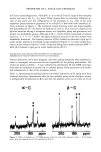
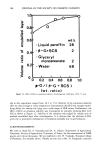
188 JOURNAL OF THE SOCIETY OF COSMETIC CHEMISTS 1.0 0.6 E 0.4 0.2 - wt% ß Liquid paraffin 28 . ß i•-G+SCS 2 ß Glyceryl monostearate 2 ß Water 68 I I I I 0 0.2 0.4 0.6 0.8 1.0 I•-G/( jS-G + SCS ) (wt. rat io) o C Figure 12. Effect of [•-G on emulsion stability. Centrifugation: 3000 rpm, 30 , 15 min. oils in this experiment ranged from 10.2 to 17.0. Stability of the emulsions observed after ten days storage at room temperature demonstrated that [3-G has enough emulsi- fying ability for various oils lying over a wide range of HLB values. Furthermore, the effect of [3-G on emulsion stability was investigated by partially replacing •3-G with SCS as shown in Figure 12. Stability of the emulsion was judged by volume ratio of residual emulsified layer after centrifugation. It is obvious that the addition of gives rise to prominent stabilization of emulsions probably due to gel formation. ACKNOWLEDGEMENTS We wish to thank Dr. S. Yamazaki and Dr. A. Okubo, Department of Agricultural Chemistry, Faculty of Agriculture, University of Tokyo, for the measurement of NMR spectra and critical discussion. We are indebted to Dr. H. Yoshioka, Shizuoka College of Pharmacy, for valuable advice. Thanks are also due to Mr. H. Futagoishi, emeritus
Purchased for the exclusive use of nofirst nolast (unknown)
From: SCC Media Library & Resource Center (library.scconline.org)