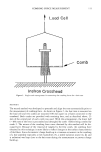
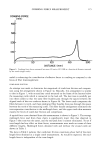
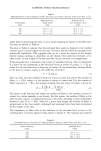
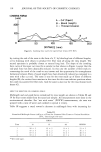
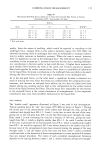
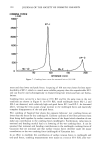
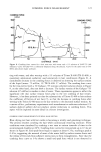
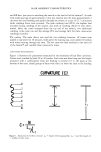
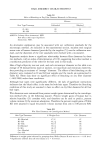
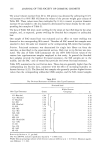
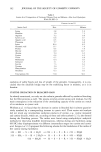
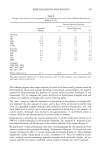
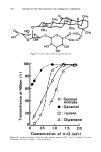
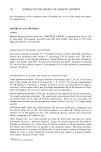
112 JOURNAL OF THE SOCIETY OF COSMETIC CHEMISTS sembly were made by Tolgyesi and co-workers (3), who used a method similar in prin- ciple to that of Newman et al. (1). During the passage of the comb through the hair assembly, the force remained at a low steady level for the most part but suddenly increased to a peak value as the comb approached the free end of the hair assembly. Tolgyesi referred to these forces as midlength (ML) and end-peak (EP) forces, respec- tively. The fundamental processes that contribute to the midlength force are hair-hair and comb-hair friction and the force required to compress small fiber bundles into the spaces between the teeth of the comb. The end-peak force is produced as the result of entanglements of the fiber ends with one another. Tolgyesi and his co-workers clearly demonstrated the association of free fiber ends with the EP force by combing a hair tress made of two different fiber lengths, in which case two force peaks were obtained: one related to the short fibers and the other to the long ones. More recently Garcia and Diaz (4) used this technique to characterize the effectiveness of various conditioning treat- ments in improving combability. Although a considerable amount of work has been done in this area from the point of view of product development, no detailed study of the method dealing with the effects of environmental conditions on the combing forces is available in the literature. There- fore, an attempt has been made to study the effect of various environmental factors. Furthermore, the method has been modified to minimize the effect of entanglements and to maximize the effect of surface treatments on combing forces. EXPERIMENTAL MATERIALS All measurements were made on European dark brown hair supplied by De Meo Brothers of New York. Hair samples were cleaned either by Soxhlet extraction with methanol/chloroform/methanol, in that order, or by washing with a 2% solution of sodium dodecyl sulfate. In both cases, the samples were subsequently rinsed thoroughly in distilled water, dried, and conditioned at 65% RH and 21øC. Tresses were built from these samples by gluing the fibers to a plastic tab. Care was taken to preserve the natural curl of the hair, and fibers were aligned prior to gluing to minimize the forma- tion of severe tangles. Unless mentioned otherwise, the fiber ends were anvil cut with a razor blade. The tresses were about 25 mm wide and 200 mm long, containing about 2- 2.5 g of hair. METHOD I Two different methods have been used to determine combing forces in this investiga- tion. In the first method the hair tress was mounted on the crosshead of an Instron tensile tester as shown in Figure 1. A hard rubber comb with 16 teeth/25 mm was mounted on the load cell. Only 25 mm of the center part of the comb was used for insertion of the hair tress and this area was marked with adhesive tape. A smooth retaining bar was used to prevent fibers from slipping out during the measurement. The tress was combed to remove severe tangles and was then introduced into the teeth of the comb. The load cell was preloaded, and the reduction in load was measured as the tress was pulled through the comb at a rate of 8.3 mm/s. An environmental chamber was used to control temperature and humidity during the measurements.

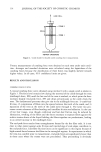
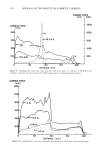
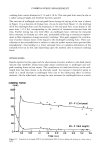
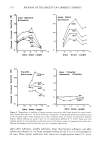
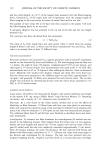
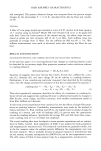
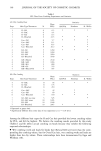
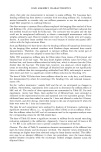
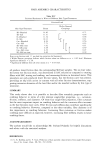
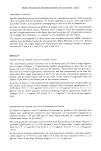
COMBING FORCE MEASUREMENT 113 Lood Cell Comb Instron Crosshead Figure 1. Single-comb arrangement for measuring the combing forces for a hair tress. METHOD II The second method was developed to precomb and align the tress automatically prior to the measurement of combing force. As shown in Figure 2, the hair tress is mounted on the load cell and two combs are mounted 100 mm apart on a frame connected to the crosshead. Both combs are provided with retaining bars, and as described above, 25 mm of the central part of each comb was used. With this arrangement, the lower half (--100 mm) of the tress is precombed and detangled by comb 1 before being combed by comb 2. The nature of the combing force curve obtained by this method will be dis- cussed later. Because of the removal of tangles by the first comb, the combing force obtained by this technique is more likely to reflect changes in the surface characteristics of the fibers. Since electrostatic charge build-up is a kommon occurrence in the combing of a hair assembly especially at low humidities (5), a sealed radiation source (c•, [3, and 'y radiation) was kept close to the hair tress during the measurement to prevent charge build-up.
Purchased for the exclusive use of nofirst nolast (unknown)
From: SCC Media Library & Resource Center (library.scconline.org)